Monthly Archives: May 2011

The Story of Jory…

Once upon a time in the small Northern NSW village of Byron Bay, there lived a golden man who was gratefully known for his dealings in little golden pellets of pollen. Now these were not just your average pellets of gold, no no no … this particular gold carried with it stories of miraculous life saving qualities and nutritious benefits that far outweighed the average claims from a bottle of multi vitamins or even any food source on the market now days. The story of Jory goes a little something like this …

Jory was born in the U.S.A under the shadow of the Pentagon and spent the first part of his life witnessing his parents consume deadly cocktails of prescribed drugs that were washed down with litres of alcohol behind clouds of nicotine smoke, in what was considered ‘the norm’ … back then. The ‘norm’ for Jory went on to be the loss of both his parents due to toxic overload in their early/mid 30’s but before their passing they managed to instill in Jory the need to find a better way to live.  

This took Jory around the world and back again on his own discovery of life, food, nutrition, facts, fasts, dietary information and some ‘Waui Maui’ cultivation to name but a few mind altering adventures.  Saving Australia til last because he felt that it was the safest and best place to be (before the government sold us out and allowed the coal stream gas miners to invade us) and having come to his own conclusions that “Jarrah” Bee Pollen was the best food source in the world to live on, he decided he wanted to spread this golden magical message across our fair shores. This decision was coupled with the fact that West Australian Pollens, in his opinion, were the world’s most vibrant in terms of  ‘aura’ as seen and tested in his own extensive research and through “Kiruan Photography” (photographs of the aura). He eventually settled in Byron Bay some 27 years ago and has survived on a healthy income from moccasin making, bee pollen dealing and various other creative and captivating hobbies.
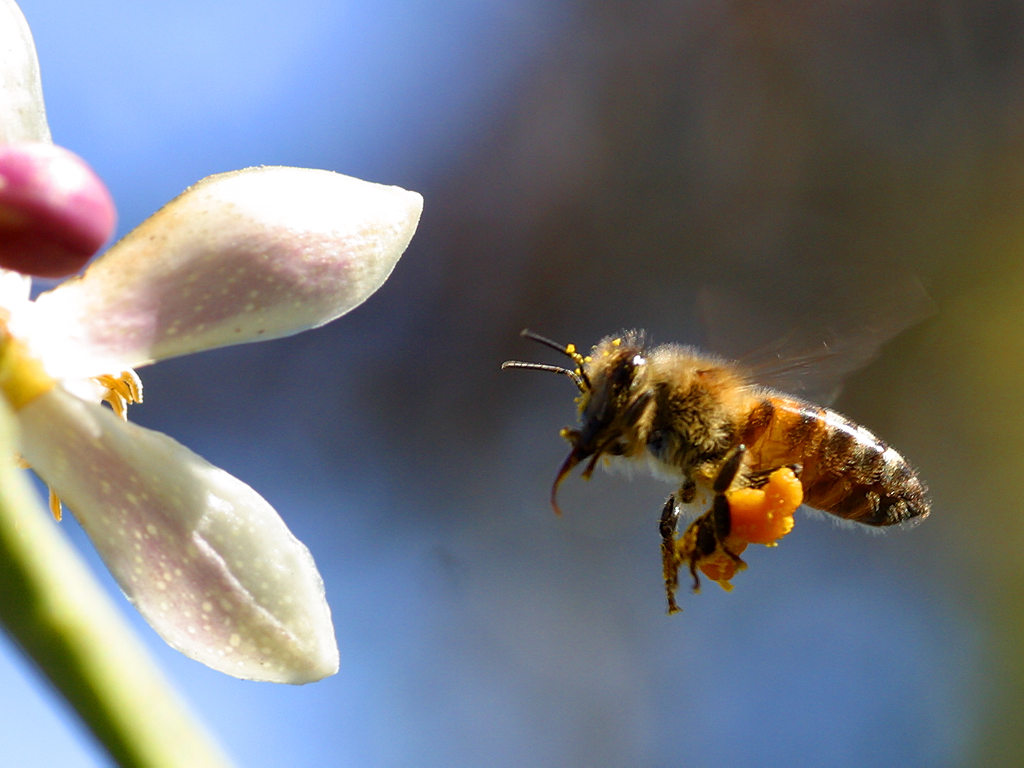
But besides all this, you may be wondering … “What is Bee Pollen” and “How can i get my hands on the gold ??” Well me hearty’s … look no further for all is about to be revealed !!

Jory did explain one thing to me that i was unsure of up until this interview and that is that the pollen that is collected by the bees is the sperm and the ova of the flowers about to be brought to life. It is carried on the back legs of the ‘bees knees’  as seen in the stunning picture above. Incredible isn’t it?

So energetically, which is where alot of Jory’s descriptions came from as i spoke to him, it carries the mammoth potential to become a life … alive !! Be it a plant, a flower, a tree, a bush, it’s all there in the pollen, captured in it’s purest essence and delivered to us by this charmingly sweet man.

The following is copied from Jory’s handout but hearing him talk about it in the studio was far more exciting and believable, especially when i had to remind myself that this was a man about to turn 60 sitting across from me who seemed as young and energetic as a boy half his age or less. A beautiful thing to witness in this world is the retainment of a youthful soul.

From Jory –

BEE POLLEN – THE WORLDS RICHEST SOURCE OF AMINO ACIDS

Amino acids are the building blocks of protein. Bee pollen has been found to be one of the world’s richest sources of amino acids with ‘Rare Australian Super Pollen’ being the most nutritionally potent and bio-available form of the product yet discovered. Instantly absorbable, clinicians have detected Bee Pollen in patients spinal fluid within thirty minutes of sub lingual (under the tongue) application !! Incredibly, bee pollen is richer in proteins than any animal source available.

Bee pollen contains more amino acids than beef, eggs or cheese of equivalent weight. It is important to know that bees recognize and select pollens which are rich in nitrogenous matter (amino acids) and leave poor quality proteins behind.

Not only does bee pollen contain a complete compliment of nutrients, it’s glucoside content helps transport these nutrients into the bloodstream.

Bee pollen contains folic acid along with an impressive vitamin array which cannot be artificially duplicated in the laboratory. It’s chemical make up is so complex that synthesising it artificially has eluded even the best modern day technology.

Bee pollen is so impressive that it contains many nutrients not found in animal products.

Linolenic acid is the only fatty acid essential for human nutrition that cannot be manufactured by the human body. Bee pollen contains linolenic acid in relative abundance.

A chemical analysis of Bee Pollen reveals it contains every nutrient required to sustain life.

Bee Pollen contains an unbelievable concentration of vital elements. It seems to be the most complete food found in nature. Some experts believe it could be the answer to world hunger !!
The story of Jory draws to it’s conclusion now with the invitation to sample some pollen and decide for yourself if it resonates with you.

!!! NB: IF YOU HAVE ALLERGIES WHEN IT COMES TO BEES AND THEIR PRODUCTS – SEEK ADVISE FIRST !!!

The golden man is contactable on 0421 509 291 and is so well known around town that if you ask anyone that sit’s outside one of our many fabulous organic cafe’s in town, they will be sure to point you in the right direction.  Join the buzz of the bay today and say g’day. Don’t be afraid to ask about what you don’t know about, we are all here to guide and teach one another.

With Love and Pollenation,

Sister Rasela

 Remember to take care of your own amazing planet – YOU !!

sustainable farms and the growing local food network

On air on bayfm 99.9 on May 23, 2011

There’s a cliche at the moment that at home or in restaurants its good to know all about our food “from paddock to plate” – we’re spending a lot of time in the paddock today on belly.  I’m playing some talks recorded at the Northern Rivers Sustainable agriculture forum 2 weeks ago.  Jane Laverty from N R food links joined me in the studio to talk about how the events were received (very well!).  My favourite speaker was gorgeous Stuart Larssen, who looks and sounds like a farmer from central casting, has a dry Aussie wit, but has been a  thinker and innovator on his large farm for 20 years.  Another very interesting speaker was Greg Reed, from the department of Primary Industries, who is running a project to improve farm planning so local farms are as sustainable as possible with the advent of climate change.  And we found out, thanks to POAMA, a predictive tool that Greg highly recommends (and I hope you can understand, because I don’t, but you can find it here), that we will be swinging into a El Nino weather system by springtime, so it will be very dry soon.

For more information on the talks, see http://www.northernriversfoodlinks.com.au/sustainable-agriculture-projects/

For lots of information on local food, go to http://www.sustainfood.com.au/

BELLY BULLETIN

Oh yes, make mine a double espresso.
More is better when it comes to drinking coffee to ward off the risk of deadly prostate cancer, according to a major US study just released by researchers at  Harvard.  Men who drink six or more cups per day have a 60 percent lower risk of developing the most lethal type of prostate cancer and a 20 percent lower risk of  any type of prostate cancer compared to men who don’t drink coffee.
Even just one to three cups per day was linked to a 30 percent lower risk of developing prostate cancer.  “Our study is the largest to date to examine whether coffee could lower the risk of lethal prostate cancer,” said Harvard associate professor  Lorelei Mucci.
The effects were the same whether the coffee was caffeinated or decaffeinated, so researchers  believe the lower risk could be linked to the antioxidant and anti-inflammatory properties of coffee.  A study last year also found that drinking coffee may protect against mouth and throat cancers.  If you are a tea drinker, sorry, no such link was discovered.

The whole of Casino is in a beefy buzz, it’s Beef Week.  The beef queen was elected last Saturday, there’s beefy fun all week, including a farmers market on Thursday, a free bbq breakfast with the butchers, cow pat lotto and milking competition on Friday, a parade, a mr beef week comp, bush poets, the lot.  See www.casinobeefweek.com.au

And if you’d like to see this region on one of the most popular TV programs in Australia, tune in to Masterchef this Thursday.  The contestants will visit  Season restaurant in Kingscliff, where the chef is cooking with some lovely local produce.  Hopefully they will show our area for more than a few seconds.
Bangalow pork belly braised in tamarind and rock sugar, crispy skinned Cudgen reef snapper fillet and coconut pannacotta is the meal they will enjoy…mmm
If you’d like to try one of chef Reuben Radonich’s dishes, clicking here will take you to a  Bangalow pork recipe.  He’s a local boy (actually born in Byron Bay, unbelievable), so he should know how to deal with the most famous local food product.

Also coming up, cooking demonstrations at the Byron Bay farmers market on Thursday June 2.

the economics of happiness

on air on bayfm 99.9 on May 16, 2011


Today on belly I had the great pleasure to talk with Helena Norberg-Hodge.  She is an occasional Byron bay local, and full time fighter for a better world.  She is currently talking about her new movie, the Economics of Happiness.  For lots of information and other interviews about the movie, as well as upcoming screenings and a way to buy the dvd, go to http://www.theeconomicsofhappiness.org/

And check out the trailer below.


You can also find one of Helena’s other movies, Ancient Futures, on Youtube or to buy online.  It shows the beautiful people of Ladakh, in the Himalayas, who have inspired a lot of her work.  Beautiful and interesting story.  Here

And Helena also shared one of her favourite recipes with us, a warm vegetable salad of potatoes and beans.  She dresses it with a vinaigrette  that has boiled egg yolk added to make an easy mayonnaise type dressing.  A bit safer than the classic raw egg mayo in many places.

BELLY BULLETIN

Amnesty International, the organisation that fights for human rights, is 50 years old this year and is celebrating by inviting you to hold or attend a candlelit dinner.  The candle wrapped in barbed wire is Amnesty’s symbol.  If you want to show your support, hold a dinner at your place or go to a participating restaurant on Saturday 28th of May and raise a glass to toast freedom.  Amnesty isn’t necessarily looking for donations, although they will be gratefully received.  They are mainly interested in a show of support on their birthday.  There is still plenty of time to register your private dinner or restaurant on the Amnesty website.  By registering , hosts get access to a free online supporter pack including email invites, menu and recipe suggestions, and a script for their toast.

The Byron shire Echo is celebrating 25 years with its Community Awards, recognising some of the wonderful people in our area.    In this week’s paper some great locals were listed in the ‘battles as an environmental warrior’ category.  The belly vote goes to Judy McDonald, who as well as fighting for locally produced food and landcare has taught so many locals to grow their own food in our sub-tropical climate.  See the paper for details.

May is also Biggest Morning Tea month, fundraisers for the Cancer Council.  There’s one in Ewingsdale this Wednesday May 18th at 10 am at the Fig Tree restaurant.  One at the Mullumbimby Uniting church hall on Friday 20th at 9.30 am.  Plenty more around, check your local papers or the bayfm community service announcements.

Backpackers doing good.  Yes it happens.  Eco-tourism consultant Angie Wilton got donations of 6000 dollars in 4 months from backpackers staying at Byron’s Arts factory, to set up a permaculture community garden there, to grow food and educate visitors about sustainable living practices.  It will rely on volunteer work once estabilished.

Love and happy chocolate, sister T

MUSIC

Yungchen Lhamo, Happiness is…, from Putumayo presents : gardens of Eden

Tony Bennett and k.d. Lang, What a wonderful world

Ludwig van Beethoven, ‘the hymn to joy” , with the Roman Philarmonic Academy choir and the “Alessandro Scarlatti’ orchestra from Naples

Shubha Mudgal, the Awakening

Al Green, Happy Days

music and stories from the Pratten sisters, and fresh peppercorns

on air on bayfm99.9 on May 9, 2011

This was a 4 – sister belly: sister T and sister B with 2 of the 3 Pratten sisters, now Joan Ajala and Ruth MacIntosh, but once girls growing up in Lismore, just before and after WW2, with their other sister and 3 brothers.  Joan and Ruth told us great stories about the beautiful fish their father caught when they stayed at the family beach house in Brunswick Heads, the mud crabs from the river (who tried to climb out of the pot – no fridge or freezer in those days to put them to sleep), the fruit and veg man who came along with his horse and cart, the oysters bought by the hessian sackful.  Mmmm.  And mum’s tea parties, with song performances and proper ladies with proper manners, as the girls giggled under the house.  And a little espionage when one woman would not divulge her wonderful teacake recipe.  Then mother in law’s ever expandable recipes, like the popular Swedish meatballs.  They had a clever signal.   When one of the 7 kids brought home an extra mouth to feed, he or she would loudly call hello from the garden gate and a little extra was in the pot by the time they got inside. And thanks to sister Robert, who regularly listens to belly on www.bayfm.org from Sydney, for explaining that their regular childhood breakfast of home smoked fish and rice is the colonial English classic “kedgeree”.
Now Ruth has put all the recipes from her mother and aunt (another great cook), and mother in law, from scruffy bits of paper onto a digital cookbook.  Her own recipes and experiments end up there too, and she has shared a few with the belly listeners.


Kedgeree-photo by justinc


BELLY BULLETIN

Djanbung Gardens, Nimbin

Would you like to grow your own taro, make cassava flour or process arrowroot? It is harvest time again at Djanbung Gardens near Nimbin, where there is a diverse range of subtropical vegetables, making self-reliance so much easier in our culture. Starting this week, so be quick, Permaculture College Australia will  host a series of short courses at Djanbung Gardens . They will teach all aspects of planning, growing, harvesting, storing and preserving your own food for year-round abundance from the garden. For more information please contact the office on 6689 1755 or visit http://permaculture.com.au

The Sustainable Agriculture forums

The free forums held last week were very good and informative.  More about them on belly soon or see

http://www.northernriversfoodlinks.com.au/sustainable-agriculture-projects/


RUTH’S RECIPES


DIP: BASIL PESTO DIP (delicious!)

Place in food processor 1 cup fresh basil leaves, 1/4 cup each pine nuts (lightly toasted), parmesan cheese, olive oil, Greek yoghurt & mayonnaise, 1 tbsp garlic, salt & pepper. Process until mixed. Thickens in fridge.

NOTE: quantities are approximate – vary and check taste – probably fine in a blender.

Excellent made with frozen basil – food process fresh basil with oil and freeze in small containers – fresh dip in the depths of winter!

DIP: OLIVE DIP

1/2 small bottle of pitted green or black olives

1/4 cup good quality mayonnaise

small quantity of Greek yoghurt (too much makes the dip yummy but runny)

Process in food processor until mixed. Don’t over-process or olives pieces will be too small.

NOTE: a variety of ingredients can be used in place of olives – a blender is probably just as effective


BASIL – how to enjoy basil fresh from the garden all year round!

Pick basil and place in food processor. Process, adding enough olive oil to ensure that all the basil is coated (this preserves the rich colour). Freeze in small containers. During the depths of winter use to make all your favourite pesto recipes, or to flavour soups and casseroles.  It will taste as wonderful as it did when you harvested it!


BEEF: SWEDISH MEATBALLS – absolutely scrumptious

A great meal for visitors which they all seem to enjoy – the family always love the leftovers

750g low fat mince (500gr mince + 250gr sausage mince)
1 1/2  cups soft bread, 1/2 cup light sour cream, 1/4 cup milk
1/2 cup chopped onion
1 teas salt, 1 tables butter, pinch ginger, pepper, nutmeg, 1/4 cup chopped parsley
1 tables butter
1 egg

Soak breadcrumbs in cream & milk – cook onion in butter till tender NOT brown
Combine meat, crumbs, egg, onion, parsley & seasonings, beat until fluffy, chill and form into balls.
Brown in butter – half cook (in electric frypan setting 7-8).

Sauce
1 can tomatoes
1-2 sticks chopped celery
1pkt Maggi Spring Vegetable Soup
1 shredded carrot

Remove meatballs from pan – add soup and about 2 cups of water.
In casserole, layer meatballs and other vegetables, pour sauce over.
Bake in moderate oven for 45min – 1 hour – serve over spaghetti or cous cous, with salad and garlic bread.


CAKE: CHOCOLATE CAKE – FLOURLESS

[We did not talk about this on the show, but the world always needs more chocolate cake recipes – and I am doing my best to be adopted as a Pratten sister so we can share the teacake recipe]

110g dark chocolate
110g unsalted butter

Melt in microwave and cool

1/2 cup castor sugar
4 eggs, separated
1 packed cup almond meal (110g)

Combine all ingredients except egg whites and mix wel.l
Whip egg whites until soft peaks form; fold in gently.
Place in 20cm greased, lined springform tin; bake at 190ºC for 35-40 mins (170ºC fan-forced).
Cool in tin; run knife around edge; slide onto plate; dust with sifted icing sugar.

Delicious served with a coulis made from frozen berries simmered with a little sugar – mash or blend.

Ruth does really good roasts too, she has promised to come back to belly with her top roast tips on her next trip to visit Joan.


FRESH PEPPER – GREEN, BLACK, WHITE AND RED


green pepper taken by the photographer, Devadaskrishnan at his farm in Kerala.

Pepper is native to Kerala, southern India and is extensively cultivated there and  in other tropical regions. Currently Vietnam is by far the world’s largest producer and exporter of pepper, producing about a third of the world’s Piper nigrum.  There’s one commercial large pepper farm in Australia, in north Queensland, near Innisfail, that supplies many of our top restaurants. According to the Innisfail pepper grower, “The imported stuff does lose some of the volatile oils, as it has to be steam-sterilised to get it into Australia,’’ But you can now get fresh pepper at Byron and New Brighton farmers markets, locally grown, so you may want to try your luck growing it too.  It’s only available for another month.  Or do taste it, really interesting, and the flavours change as it ripens week by week.  A little like the picked green, minus the strong vinegar taste of course.

The pepper plant is a perennial woody vine growing to four metres in height on supporting trees, poles, or trellises. It  roots readily where trailing stems touch the ground.
To grow – from seed or cutting, 3-4 years to fruit
– on strong trellis, full sun, mulched (roots like staying cool)
– plenty of food and water
In the wild, pepper flowers are pollinated by rain, so it’s important to irrigate plants so the water flows over them.  Or wait a few minutes for the rain to start, if you live in the Northern Rivers.
Berries that are picked when they’re fat and green can be dried to make black pepper. If you allow the berries to mature and turn red, then peel them to reveal the seed, you’ll get white pepper.

Fresh pepper is very popular in Thai cooking, so try adding it to your favourite red or green curry, or use in a stir fry or Thai salad.

PEPPER SQUID – adapted from www.thai menu.net

Serves 4

In a bowl combine 500 g cleaned squid , 2 tablespoons of oil  and 1 tablespoon of
roughly crushed green peppercorns; allow to stand for 15 minutes.

Heat a large wok or heavy based frying pan until very hot. Add 2 teaspoons of oil from the marinating squid. Add 4 chopped cloves of garlic and 1 teaspoon of chopped red chillies to the pan and cook for 5 seconds.
Add squid to the pan in batches and stir-fry, tossing constantly, for 2 minutes each batch. Transfer each batch to a plate.
Reheat wok between each batch. Add 2 tablespoons of fish sauce and 2 teaspoons of soy sauce to wok. When it is bubbling, pour it over the squid and serve immediately, garnished with 1/2 cup of fresh basil leaves.
Accompany with rice.


MUSIC


Today all the music on belly was chosen by Joan Ajala, aka the middle Pratten sister.  Joan shared some of the music she has come to love in her many years as a music teacher.

Give me the simple life, sung by Sharny Russell, with George Galla on guitar, from “Velvet Jazz”
Allegro from Vivaldi’s concerto in C, Genevieve Lacey on recorder with the Australian Brandeburg Orchestra, from : “Vivaldi – il flauto dolce”
Va tacito e nascosto Cesare, from the opera ‘Julius Caesar’, by Handel, sung by Margreta Elkins
Concerto for flautino in C major RV443, Largo, by Antonio Vivaldi
Gavotta, allegro, from Arcangelo Corelli’s Concerto for flauto no.10 in F major, Maurice Steger , from the CD “Mr Corelli in London”


let us know if you enjoyed Joan’s music as much as we did!

Love and peppered chocolate, and remember we’d love to hear your food stories too, call bayfm on 6680 7999, or email belly at belly dot net dot au, or comment below

sister T


May: mushrooms, mandarins and mystery sounds

on air on Bayfm 99.9 on May 2, 2011


It’s the first belly of May, so as usual we talked about some of the delicious foods in season this month.  Ms May (aka Alison Drover) brought some  cooler weather recipes, she’s been all over Australia to see what’s in season.
It’s also the first belly of a new bayfm 6 month programming season, so I marked the occasion with our first ever mystery sound – so mysterious that nobody rang in – I would have been very surprised if anybody had recognised it in fact.

MMMMMMISS MAY’S MONTHLY ROUNDUP

Seasonal Fruit And Vegetables in Australia in May

Fruits:

apples : bonza – braeburn – cox’s orange pippins – fuji – gala – golden delicious – granny smith – jonagold – jonathan – mutso – pink lady – red delicious – snow – sundowner
bananas, cumquat, custard apple, feijoa,
grapes : purple cornichon – waltham cross,
kiwifruit, lemons, limes,
mandarins, champagne melons,
nuts : chestnut – hazelnut – peanut – walnut,
pears : howell – josephine – packham – red sensation – williams,
persimmon, quince, rhubarb.

Vegetables:

asian greens – bok choy, – choy sum – gai laan – wonga bok,
avocados : fuerte – sharwill,
beetroot, broccoli, brussels sprout, cabbage, carrots, cauliflower, celeriac, celery, daikon, eggplant, fennel, garlic, ginger, horseradish, leeks, lettuce,
mushrooms : wild – field – pine – slippery jacks,
okra, olives,
onions : brown – spring,
parsnip, peas, potato, pumpkin, shallots, silverbeet, spinach, squash, swede, sweet potato, taro, tomato, turnip, witlof, zucchini.

MANDARIN CAKE

makes one 24 cm cake, serves 10 – 12

3 mandarins
250g (1 cup) caster sugar
6 eggs
230g (2 cups) ground almonds
to serve
60g (¼ cup) caster sugar
zest of 2 oranges

This is a great cake and ideal for all those that  need gluten and wheat free. It is a cake that not only tastes good but the vibrancy of the orange mandarins  that make it look so good. I often decorate it with nasturtium flowers and serve yogurt with it.

Put the mandarins in a medium saucepan and cover with water. Bring to the boil and simmer for 2 hours, adding water when necessary to keep the mandarins covered at all times.
Preheat the oven to 160°C (325°F/Gas 3).  Grease a 24 cm (9 inch) springform cake tin well.
Drain the mandarins and cool to room temperature.  Once cooled, split them open with your hands and remove any seeds.  Puree the mandarins, including the skins, in a food processor.  Add the sugar and eggs and mix together until combined.  Add the ground almonds to the mandarin purée and stir thoroughly.
Pour the mixture into prepared tin and bake for 1 hour 10 minutes, or until the cake looks set in the middle, springs back when touched and comes away from the edges.  Remove from the oven and allow to cool in the tin.
While the cake is cooling, put the extra sugar in a saucepan with 60 ml (¼ cup) of water over a low heat and stir until the sugar dissolves.  Add the orange zest and boil the mixture until it just starts to caramelise.  Lift the zest out with a fork and cool it on a plate.
Serve the cake with caramelised citrus zest and a sprinkling of icing sugar.

MUSHROOM BREAD SOUP

This is an easy mushroom soup. May is a time that mushrooms grow well as the temperature is cooling down. Visit your local farmer market and see what is growing and be adventurous. With your mushroom types.

500g mushrooms – try to buy from Farmers Market as you will taste the difference in flavor and be sure to find varieties that provide all the wonderful textures.
4 cups chicken stock
2 slices sourdough bread, crusts removed

Simmer sliced mushrooms in stock with bread for 10 minutes, or until mushrooms are tender. Blend soup and season to taste. Garnish with chives and creme fraiche.

VEGETABLE STOCK

Celery stalks, coarsely chopped
Carrots coarsely chopped
Leeks white parts only, coarsely chopped
Onion coarsely chopped
Garlic cloves bruised
White peppercorns
Bouquet garni – this is a mixture of herbs used to flavour the stock. You can make this easily by using parsley stalks, thyme sprigs, rosemary, bay leaf, clove of garlic and tying them together so they are enclosed in a piece of muslin. The bag of herbs is placed in the stock and removed afterwards.

For vegetable stock, combine ingredients in a saucepan and add bouquet garni. Cover with cold water, bring to the boil over medium heat, then reduce to low and lightly simmer, skimming occasionally until stock is flavoured (30-40 minutes). Remove from heat, strain through a muslin-lined fine sieve (discard solids). Cool to room temperature then refrigerate stock until chilled (2-4 hours). Makes about 2 litres. Stock will keep refrigerated for up to 3 days and frozen for up to several months

PLANTING IN MAY

Miss May says time is running out so get out in the garden and start planting so that you will have the abundance of vegetables through to winter.
Now is the time to plant broccoli, broad beans, beetroot, coriander, cabbages and Asian greens. Visit the Sustain Food website for a local regional planting guide. http://sustainfood.com.au/index.php?page=grow-what-s-in-season-vegetables.

This is also the time to save seeds from your summer crops so that you have them for the next year. Saving seeds helps safeguard the food security of the plant and is also a great way to ensure that the seeds you sow grow.
I have some heritage tomato seeds that my neighbour gave to me in Sydney and she has had them for over 30years. They grow and are so resistant and produce the juiciest tomatoes.

Alison Drover a.k.a. Miss May


THE MANDARIN POEM

Yes the beautiful mandarin, loved in China for many centuries as much for its scent as for its taste.  This is a poem about the first mandarin of the season being presented at the imperial palace.

LIU HSUN  – AD 462 -521

On the morning of the first frost,

the gardener plucks and presents it;

its perfume extends to all the seats of the guests,

when opened, its fragrant mist spurts upon the people.


THE MYSTERY SOUND

Apologies to anyone who thought their radio was broken – the mystery sound was very odd

If you’d like to listen, go to

http://austringer.net/wp/index.php/2010/06/25/listening-to-snapping-shrimp/

and for sound + good explanation

http://www.ieee-uffc.org/ultrasonics/symposia/2003/hawaii03/plenary_session.html

The loudest sound under the sea, would you believe, is prawns, or shrimp – usually called snapping shrimp.  They make a sound that can be over 200 decibels, louder than a jumbo taking off.  They use the sound for hunting, to stun their prey.  They are very common in sub-tropical waters, and they are spreading with warming seas, so don’t be surprised if your bucket of prawns makes strange noises.

If you know of any other edible animals (or plants!) that make odd noises, or you have a good cooking sound that doesn’t just sound like static and would be good for a guessing game, please send it to the bellysisters.  Next time I will try to organise a prize for the first correct guess.  Of course the glory is probably enough.

Love and chocolate covered prawns,  sister T

MUSIC

Bellydance, Undercover (with ya lover)

James Grehan, Miss Mayhem

the Sydney Symphony Orchestra, a bunch of whales and dolphins, Jean-Pierre Jacquillat conducting, Danse Lente, from Trois Danses by Durufle’

Burt Bacharach, Another spring will rise

Keren Ann, the end of May

Bianca Meier, Walk the earth