Author Archives: sister T

tasting NSW with the Sample festival and the Good Food Guide

On air on Bayfm 99.9 community radio 12/09/2011


The Sample Festival judges hard at work: L to R Steven Snow, Joanna Savill, Barbara Sweeney and Belinda Jeffery


A show packed full of goodness.   I took listeners to last Saturday’s Sample food festival, where I spoke to happy people in the sun, and local food legends Steve Snow and Belinda Jeffery.  The Good Food Guide co-editor Joanna Savill, and the regional editor Barbara Sweeney were also up for the festival, I asked them about the Guide, which has just come out, and their best tips for eating in Byron, Sydney and all over NSW.   But I started the show with the story of my conversion to the love of turnip (cue angelic singing) thanks to the delicate Japanese turnip, KABU.

HOW TO BECOME A BORN AGAIN TURNIP LOVER

I have been experimenting with kabu for about a year.  There are 2 types of people in the world, turnip lovers and oh no not turnip people.  I used to hate turnip but I’ve seen the light.
Yes thanks to kabu I am a turnip convert. At least in small doses.Turnips are an ancient vegetable, first cultivated 4000 years ago in Northern Europe.  I used to just think Baldrick when I saw turnips, they are firmly associated with starving medieval peasants, desperate for anything remotely edible.    But they are also associated with purity and simplicity and virtue, the simple life and monks.  And they are good for you. Kabu is a good turnip to try because the taste is very mild.  The Japanese and the French use a lot of turnips, usually young, crisp, sweet varieties.  In France they are traditional with duck, the Japanese pickle roots and leaves and use them in soups and salads.  I love them just chargrilled, thinly sliced in a mixed salad, in a mash with potatoes, or as a fast pickle, sliced and sprinkled with sugar, salt, and lemon juice for an hour or 2.  Or even just before you start cooking the rest of the meal.  If you are tentative about turnips, start with just  a little mixed with other ingredients.  They can just bring an earthy depth to dishes, a light turnip note not a shout, if you use them in moderation.  And we may both end up fully converted to the love of turnips.   (aaaah ah aaah!  more angels)

IN SEASON – PECANS

Go no further than Belinda Jeffery’s flourless chocolate and roasted pecan cake – it is the featured recipe at the moment on her website, the picture is pure chocolate porn.  I made it last night in someone else’s kitchen, with an oven that has the temperatures completely rubbed off the relevant knob (what do people do to these knobs?  This has happened to me with other ovens).  It turned out just magnificent, and super rich – it is basically like eating a cake sized chocolate truffle.  I used one of my favourite malt whiskys in it, Laphroaig, and no vanilla (it didn’t stand a chance).  Mmmmm.  If you must be restrained, strawberries and pineapple are also in season (and  go well with this cake, with a bit of plain thick organic cream)

THE 2011 SAMPLE FESTIVAL – A TASTE OF THE NORTH COAST

Last Saturday was a sunny day in Bangalow, tons of people went to the Sample food festival, many locals from the whole region, and plenty of visitors.  One comment from many people was about the venue – Bangalow is much easier to reach from many parts of the North Coast than Byron Bay, and most people know the Showgrounds are a beautiful venue thanks to the long-running weekend markets.There were lots of stalls selling tastings from local food producers, caterers and restaurants,  a farmers market that was supposed to stop at lunchtime and ended up going all day, music, a whole kids area, wine, beer, cooking classes thanks to Leah Roland of the Bangalow Cooking School and local chefs, and some high powered judges to see which restaurant or caterer did the best small and large dishes on the day.  By late morning the queues at the restaurant stalls were long, but I have never been so happy to queue.  Not just because there was good food at the end of the line, but because the success of the day means there are lots of us ready to attend a well organised celebration of local food, and days such as Sample are more likely to become  regular events.  So let me take your ears there.  First some  free food demostrations that were going all day, then replete and giggly eaters and the food judges impressions.  All the bits of purple writing below are links to audio, just click, and let the bellysisters know if you have any problems listening to our belly bits.

sample_sounds

As the music was pumping at the end of the day, I spoke the two local judges of the restaurant and caterers’  competition for best plates of the festival.  Steve Snow, chef of Fin’s in Kingscliff, is happy to come to Bangalow for any reason and no reason. If anybody is reading this, please take note, it is much easier for my belly to get to Bangalow than Kingscliff.

Steve Snow at Sample Food Festival 2011

Writer and TV and radio presenter and Mullumbimby local Belinda Jeffery was another judge at the Sample food fest last Saturday – and a very proud local indeed by the end of the day.  By the way the day was such a success that even the table the judges sat at could have been sold several times (not sure if with or without the judges), the music stage was sold, and who brought those amazing roses?

Belinda Jeffery at the Sample Food Festival 2011

Later that same evening the food lovers of the North Coast gathered for a gala dinner at the Byron at Byron Resort, again organised by the indefatigable and gorgeous Leah Roland.  Joanna Savill and Barbara Sweeney were kind enough to share their impressions of the day with belly just before enjoying an array of dishes from some of the area’s best chefs.

I spoke with Joanna Savill, who you may remember from The Foodlovers Guide to Australia TV program, about the Sample festival in the dark in the rainforest –  we were trying to find a quiet place to talk.  The only place was on a walkway among rustling trees and the odd bat.

Joanna Savill at Sample

I also asked Joanna about the brand new Good Food Guide, since she is the co-editor, and she has lots of advice for every pocket on where to eat if you go to Sydney.

Joanna Savill on the Good Food Guide

Barbara Sweeney was the fourth judge at the festival.  She is an experienced writer and restaurant critic, and was involved many years ago in the student bible, Cheap Eats.  You may have caught her before on belly talking about Mexican food in Australia.  This was  first year as regional editor of the Good Food Guide.

She talked to belly about places we may want to discover as North Coast locals or visitors all around NSW.

Barbara Sweeney 1

Barbara Sweeney 2


And congratulations to Fleur’s in Ballina and Satiate in Bangalow on winning the $10 and $5 dollar plates of the festival categories respectively!


miss September and the honeybees working hard on lavender honey ice-cream at the Sample festival


BELLY BULLETIN

If you are in the mood for a festival, the Iluka Living the Good Life Festival is on this Saturday  17 September. The festival is open to visitors or stall holders selling local produce, or to producers who would like to run presentations or workshops.
For more detailed information visit the event web page www.livingthegoodlifefest.com/.

Mullum farmers market is giving $1000 to Mullum High as part of a project in which students will be growing and selling flowers at the market and breeding heritage poultry.


Live long and eat chocolate,

Sister T


MUSIC

Big Train, Max Greger and his orchestra

Hildegard of Bingen, O choruscan lux stellarum, antiphon, from ‘music of the angels’

Bass Bucket, Yes Please

Mariza, Fado Curvo

Bass Bucket, Bass Bucket
spring belly : leaves, flowers and a foodie festival

On air on Byron Bay’s bayfm 99.9 community radio on September 5, 2011

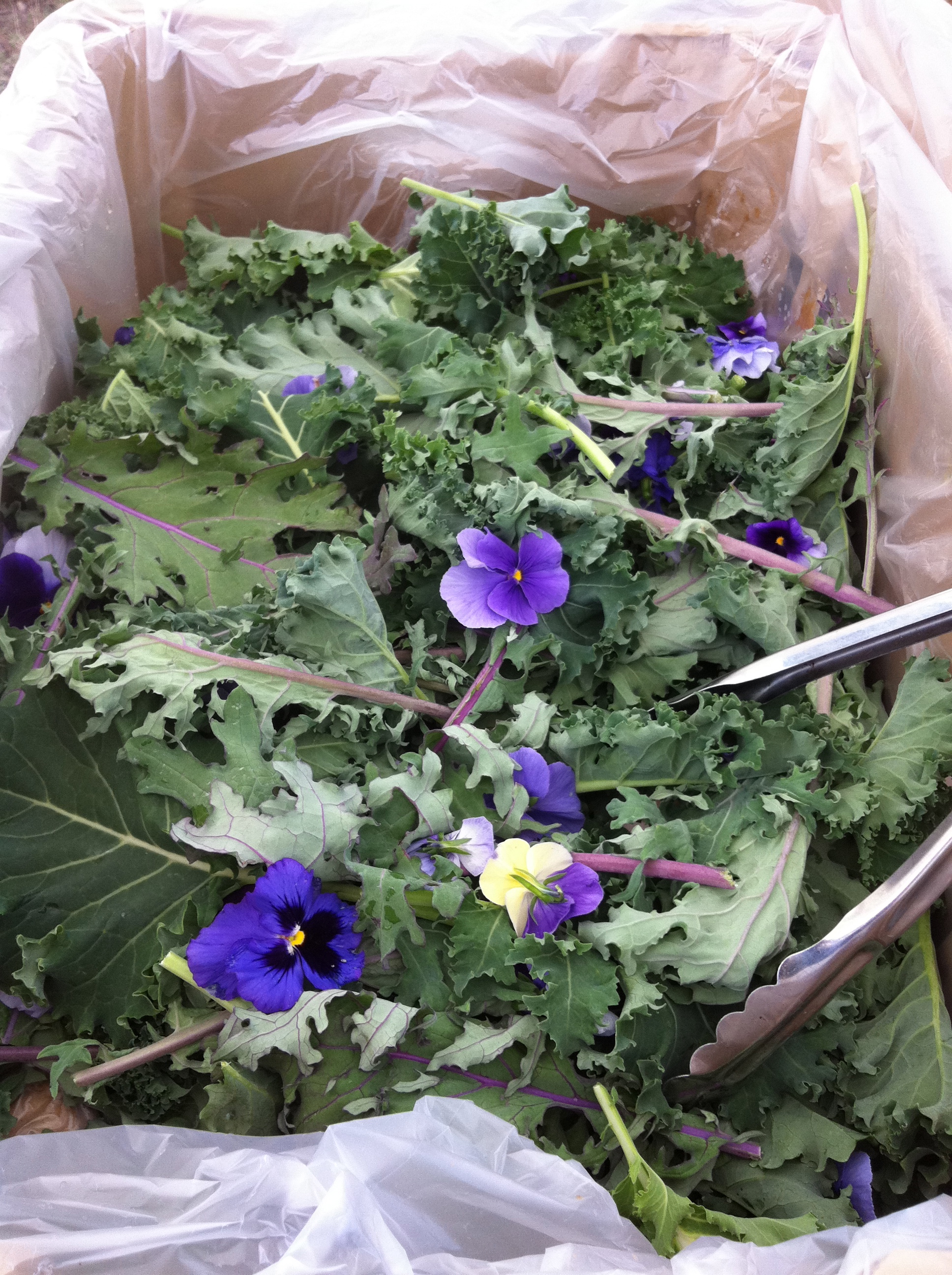
This week the socks and cardies are coming off with the first true week of spring temperatures.  It was an endless cold winter by our totally spoiled sub-tropical standards.  For once the official start of spring matches what the skies are doing.  And weeks of sun and rain every day are making even the most neglected veggie patch come to life.  So we are celebrating by filling our plates with simple but vibrantly colourful salads, with plates covered in leaves and flowers like a happy hippie.  And we are leaving the fancy cooking to the pros, and tasting their efforts at a big delicious festival this Saturday, September 10, in Bangalow, the Sample Food Festival.

Into the beautiful bayfm studio, turned for the occasion into a flower decked bower buzzing with nectar drunk bees, and the odd bit of static (too much spring energy may interact with your hardware – beware!), Miss September wafted in, bearing a jar of  calendula and orange marmalade decorated with lavender flowers for sister T, and lots of seasonal goodness for the listener.  Just remember, if Miss September invites you to dinner, take along a bucket of your best pee for her peas.


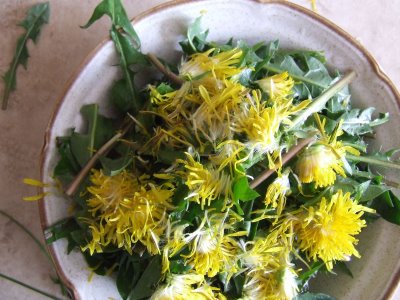
Miss September's dandelion salad


BEST IN SEASON FOR SEPTEMBER – by Miss September, Alison Drover

Its spring time….. pick and eat your flowers and love your lettuces, and pee for your peas.

WHAT’S IN SEASON IN NSW

Vegetables:

artichokes, asparagus, beetroot, cauliflower, kohlrabi, bitter melon
asian greens including wombok (aka Chinese cabbage, aka celery cabbage),
broad beans, sugar snaps, peas
broccolini, broccoli
lettuce, spinach, silverbeet
mushrooms, cultivated and shiitake
new potatoes, swedes, sweet potatoes, potatoes

Herbs, spices and aromatics:

chillies, coriander, curly parsley,flat leaf parsley
ginger, horseradish, turmeric
mint, oregano, rocket, thyme
spring onions (aka green onions, aka shallots – not eschallots)

Fruits, berries and nuts:

apples (Lady Williams), nashis
bananas, papaya, melons, pineapple
cumquats, grapefruit, lemons, mandarins (Honey Murcott), Seville and Blood oranges, pomelo, tangelos
strawberries
Watermelons in Queensland being harvested

LOCALLY AT  NORTHERN RIVERS MARKETS

rocket, kale, lettuce, cabbage, beans, peas, fennel, beetroot, potatoes, ginger, passionfruit, bananas, herbs and honey

The best thing to be using a market and ideal for the arrival of warmer days are salads using combinations of different greens and lettuces, radishes and herbs. Make your own dressings and celebrate the arrival of the sugar snaps and peas.

Spring is a posy of flowers, which are great for people and planet. Many flowers are edible and can help us heal and stay healthy and also play a vital role in encouraging the bees in our garden, which are the pollinators for plant biodiversity.

EDIBLE FLOWERS

The first rule in growing edible flowers. Make sure of which kind of edible flower you are going to grow whether it is perennial or annual. The second rule is, you should choose those which you will likely use often. Thirdly, thoroughly check the soil you are going to use. If you want to grow the best tasting edible flowers, make sure that the soil is clean and the fertilizers you put in are organic.
In harvesting, the best time is at its growing peak and in the morning when the dew has already evaporated. It is also important to keep them cool after harvesting. Long-stemmed flowers must be placed in a vase with fresh cold water while short-stemmed flowers must be placed in plastic bags or damp paper towels and then refrigerated.
The ten easiest edible flowers to grow are lavender, chamomile, calendula, borage, chives, antique roses, sweet violet, pansy, Johnny-jump-ups, and nasturtium.

Violets aren’t just another pretty face. They are loaded with phytochemicals and medicinal constituents that have been used in the treatment of numerous health problems from the common cold to cancer. The late Euell Gibbons even referred to them as “nature’s vitamin pill”.  A 1/2 cup serving of leaves can provide as much vitamin C as three oranges.

This lady is very inspiring  www.herbsarespecial.com.au/free-herb-information/indexs.html

Her words on  nasturtiums:

NASTURTIUMS

Scientific research has found the plant has a natural antibiotic action that is fast-working in the body. It is interesting to note that the antibiotic agent, tromalyt, has been found in the urine within one hour of digesting the herb. Noteworthy, too, is that this antibiotic does not interfere with intestinal flora, and it has been found to be effective against some microorganisms that have built up resistance to common antibiotic drugs.
Nasturtiums are good companion plants. They excrete a strong pungent essence into the air and soil, which has been found to deter aphids, white fly and root pests; and the essence secreted into the soil is also absorbed by other plants, helping them to resist attack by pests and disease. Plant nasturtiums between cabbages, broccoli, melons, cucumbers, pumpkins, potatoes, and around fruit trees.
Aphid Spray: nasturtium leaves (infused in boiling water, cooled, strained, and with a little liquid soap added) are used as a spray for aphids on vegetables and other plants.
Nasturtium is a vigorous ground sprawler, when the plants have thickened up and started to spread, start picking the leaves and flowers to eat.
Leaves have a pungent peppery taste, while the flowers are milder in flavour. If leaves and flowers are chopped up finely and added to other greens and vegetables, they are not as noticeably hot in flavour. I encourage every home grower to plant this valuable herb, learn to enjoy it and use it daily for its high content of vitamin C, iron and other minerals, and the powerful antibiotic, antimicrobial, antioxidant and general tonic actions. The hot pungent seeds can be eaten, too

NASTURTIUM VINEGAR

15g salt
100g nasturtium seed pods
A few peppercorns (optional – I used them)
Herbs, such as dill or tarragon sprigs, or bay leaves (optional – I used bay leaves)
200ml white wine vinegar

Rinse – make sure you don’t use pesticides
Tip – gather them up wrap in damp paper towel zip lock day

A SPRING PLATE

Spring potatoes boiled with a platter or greens rocket, radish,  fennel, oranges and salsa verde with a nasturtium. ( this is what I will be cooking at Sample event)

Take your pick of what you would like on the plate according to what is good at the market e.g.

•    1 spring new potato
•    1 radish
•    slices of orange
•    spring peas
•    rocket

“SALSA VERDE” – green sauce in Italian – goes with meat, fish or even pasta

1 spring onion trimmed very finely sliced
¼ cup chopped parsley
1 tablespoon chopped parsley
1 tablespoon chopped rocket leaves
1 tablespoon chopped French tarragon
1 teaspoon chopped lemon thyme
1 tablespoon chervil
1 tablespoon salted capers soaked and rinsed
¼ cup oil
sea salt
lemon zest and juice of one lemon

Add each ingredient stir in oil. Add lemon juice before serving so that you don’t lose the bright colour.
Variations: add croutons, add boiled egg

Tip for the garden fork :

Mulch to ensure you get onto those weeds and also make sure you are getting trellis ready for tomatoes ..
Visit www.sustainfood.com.au for planting and harvest tips.

Save your pee in a bucket as long as you are not taking medication it is a great fertilizer for your garden and cuts down the flushing.

Our urine is full of useful chemicals like nitrogen, potassium and phosphorus. But urine contains salt, making it a bit powerful to apply directly to plants. You’ll have to mix the urine with grey water at a ratio of 8 to 1.
You will also save on cleaning products.


Suitably nourished and refreshed by the spring energy and much giggling about peeing in the veggie patch (intriguing depth of flavour in those strawberries madame – what is your secret?), sister T went on to play an interview with the energetic and enterprising Remy Tancred, publisher of The Lennox Wave, and of the one year old Sample Magazine, the North Coast’s own Ita.  Actually she looked a bit tired – organising a massive one day food festival will do that to you.

Sample is full of stories about locals involved in food, from farmers to chefs.  Check out the recipes for a great idea to brighten pancakes in spring.  A recipe from the Byron Beach Cafe, hot pink pancakes, coloured with puree from beetroots roasted in their skins, layered with orange slices.  You could top them with nasturtium flowers for a truly vibrant breakfast.

The Sample Food Festival at the Bangalow Showgrounds will include lots of free music and entertainment for kids and adults, even those who don’t live breathe and dream food.   You should catch the goat milking demo – those Nimbin goats have rectangular pupils, you can see how they got the demonic reputation.  There is a session on knife skills, and some of our top chefs sharing knowledge.  Twenty two local restaurants and caterers will have plates to taste, for $5 or 10, the list of dishes sounds far too good for an easy plan of attack.  Tenterfield lamb to Barcoo beef, vegan lasagne to mixed grain risotto, cheviche to crocodile, lemon myrtle cupcakes to macadamia and honey meringues, goat, squid and of course lots of Bangalow pork.  Just to start.   There is a producers market in the morning, and about 60 stalls of other North Coast food and food related businesses.  And the lovely Leah Roland of the Bangalow Cooking School is holding a 2 hour kids class at 10.30  and then an adult cooking class at 12.30 in the Scout Hall, with the help of some top local chefs.  Lots more info here , in the new issue of Sample, or the local papers.

I think this is a great opportunity to see what our local restaurants, farmers and food businesses have to offer, with no entry fee.  I hope lots of people go,  so Remy and the Sample team are crazy enough to do all this again next year.    And thanks Remy for donating a free adult class ticket with Leah Roland and a bunch of Sample magazines for bayfm subscribers.


BELLY BULLETIN

Bangalow-based macadamia farmers, Pam and Martin Brook of Brookfarm have won a lot of prizes for their macadamia products.  Now they have been named finalists in the Diversification Farmer of the Year category in the  2011 Australian Farmer of the Year Awards. There are no categories for best ute or most battered hat, but a lot of emphasis on diversification, biosecurity and innovation.  It is an elite group.  Another finalist is Lindsay Bourke of Launceston (TAS), a beekeeper and honey producer. He runs 3000 hives and a honey production business without insecticides, preservatives or additives.  The national winner is in the running for a $50,000 scholarship.

Good news on the fast food front.  KFC has begun removing all toys from its children’s meals,  a move welcomed by anti-obesity lobby groups.  The Obesity Policy Coalition’s Jane Martin says:
“Parents are so familiar with the pester power that these kinds of toys create.  We’d really urge other fast food outlets,  to follow this example and stop using toys to market junk food to kids.”

Australia has brought in its biggest ever truffle harvest this year, due mainly to a big season in Western Australia.  One WA company has doubled last year’s crop.   Producers say  the increase will help Australia make a name for itself in the global truffle market.  And maybe prices will drop a bit for us consumers.


TODAY’S SUNNY SEPTEMBER MUSIC


Belleville Rendevous, by M – from the 2010 So Frenchy so Chic compilation

Yellow daisies, by Fertile Ground with Navasha Deva

The Street of Barefoot Lovers, by Muzika

Visa fran Utanmyra, by Jan Johansson, from ‘Jazz pa Svenska’, arrangements of Swedish folk songs


stay healthy and pee happy,

Sister T


Judy’s citrus tales

SEVILLE ORANGE MARMALADE RECIPE – by Judy McDonald

7 Seville Oranges
10 cups of water [2.5 litres]
cc 8 cups of sugar [1.6 kg]

1.Wash oranges, scrub clean if necessary, cut out any imperfections in the skin.
2. Cut oranges into quarters and remove and save the central membranes and all pips [the source of pectin needed for a good set].
3.Slice oranges finely and put in a large ceramic or glass bowl and cover with the water.
4.Collect all the pips & membrane in a muslin bag [with string attached] and leave to soak with the fruit and water over night [24 hrs].
-soaking overnight will help tenderise the skins and reduce the cooking time in the first stage.
5.Next day, put the fruit, pips etc  [in the muslin bag tied to jam pan handle] into a large cooking container /preserving pan.
6.Bring to the boil slowly and simmer for around 45 minutes until the skins are tender.
7.Use a metal spoon to press all the pectin out of the muslin bag and into the fruit mix.
8.In the meantime it is recommended that you warm the sugar [reduces the time taken to bring the fruit pulp back to the boil in stage two] and thoroughly clean and prepare your jars and lids.
9.Measure the fruit pulp by the cup and then put back into the preserving pan with the equivalent cups of sugar [ie one cup of pulp =one cup of warmed sugar].
10.Stir and dissolve in the sugar with a wooden spoon and bring the mixture back to the boil quickly on a high flame and boil for up to 40 minutes.
12.Stir with a wooden spoon pretty constantly to prevent the marmalade sticking to the bottom of the pan and burning.
13.Whilst it is boiling skim off the scum with a metal spoon.
14.Start testing from about 20 minutes after it has boiled, to see if the marmalade has set [see note below].
15.Leave the jam rest for 5-10 minutes before putting into hot jars [ pre-heated in the oven to sterilise them] to ensure that the fruit sits evenly in the jars rather than rising to the top.
16.Wait for the jam to cool before putting on the lids to avoid condensation forming which can cause mould to form on the top of the marmalade. Cut rounds of baking paper inserted in the lid can help.

Setting point
-you will notice the mixture becoming more viscous, wrinkly skin will begin to form on the sides of the pan, sticky drops will fall from your wooden spoon when it is held up on its side.
-another test is to have a cold plate [put in freezer before etc] and when you think the marmalade[or jam] is beginning to set, put some ‘drops’ onto the plate.
It is set when the the skin wrinkles,or you when you can run your finger cleanly through the centre dividing the drop.

-freshly picked fruit will reach setting point more quickly, sometimes only 20 minutes of boiling is required.
-the longer you boil in the second stage,the darker the marmalade [or jam] will become and you’ll lose the fresh fruit flavour[as well as possibly ending up with over dense /hard set marmalade].

-don’t pick your citrus for marmalade in wet weather [it can adversely affect the process].
-don’t try and reduce the sugar ratio it will affect the setting process and the marmalade will not ‘keep’: it will not be ‘preserved’ …

Seville Orange Marmalade

7 Seville Oranges 
10 cups of water [2.5 litres]
cc 8 cups of sugar [1.6 kg]

1.Wash oranges, scrub clean if necessary, cut out any imperfections in the skin.
2. Cut oranges into quarters and remove and save the central membranes and all pips [the source of pectin needed for a good set].
3.Slice oranges finely and put in a large ceramic or glass bowl and cover with the water.
4.Collect all the pips & membrane in a muslin bag [with string attached] and leave to soak with the fruit and water over night [24 hrs].
  -soaking overnight will help tenderise the skins and reduce the cooking time in the first stage.
5.Next day, put the fruit, pips etc  [in the muslin bag tied to jam pan handle] into a large cooking container /preserving pan.
6.Bring to the boil slowly and simmer for around 45 minutes until the skins are tender.
7.Use a metal spoon to press all the pectin out of the muslin bag and into the fruit mix. 
8.In the meantime it is recommended that you warm the sugar [reduces the time taken to bring the fruit pulp back to the boil in stage two] and thoroughly clean and prepare your jars and lids.  
9.Measure the fruit pulp by the cup and then put back into the preserving pan with the equivalent cups of sugar [ie one cup of pulp =one cup of warmed sugar].
10.Stir and dissolve in the sugar with a wooden spoon and bring the mixture back to the boil quickly on a high flame and boil for up to 40 minutes.
12.Stir with a wooden spoon pretty constantly to prevent the marmalade sticking to the bottom of the pan and burning.  
13.Whilst it is boiling skim off the scum with a metal spoon.
14.Start testing from about 20 minutes after it has boiled, to see if the marmalade has set [see note below].
15.Leave the jam rest for 5-10 minutes before putting into hot jars [ pre-heated in the oven to sterilise them] to ensure that the fruit sits evenly in the jars rather than rising to the top.
16.Wait for the jam to cool before putting on the lids to avoid condensation forming which can cause mould to form on the top of the marmalade. Cut rounds of baking paper inserted in the lid can help.

Setting point
-you will notice the mixture becoming more viscous, wrinkly skin will begin to form on the sides of the pan, sticky drops will fall from your wooden spoon when it is held up on its side.
-another test is to have a cold plate [put in freezer before etc] and when you think the marmalade[or jam] is beginning to set, put some 'drops' onto the plate.
 It is set when the the skin wrinkles,or you when you can run your finger cleanly through the centre dividing the drop.

-freshly picked fruit will reach setting point more quickly, sometimes only 20 minutes of boiling is required. 
-the longer you boil in the second stage,the darker the marmalade [or jam] will become and you'll lose the fresh fruit flavour[as well as possibly ending up with over dense /hard set marmalade].

-don't pick your citrus for marmalade in wet weather [it can adversely affect the process].
-don't try and reduce the sugar ratio it will affect the setting process and the marmalade will not 'keep': it will not be 'preserved' ...

reverse cooking, positively strawberry & the art of the sponge

on air on bayfm’s 99.9 on August 1, 2011


MORE COMING!


By Khiara Brown (11 years old)

Miss August – Alison Drover

The sun is shining and the strawberries are putting smiles on everyone’s’ lips. Spring is on the way and it is the time for kissing goodbye the cold.   Take time to savour the winter vegetable soups – conserve and preserve surplus so that you can enjoy them in the months to come.
Asian greens are high in magnesium and so easy to cook.
Look for Choy sum, wombok, bok choy and use finely chopped cabbages with
Root vegetables – turmeric,  galangal, ginger and spring onions.
Eat locally and waste not, enjoy August

X Alison Drover

What’s in season around Australia in August

Beetroot
Mushrooms
Brussel sprouts
Broccoli
Cabbage green and red
Carrots
Cauliflower
Celeriac
Kohlrabi
Leeks
Onions
Parsnips
Potatoes
Pumpkins
Silver beet
Sweet potato
Witloaf
Rhubarb
Oranges Navel and Seville
Tangelo
Mandarins
Lemons

ASIAN ROOT FAST CONFIT – perfect for vegetables and for basting chicken

Typically when we make a sauce or stirfry we add our ingredients to the oil.
This technique is the opposite as the hot oil is poured over the ingredients.  The benefit is that you have a concentrated flavour and infusion.
This is one recommendation however you can vary this according to individual preference and what is in season

•    3 stalks fresh lemon grass peeled and chopped
•    1 tablespoon ginger  – peeled and grated finely
•    1 tablespoon galangal root – peeled and grated
•    ½ tablespoon turmeric root – peeled and grated
•    2 shallot – peeled and sliced finely
•    1 clove of fresh local garlic peeled and chopped

½ cup of Sesame oil or vegetable cooking oil

*Variations – add 1 piece of lemon zest or orange approximately 5cm x 5cm piece,  palm sugar, coriander roots chopped

Put all the ingredients into a heatproof bowl  – ceramic style bowl is great.
Heat  oil in a saucepan until it is spluttering but not burning or smoking.
Pour the oil over the mix and combine. It will splutter and crackle which is the idea as all the ingredients are cooking.

Ideas

Vegetables

Cook up some a mix of Asian greens whatever is in season and available. Add your root oil mix and then serve.

Chicken

Take a pastry brush and brush the chicken with the oil and then roast in the oven. Alternatively for a stronger more intense flavour pour over the oil and leave to marinate overnight before cooking.

THE PERFECT SPONGE – made even more perfect with strawberries

Alison writes for Sprout Magazine  and these are her thoughts on baking the perfect sponge.

Sponges look easy but really test  our baking skills yet they are well worth the patience and can be enjoyed all year around filled with jam in summer, lemon butter in winter as it gets really cold with marmalade and some real custard.
The test is following the instructions and understanding the principles of baking as you go step by step. The proof is my confession that one of the first sponges I made for this article failed, which further highlighted for me the difficulty in baking and the art of the sponge. It was actually a blessing though, as it made me provide much more detail in the method so you can get the perfect sponge every time.
The following recipe seems to be the one that works. Duck eggs are best but if you can’t get these, go for the freshest eggs you can get. If your oven is not fan-forced or has a fan-forced function that can be switched off, preheat oven to 190°C and move the oven rack to about one-third of the way up from the base of the oven. If you are using a fan-forced oven or are not able to turn the fan off, preheat oven to 170°C.
You will need two 20cm diameter cake pans that are at least 5cm deep. Grease the inside of the pans and line the bases with a circle of non-stick baking paper, then grease the baking paper (this will make it easier to pull the baking paper off the cake when removed from the oven)

100g (2/3 cup) self-raising flour
50g (1/3 cup) cornflour (cornstarch)
1/8 teaspoon fine salt
5g (1 teaspoon) butter, at room temperature
60ml (3 tablespoons) boiling water
4 large eggs, at room temperature (I used eggs with a minimum weight of 59g)
150g (2/3 cup) caster sugar

Sift the self-raising flour, cornflour and salt together three times to remove lumps, aerate, and thoroughly combine the ingredients.
Once the ingredients have been thoroughly sifted, place the sifter over a bowl or on a piece of greaseproof paper to catch any flour that might escape from the sifter and return the flours to the sifter. Set aside.
Place the butter and boiling water in a small heatproof jug. The water needs to be hot so that the butter will completely melt.
Break the eggs into a large bowl. Using an electric mixer beat on medium-high speed for about 10 seconds to combine the yolks and whites. With the beaters running, add the sugar and continue beating on medium-high speed for about 6 minutes When you lift the beaters, the mixture that falls from the beaters should sit on top of the egg mixture (rather than sinking in).
Sift about one third of the flour mixture over the egg mixture, and using a large deep spoon, gently but quickly fold the flour into the egg mixture until nearly combined. Sift half the remaining flour over the egg mixture and gently fold until nearly combined.
Sift the remaining flour over the egg mixture and pour the water/butter mixture around the edges of the bowl. Fold the ingredients together, making sure you scrape the bottom of the bowl as you fold so the water combines with the other ingredients and doesn’t remain in a pool at the base of the bowl. Don’t mix any more than is necessary to combine the ingredients—if you knock too much air out of the mixture the resulting cakes will be flat and tough.
Divide the mixture evenly between the prepared pans.
If your oven has any hot spots, try to avoid placing the cake pans in the hottest areas of the oven. Bake for 20–24 minutes or until the cakes are lightly golden and spring back when gently pressed in the centre. Don’t use a knife/skewer to test the cakes in case they deflate.
Place a piece of non-stick baking paper on a wire rack, and turn the cakes out onto the baking paper. The baking paper helps prevent the tops of the cakes from being marked by, or sticking to, the wire rack. Gently peel the baking paper off the cakes.
Turn the cakes over so they are top-side up. Place a piece of greaseproof paper loosely over the cakes while they are cooling to help prevent them from drying out.
Spread a thin layer of strawberry or raspberry jam on one of the cakes—the least attractive side as it won’t be visible—top with a layer of fresh whipped real cream, gently place the other sponge on top.
Make a real pot of leaf tea, gather around and enjoy immediately.

CAKE MAKING TIPS

•    Use eggs at room temperature—and for goodness sake use organic or free-range.
•    To ensure good volume, use a metal spoon with a cutting and sweeping action when mixing in the flour—any grease in the bowl, even a small amount of yolk with the egg whites, will prevent the sponge from rising.

Principles of cake baking
•    Beating introduces air into the mixture, therefore, beat butter, sugar and eggs well together in some varieties, and eggs thoroughly in all cases.
•    Beating the mixture after adding the flour and any fruit forces out the air; therefore never beat mixtures after the flour and fruit are added.
•    Air expands with heat, thus raising and lightening mixtures, so a hot oven is necessary.
•    Large cakes, if baked quickly, brown on the outside before being baked through. Small cakes baked slowly lose their moisture through evaporation and become dry and hard, therefore, bake large cakes slowly and small cakes quickly.
•    Lay one or two layers of paper over the top of large cakes, to prevent them over-colouring.

Other reasons cakes can fail

•    Ingredients. Bad or damp flour, rancid butter, cheap, dirty, or dry fruit, doubtful eggs, inferior sugar.
•    Methods. Rubbing the butter into the flour badly, or creaming the butter and sugar together insufficiently.
•    Moving cakes before they are set, this causes them to sink, and sometimes form holes in the centre. Banging the oven door during baking produces the same effects.
•    Not testing cakes with a skewer to ascertain if they’re thoroughly baked before removing from the oven.
•    Placing cakes when baked in such positions that the steam is unable to escape, with the result that it condenses inside the cake, and causes it to become heavy.

STRAWBERRY MUFFINS – made with buttermilk
small is beautiful and no need for a muffin top – quality over quantity
Recipe Alison Drover

Makes 10 muffins

•    380g flour plain
•    150g sugar
•    1tsp baking powder
•    pinch of salt
.        150 grams butter
•    2 eggs organic or free range please
•    300ml buttermilk
•    ½ vanilla bean
*   1 punnet local strawberries – rinsed, hulled (green bit removed from the top) and then chopped roughly but taking care not to squash   the fruit or bruise it.
*  ½ cup approx Demerara sugar

Weigh flour, sugar, salt, and baking powder into a large bowl. Stir don’t  beat several times with a whisk.
Melt butter – take care not to split the butter so melt slowly on the stove on low. Break eggs into a separate bowl and stir in the buttermilk and vanilla.
Pour the eggs over the melted butter and then place the bowl over the gas flame.
Stir continuously and until it is about 38 degrees blood temperature. (If you use a temperature once you will know what this should be for the future)
Gently fold the wet and dry ingredients. Don’t worry if there are a few lumps as it is more important that your dough is not overworked, as this will make your muffins heavy.
Add chopped strawberries halfway through this process.
Take a metal spoon and knife and transfer to patty tins.
Sprinkle carefully so as not to spill on the tin as this will burn the top the sugar on each individual muffin. This will give the muffins the crunchy top, which is delicious and also compliments the strawberries by creating a toffee like top.
and bake for 150 degrees Celsius for 20-25 mins.


BELLY BULLETIN

The Sydney Morning Herald this week is investigating sales of rural land in NSW.
Mining and energy companies have bought up more than 35 000 hectares .  Foreign investors in agriculture have bought 225 000 hectares – both just in the last year.  The dominance of overseas buyers is being put down to Australia’s openness to foreign investment, and recent difficulties in getting credit within Australia.  There is growing worldwide demand for agricultural produce, as well as rising prices for mineral resources, especially coal and natural gas in NSW.  Many farming communities are concerned about agricultural land being used for mining.  Mining companies say some land is being bought as environmental offsets, and will not be lost to farming.

Do you remember all the rain we had in the first half of this year?  Unfortunately it also fell in most of Australia’s wine regions.  Wine grapes really don’t like rain just before and at harvest time, it dilutes the flavours and tends to cause rot.  So when you see the 2011 vintage on a bottle, maybe look for wines from Western Australia, which had very little rain.  The NSW hunter Valley was also ok.  You should expect very cheap prices though, as it was a big harvest.  Experts are concerned that many winemakers added concentrated grape juice to low quality wine to boost alcohol levels and richness, which is legal but doesn’t lead to a fabulous wine.  Concentrate has little flavour and can also be made from rot affected grapes.  Former Winemakers association of Australia president Alister Purbrick says as much as a quarter million tonnes of grapes may have been made into concentrate this year.

In local news, the Byron Bay Writers’ Festival starts this week, with workshops from today and festival events all over the region.  The main event is back at the old beach resort aka North Byron.  Festival director Candy Baker told me on the weekend she is predicting a mini draught for the rest of the week.  No cooking workshops this year unfortunately, but plenty of lunches and dinners.  Food obsessed festival guests include locals Belinda Jeffery and Janella Purcell, last year’s Masterchef winner Adam Liaw, and Victoria Alexander.  The very first session on Friday, at 9am, is called ‘eat my words, why we love foodbooks’, so make sure you get there for that one.  There’s also a new event, called Writers at the Lakehouse, where you can have a nice cuppa tea or coffee, and hopefully a biscuit, with your favourite writer.  This is a separately ticketed event, with tickets available at the Box Office on the day, so you could go along just for that.  15 people per writer, five writers in the Lakehouse at any one time.

It’s a good time for cookbook writers.  At the Australian Book Industry awards last year, 5 out of 6 finalists in the illustrated book category were food books. And the first Masterchef winner, Julie Goodwin, won with “Our family table”, beating books by 3 well known food professionals.  The  Award for outstanding service to the Australian book industry went to the first lady of Australian cooking teachers, Margaret Fulton. She is the first woman in six years to win the award and the first cookbook writer.

Tor’s Thai cooking lesson in Bangkok

on air on Byron Bay’s bayfm 99.9 on July 25, 2011


This is the charming smiling face of Tor Klinyu, the owner and teacher at Isan House Restaurant and Cooking School in Bankok.  If you have ever wondered why there is a cliche’ about Thailand being the land of smiles, look no further!

A cooking class in Thailand is a great way to see a bit of real Thai life, as well as to learn about one of the world’s great cuisines.  You can do it even on a short stopover, as most of the classes just go for half a day, morning or afternoon.  Many classes include a market visit, especially if you book in the morning.  There seems to be a boom in cooking classes at the moment, and there is something for all tastes.  The glamour option, which has been around for years, is the Oriental Hotel.  You can also do classes while floating serenely on the Chao Praya river, or go to vegetarian classes at a Khao San road institution in the middle of backpacker land.  I have tried three places, all very different and all very enjoyable in their own way.  In all of them you do most of your own cooking, ingredients are explained thoroughly, and you finish by eating far too much delicious food.  Do take the warnings to go to class hungry seriously!  At current rates of exchange, most classes will cost you between $30 and $100 for half a day.

I have tried :  The Blue Elephant, a more upmarket option attached to a large Thai restaurant in a lovely old house, which must have been gorgeous before the gardens were sold to build high rises.  A charming, rotund chef teaches finely balanced proper recipes.  A score of assistants helps you cook up your creations – if only you could take a dozen or so home to do all the chopping and grating.  But you can buy the ready made Blue Elephant pastes instead.  I am still cooking their jasmine cake regularly.


Silom Thai Cooking school, where you cook in a medium rise, typical (I think) central Bangkok flat.  You wash ingredients in little domestic sinks, you chop and grate ingredients sitting on the floor, and you cook in woks lined up along the building’s connecting outdoor corridor.  The recipes are kept simple, the instructor is another very charming Thai man.  Proof you don’t need a fancy kitchen to make a banquet.


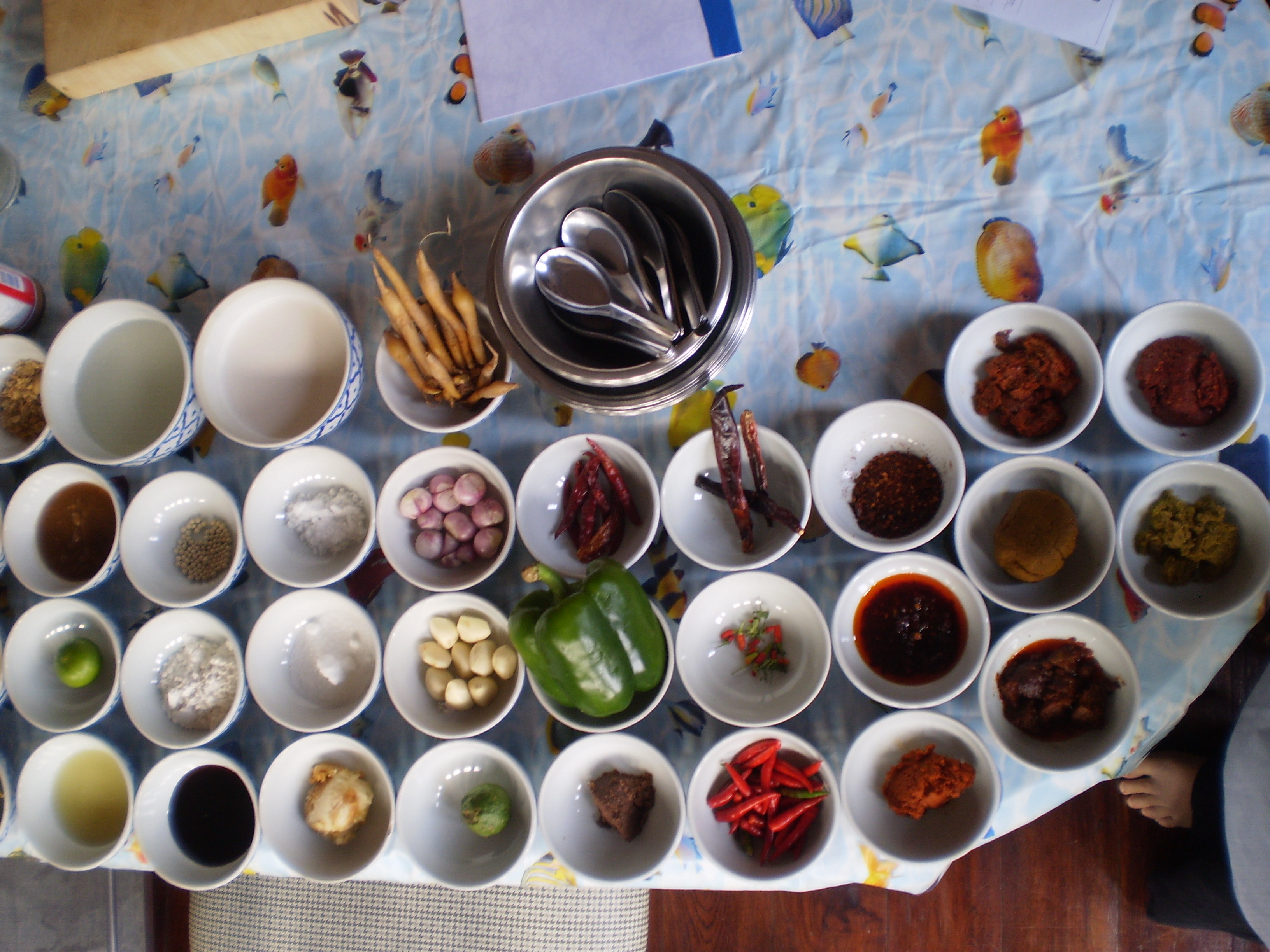
And Tor’s place, Isan House.  You walk past a whole heap of girly bars, turn a few corners and find her family’s charming restaurant, with an outdoor deck for cooking and about a million ingredients lined up inside.


I was lucky enough to be in Bangkok when the streets were a bit too lively with political unrest, and tourists were staying away, so I was the only one at Tor’s lesson and she allowed me to record it.  Today on belly I played a bit of her story.  She starts classes with descriptions of Thai ingredients, and talks about the dishes in which they are used.  In today’s belly she described sweet, holy and lemon basil, saw tooth (perennial) coriander and kaffir lime leaf and skin.  More ingredients soon.  As you can see there are quite a few.  You can find a good list of Thai ingredients, with pictures, on wikipedia.


* I have found lemon basil locally as seedlings, called “lime basil”.  It has a really gorgeous intense lemon zest smell and taste.  Thais also use the seeds in desserts.


* Tor recommends you use the zest/skin of kaffir limes, not the leaf, in curry pastes if you can find it.  My kaffir lime fruits about every 3 years, the grated zest keeps really well in the freezer.  Use leaves whole in curries, soups and stir fries.  Tor also deep fries the leaves as a snack.


TOR’S MUSHROOM BREAD

A very easy recipe, which reminds me of that Australian country Chinese classic, sesame prawn toasts, but is taken straight to Thailand by the little sharp side salad.  One of the 100 dishes on the Isan House menu.

bread, sliced and cut into triangles
beaten egg
sesame seeds
mushrooms, sliced and seasoned with a little pepper and salt or soy sauce
flour
finely chopped garlic
finely chopped coriander

Toss mushrooms in flour.
Mix sesame seeds, coriander, garlic and pepper
Squash mushrooms into toast.  Top with sesame mix.
Dip in egg.
Deep fry 2 or 3 at a time in a wok until golden brown.  Use any mild oil.

Cucumber salad

Make the dressing by bringing to the boil a little white vinegar, water, salt and sugar, combined to your own taste.  Allow to cool.
Slice cucumber and shallots (or substitute mild red onions).   Top with dressing and “1 or 10 chillies” as Tor says.


THE SEARCH FOR LEMON MYRTLE SLICE – a.k.a. my homework for Joy.

The very charming Joy and David Johnson were on belly recently talking about working, cooking, and falling in love on the trains in the 50s.  They are also neighbours.  The last time we ran into each other (this always happens on the way to the beach, what a tough life we live),  she asked me ever so nicely to put out a call for lemon myrtle slice recipes.  Well I did and you lot did not get in touch with any, but I found a gorgeous recipe that I will have to try soon, a variation on a no cook cheesecake.  This type of cheesecake is a great beginner’s dish by the way, you just need to be a little careful with the gelatin.

You will find the full recipe and pictures here.  It is an Australian blog called “Not Quite Nigella” – great name.

Lemon myrtle is a lovely local native, a eucalypt with lemon scented leaves used in cooking and toiletries, but there is a lot more than lemon going on in the scent.  You can easily grow it, but watch out for a new fungal disease, myrtle rust, unfortunately taking hold in Australia.

* For a stronger lemon myrtle taste (or instead of the dry leaf), try making a strong lemon myrtle tea with fresh or dry leaves and the 1/4 cup of water in the recipe.

* To make your own powdered leaf, first hang branches to dry in a dark place.


BELLY BULLETIN

It’s something we’ve all suspected – there is a hunger gene.  There are about 60 gene variations that can influence our weight, but one gene can have a big effect all on its own. It is a defect of gene MC4R and it stops the brain from getting the message that we have had enough to eat.  Fortunately it only affects a minority of people because it is a serious problem.  It has probably always been around, but it is much easier in our world to get access to very high calorie food and do no exercise.  You only need one parent with the faulty gene to inherit it. About 3 to 6 per cent of people who become very obese have this gene.  Scientists are trying to raise its profile  so that suitable lifestyle changes can begin early.  At the moment there is no medical fix, even weight loss surgery may fail if you have this gene.  But it can lead to severe overweight from early childhood, and it can easily be found with a blood test.  Doctor Daniel Chen, from Sydney’s Garvan Institute of Medical Research, would like a blood sample from you if your Body mass Index is over 30, especially if you have very healthy blood pressure for your weight.
d.chen@garvan.org.au or 92958557.

And if you have the hunger gene maybe you should stay away from Southend on Sea, east of London, where they have just broken the world potato chip record, to celebrate one of England’s national dishes, fish and chips.
Five staff  of the Adventure Island fish and chip shop took four hours and 20 minutes to cut the potatoes, deep fry the chips and box them up, beating the previous record of 368.5kg set in 2004.  The box had to be an extra large version of the regular chip boxes to meet food hygiene standards.  Spokeswoman Tracy Jones said :
“It was hot work. We did it all from scratch. The previous record was done with frozen chips.  There was a really good atmosphere. Loads of people turned up. The biggest problem was stopping children putting their hands in and taking the chips before we were finished.”
The money went to charity and the leftovers to the pigs.  The Adventure Island amusement park is on a roll with records – it has also just set the world records for the most naked people on a rollercoaster (102 people) and the longest dodgem car marathon (26 hours).


MUSIC

lots of traditional Thai instrumental tracks, courtesy of wonderful local Thai cook Thome – sorry all the info is in Thai script!

The Oyster Murders, Lovers who drink the sea

Bianca Meier, Walk the earth

Oka, Pandanus

Nadia Piave, Musetta, from Caffe’ d’Amore

eat words and ham

on air on Byron Bay’s bayfm 99.9 on 18 July 2011


It was a great delight today to talk with the new Byron Bay Writers Festival director Candida Baker about all the lunches and food centred talks coming up at the 2011 festival.  She is a food lover and keen cook, as demonstrated by her neatly making sure that the truly obsessed can actually go to all food events – second helpings but no double bookings!  For more info and links go to their site here.  Be quick because a lot of the lunches and dinners do sell out.

Candida has one sister who is an ex-chef, another now cooking in the south of France (the popular one).  Her father was an actor but his cooking was so popular with his friends that after many long and boozy meals he  wrote his own cookbook.  He taught Candida to make her own roast ham at Christmas, starting from raw smoked ham, a two day process.  As soon as she can drag herself away from long production meetings she will send me the recipe to share with you.

And I have a recipe to give and a request from Joy, the riverina Express train cook who was on belly recently.

She’d like to share a guaranteed to work tea.


JOY’S FLUE TEA

1 part yarrow

1 part elderflower

2 parts peppermint

Mix herbs together and store in an airtight container.

Put one heaped teaspoonful in a mug, pour in boiling water, let stand 5 minutes.

Drink as often and as hot as you can.


And Joy is looking for a lemon myrtle slice recipe – can you help?  If you can please email belly (at) belly (dot)net(dot)au.


BELLY BULLETIN


Here’s a tip  if you keep chickens or other farm animals and predators have been trying to get to them.  A  farmer near Toowoomba  has discovered a new way of deterring foxes from killing his lambs.
Organic farmer Jonathon Arkins has been collecting human hair from local hairdressers, putting it in old stockings, and tying it to fence posts around his property.  The technique seems to be working so far.  In his words :
“So farmers, you may have to go out and raid your wife’s or lady friend’s drawers for their stockings and you just get a handful of hair and stuff it down the bottom and tie a knot in it. And then just tie it up from the ground… that’s enough to get the scent out – foxes hate the smell of humans.”   Or maybe the smell of hair dye.

Another type of experiment has been in the news with the destruction of the CSIRO’s Genetically Modified wheat plantings.  In my last belly bulletin I told you about the world first GM wheat trials near Canberra, which were supposed to lead to human testing in about 6 months.  Last Thursday Greenpeace activists whippersnippered the whole crop.  You can look up the Greenpeace website for more information, but they say the CSIRO research has been compromised by its links to biotech companies, and human trials were to go ahead without adequate safety testing.  Farmer groups and scientists have come out both for and against the GM wheat trials.  Farmer concerns include the potential for contamination of the non-GM crop and damage to the multi-million dollar Australian wheat industry.  The CSIRO says it will probably have to abandon this year’s plantings.  CSIRO chief of plant industries, Dr Jeremy Burton, says :
“Differences of opinion are fine, but if it comes to this sort of action, it does seem to be unnecessary, really.”

In local news, a screening of the film ” The Economics of Happiness”  will be held this thursday July 21 at the Mullumbimby Civic Hall.  Doors open at 6pm.  The fimmaker Helena Norberg-Hodge will be in attendance, and there is food by Santos.  And congratulations to the staff and management of Santos Mullum for donating 10 000 dollars to Rainforest rescue and Sea Shepherd last week.

And finally, the head of Byron United was complaining in the Byron Shire News last Thursday that too many businesses are opening without first doing their homework and closing soon after, and that we need innovative ideas.  Well here is a very innovative idea. I’m pretty sure we don’t have a cat cafe in Byron.  Not – somewhere where you can take your pussy for sushi and organic cream.  A cafe where the cat deprived pay to spend an hour surrounded by dozens of cats, and maybe also have a coffee.  They are becoming very popular in Japan, Korea and Taiwan, where people often have no room for pets and horrible landlords that don’t allow pets.  You go to the cafe, leave your shoes outside, disinfect your hands, and you may stroke any cat that is awake and feeling friendly.  You can rent cat toys and buy them treats. And shouting or smoking please.  Some  cafes  specialise in categories of cat such as black cats, fat cats, rare breeds or rescued stray cats. In Japan you can also rent a cat.  I look forwards to the MUllum Moggy cafe, or the Byron Black cat bar.


MARA SEEDS FIELD DAY

This info came in too late to make it on the show – The Mara Seeds softer farming demonstration is happening this Friday, they will overcater in case unexpected guests turn up, but please try to contact them if you are interested.

This will be a fantastic opportunity to experience first-hand the Softer Farming Method trials being undertaken by Stuart Larsson and the Mara Seeds team as part of the Northern Rivers Food Links Sustainable Agriculture Projects focus area.

Email: admin@maraseeds.com.au | Phone: 02 6664 5145 (8:30am – 3:30pm, Mon – Fri)

tastes of July

on air on Byron Bay’s bayfm99.9 on July 4, 2011


Today Sister Carolyn, one of the original bellysisters, made a return visit to the little belly kitchen.  She had a long chat about the most delicious in season  flavours of July with Miss July herself, Alison Drover.  Who has just sent us a very fab picture of herself.   (I think I recognise the very cute apron too, made by a stallholder at the weekend markets).


MISS JULY’S MONTHLY GUIDE


Winter citrus is great this year because of the cold we have had and the frosts. Pecans are also great.

My breakfast is oranges peeled and sliced crossways warmed on the stove with raw unheated honey, rosemary and pecans with a dollop of yogurt ­ great for keeping the winter bugs at bay. Rosemary contains substances that are useful for stimulating the immune system, increasing circulation, and improving digestion. Rosemary also contains anti-inflammatory compounds that may make it useful for reducing the severity of asthma attacks. In addition, rosemary has been shown to increase the blood flow to the head and brain, improving concentration.

Enjoy Alison


JULY IN SEASON FRUIT

Avocados

Custard apples

Fuji apples

Grapefruit

Pomelo

Lemons

Limes

Mandarins

Nashi

Pineapple

Rhubarb

Quinces

Pomegranate


JULY IN SEASON VEGETABLES

Beetroot

Broccoli

Brussell sprouts

Beetroot

Brown onions

Carrots

Celery

Chinese Greens

Fennel

Ginger

Sweet potato

Pecans ­ great this winter because of the cold.


RECIPES


Bastille day is the 14th of July and hence a French recipe which is typically French – simple yet so good


CELERIAC AND PECAN REMOULADE

* 1 celeriac

* 1/4 cup of pecans

* Mayonnaise ­ see list below


Great with roasts meats or fish and great for lunch served French style as

an picnic accompaniment along with a baguette, some cheese, olives and a

cold chicken or meats.

A remoulade is a mayonnaise sauce served cold which often has herbs and

things added.

Take some local pecans say 1/4 cup and place them on a oven tray in a oven

around 150 for about 5 minutes until they are crunchy. Remove from the oven

and leave to cool.

The celeriac is not a pretty vegetable very knobby all over but don’t be put

off it well worth the peeling.

Take the celeriac and cut the top and bottom off so that rests on the

surface. Peel the entire vegetable taking care around the knobbly bits.

As soon as you have done this like apples you need to add lemon juice to

avoid discolouration. Squeeze half a lemon into a cup of and pour over the

celeriac.

Remove the celeriac from the water and shred the celeriac into matchsticks.

Squeeze the other half of the lemon juice over the celeriac.

Make the mayonnaise.


HOMEMADE MAYONNAISE

2 egg yolks

2 tsp white wine vinegar

1 tsp Djon mustard

Salt

Freshly ground pepper

300ml olive oil


Place all the ingredients in the blender and pulse for a few minutes

alternatively whisk your egg yolks with the mustard and slowly pour in the

oil whisky as you go and the add the remaining mustard, salt and pepper.

The consistency for a remoulade should be like a thick sauce.

Add the mayonnaise to the celeriac matchsticks and mix.

Just before serving chop the pecans roughly and add to the remoulade.

Serve cold.

Variations : Apples can be added for a different taste. You can also add herbs

like basil depending on the accompanying food ie fish is great with basil.

Romance and roast duck on the Riverina Express

Oh yes, the romance of train travel may be a cliche’ but have you ever thought about the romance that goes on among those who work the trains.  Or what it takes to prepare a proper meal while rolling along.  Today’s guests David and Joy took us to the buffet car of the Riverina express in the 50s, where Joy was a waitress and then the cook. David worked on the trains for 43 years, he swept Joy off her feet in romantic Junee.  They have lots of great food stories, from WW2 bananas, to the 23 wild ducks and why a rolling kitchen needs an electrician always at hand (just in case your oven breaks down while cooking 23 wild ducks of course).


The connection from the Riverina Express leaves Junee for Narrandera


JOY’S LAMB’S FRY AND BACON

a.k.a. David’s favourite meal

Soak 1 lamb’s liver (lamb’s fry) in a bowl of water
with 2 teaspoons of salt for about
1 hour.
Then slice the lambs fry,  dip slices in plain flour,
then fry slices in a a small amount  of oil,until a nice crusty brown
coating is obtained.
Transfer fry into a saucepan, then make a thin gravy with plain flour,
scraping all the lovely crumbs from pan.
Add 2 rashers of bacon,cut into small pieces, add to saucepan with fry and simmer
slowly until lambs fry is tender…….
serve with mash and crusty bread….
serves as many as you like……

BRANDY ALEXANDER PIE

A very easy pie, says Joy.

1-2 sheets frozen, thawed shortcrust pastry
250 g. white marshmallows
1/2 cup milk
1 tbs instant coffee powder
1/4 cup warm water
2 tbs brandy
300 mL cream, whipped

Decoration: whipped cream rosettes and chocolate mints

Line a 20-23 cm fluted pie pan with pastry.  Prick pastry with a fork, bake in a pre-heated 200C oven for 15 minutes, or until golden.  Cool.

Combine marshmallows and milk in a saucepan, heat gently, stirring occasionally.  Dissolve coffee in water, stir into marshmallows.  When smooth, remove from heat and mix in brandy.  Cool.

Fold in cream, pour into pastry case and refrigerate for 3 hours or until set.  Decorate with cream rosettes and quartered mints.

THE BELLY BULLETIN

Seven fast food chains, including McDonald’s, Pizza Hut and KFC, signed an industry code of conduct in August 2009. This code allows the industry to self-regulate fast food TV ads, and limit advertising of unhealthy food to children.  Two years later, a study led by Sydney University has found kids are still being exposed to the same number of junk food ads.   TV ads for junk food have stayed the same since 2009 :  1 per hour overall and 1.3 during peak viewing times for children.
“Children’s exposure to unhealthy fast-food advertising has not changed following the introduction of self-regulation” the researchers said.  They have called on the Federal Government to ban fast-food advertisements for children.
The Federal Government says it is continuing to monitor the effectiveness of voluntary codes.

The CSIRO has been given permission to conduct Australia’s first trial in which humans will eat genetically modified wheat.  The wheat has been modified to lower its glycemic index and increase fibre.  It is being grown in outdoor trials in the ACT.
The CSIRO’s Matthew Morell say animal feeding trials of up to three months have been done.  If the animal trials are found to be successful, the CSIRO will move to human trials in about 6 months.  Dr Morell believes its a first for GM wheat. No genetically modified wheat strain has ever been approved for cropping in Australia, and Dr Morell is not aware of any being approved internationally.
Greenpeace says there should be animal feeding trials for at least two years, and that the short trial periods show that there is no real intention to test for negative health effects.  The CSIRO has developed the GM wheat in a partnership which includes Europe’s largest grain company.

If you’d like to participate in the community food gardens survey by Tara Baker , that I have previously mentioned on belly you now only have until this Thursday, June 30.  Southern Cross University  Honours  candidate, Kara Baker,  is interested in hearing from local community members from the Northern   Rivers  to determine the likely community support for new  gardens throughout the region.   The survey is anonymous and only takes a few minutes. The results of this research be part of Kara’s Honours thesis and  may also be published.  LINK to survey
If you have any questions   Kara Baker, k.baker.11@scu.edu.au

And finally, a disaster relief idea that should be very popular in Australia.  One of Japan’s biggest brewers is planning to deploy a beer wagon  to serve cold ale to tsunami survivors and people involved in reconstruction.  The fast-chilling beer wagon  will make the rounds of summer festivals and other events along the tsunami-devastated east coast.  It is expected the beer will be served free to disaster survivors, and is also designed to help people who work up a sweat while working on reconstruction projects.


MUSIC

Serge Gainsburg – scenic railway

Transvaal diamond syndicate – train a coming

Elvis Presley – shake rattle and roll

Tess Mc Kenna – Gippsland Train

KIU – Trains


June temptations: apples, silverbeet, truffles and farmers

On air on bayfm 99.9 on June 6, 2011

A belly full of temptations – Ms June  tempted us with apples and silverbeet and the other good things in season in June, I dreamt of Australian  truffles, and found out how to get a truffle dog, and we found out what sustainably grown food really means.

COMMUNITY GARDENS SURVEY BY TARA BAKER AT SOUTHERN CROSS UNI

https://scuau.qualtrics.com/SE/?SID=SV_9ubtlzfLcBV57ms

An invitation to participate in important research!  Do you support the establishment of community food gardens within the
Northern Rivers?   You are invited to participate in a region wide online survey taking no more  than 5 – 10 minutes of your time.

Southern Cross University Bachelor of Environmental Science with Honours  candidate, Kara Baker, is currently seeking input from community members, regarding the attitudes towards the establishment of community food gardens.
She is interested in hearing from local community members from the Northern   Rivers region in order to determine the likely community support for new  garden establishment throughout the region.   The survey is anonymous and you do not have to answer all questions if you do  not want to or can’t.   The survey closes 5pm, Thursday 30th June 2011.
The results of this research will form a part of Kara’s Honours thesis and  may also be published.
If you have any questions   Kara Baker, k.baker.11@scu.edu.au


MISS JUNE’S RECIPES (BY Alison Drover)


Silverbeet, sweetpotato and goats fetta pies

Serves 6
Cooking Time Prep time 45 mins, cook 1 hr 20 mins (plus resting, cooling)

120 ml  olive oil
4  onions, thinly sliced
8 oregano sprigs
2 tbsp  Vinegar
2  sweet potatoes (about 480gm each), coarsely chopped
2  fresh bay leaves
2  garlic cloves, finely chopped
1 bunch  silverbeet, trimmed, coarsely chopped
150 gm  goat’s feta – look for Nimbin orange feta at the market as this adds great flavor

For brushing:  Eggwash

To serve:  green salad

Cream cheese pastry
400 gm (2¾ cup)  plain flour, sieved
170 gm  cold unsalted butter, coarsely chopped
140 gm  cold cream cheese, coarsely chopped
30 ml  white vinegar
¼ tsp  baking powder

Place all the ingredients for pastry into the food processor, pulse ingredients adding 30ml iced water in a food processor until coarse crumbs form. Turn onto a work surface and push dough with the heel of your hand to bring together. Shape into a disc, wrap in plastic wrap, refrigerate to rest (1-2 hours).

Meanwhile, heat half the oil in a large saucepan over low-medium heat, add onion and four thyme sprigs and sauté, stirring occasionally, until onion is very tender and light golden (30-45 minutes). Add vinegar and stir until evaporated (30 seconds-1 minute), season to taste and set aside.

Meanwhile, combine sweet potato, bay leaves and remaining thyme sprigs in a large saucepan, cover with cold water, bring to the boil over medium-high heat, then simmer until tender (30-40 minutes). Drain well (discard herbs), then process in a food processor until smooth, season to taste and set aside.

Heat remaining oil in a large saucepan over medium heat, add garlic and sauté until beginning to soften (1-2 minutes), then add silverbeet and 2 tbsp water, cover with a lid and toss occasionally until wilted (1-2 minutes). Drain well, squeeze out excess water, season to taste and spread on a tray to cool to room temperature.

Preheat oven to 190C. Divide pastry into 6 pieces. Working with one piece at a time, roll out on a sheet of baking paper into 3mm-thick rounds. Spread each circle with sweet potato purée, leaving a 1.5cm border. Top with onion mixture, scatter with silverbeet and feta. Brush edges of pastry with eggwash, then fold and pleat to create an open pie. Transfer pies to oven trays lined with baking paper, brush pastry with eggwash and bake, swapping trays halfway through baking, until golden and cooked through (15-25 minutes). Rest for 5 minutes, then serve with a green salad.


Baked Apples with honey, pecans – homemade real egg custard

4 (or 1 for each person)  large apples
1 cup of water
2 tablespoons of honey
2 tablespoons brown sugar
2 tablespoons lemon juice – zest first
2 tablespoons butter
1/2 cup of pecans

Preheat oven to 350ºF.

Wash all apples. Core apple to within a 1/2 or 1/4 inch from the bottom of the apple.
Peel and remove skin from top one fourth of apple.
Half way down apple, thinly score through the skin. Make score completely around entire outside of apple to help keep apples from spliting.
Place apples in baking dish.
Mix water and lemon juice together. Fill each apple with approximately 1 tablespoon of this mixture. Pour remaining mixture into baking dish.
Place 1/4 of butter in each apple.
Mix pecans, brown sugar, and cinnamon, butter together. Fill the center of each apple with a portion of the mixed ingredients.
Prior to baking, spoon liquid from bottom of  baking dish into each apple.
Bake uncovered 45 minutes or until apples are soft. Every so often open the oven and pour  juices over  while baking.

Fresh Organic Egg Custard

Ingredients

1 fresh vanilla pod

500ml full-fat milk

5 organic free-range egg yolks

80g caster sugar

Make sure you use the best milk possible which makes sense as this is the basis of custard. Look for Country Valley at your Farmers Market and read all about how happy their cows are.

Pour full-fat milk into a heavy-based saucepan. Split a vanilla pod, scrape out the seeds and add the seeds and pod to the pan. Bring just to the boil, then remove from the heat. Set aside until required.

2. Put egg yolks into a large bowl with golden caster sugar. Using a hand whisk, whisk until thick and pale.

3. Pour the vanilla-infused milk through a sieve onto the whisked egg yolk and sugar mixture, stirring well. Discard the pod (the seeds will fall through into the custard). Quickly wash out the pan and return the mixture to the clean, dry pan.

4. Return the pan to a low heat and cook slowly, do not let it boil or raise the heat, stirring continuously with a wooden spoon until the custard is thick enough to coat the back of the spoon. This will take about 10 minutes.

Use a finger and drag it through through the custard on the spoon: if it leaves a straight, clear line, it’s ready.

Custard requires patience and cooking slowy over low heat stirring at the same speed until it thickens and it coats the back of a wooden spoon. Boiling point is the enemy once you have added the eggs, so always keep the temperature of the custard just below the boil.

If it boils, the eggs will begin to separate, much as they would if you were making scrambled eggs. If this happens, you may be able to save the custard by quickly straining the egg mixture through a sieve into a blender and whizzing it until smooth. You may then reheat it with a little blended cornflour and milk to help it stabilise, but all this will depend on how far it has curdled in the first place. It will only take about 8 minutes to cook, and remember: a fresh egg custard thickens only to something akin to fresh pouring double cream.

She’ ll be apples or pears cake ­
80 g unsalted butter
190g sugar
1 organic free range egg
Zest from one large lemon
185ml cream liquid
1 1/3 cups plain flour
2 teaspoons baking powder
2 pears 2 apples or all apples or all pears
1 tsp cinnamon

20 g melted butter
60 raw sugar

Preheat oven to around 350 F

Cream butter and sugar together ­ making sure it is white and fluffy not
greasy. Add the egg, lemon zest, cinnamon beat for few minutes ­ do not
over beat as you are making a batter mixture for the cake.Add the cream and
mix. Note to cook ­ sometimes it looks like it is curdling do not worry it all
comes together at the end.
Sift in the flour, baking powder and salt and the beat until smooth.

Peel and core apples and pears ­ cut them into thin wedges like you see in
the pastry shops on the top of tarts. Brush the fruit with melted butter and
sprinkle with sugar and arrnage in a fan like pattern around the top of the
cake. Sprinkle with remaining sugar.

Bake for around 1 hour ­ check on it by inserting a skewer into the cake and
it should come out clean. The fruit will brown and caramelise with the
sugar.

This is a great winter cake for dessert and even better surrounded by warm
organic custard.


SUSTAINABLE FARMS

I played part of a talk by Greg Reid from Industry and Investment NSW, given at the recent Sustainable Agriculture forums.

Here is a whole lot more from his talk.


TRUFFLES

If you have a very special friend with a birthday coming up, or several deserving friends, this may be the year to spoil them with Australian truffles. Truffles, the vegetable not the chocolate, look like  potatoes with a really bad skin condition and smell and taste like sex and garlic and roses and fallen autumn leaves. The season is just starting and goes until early August, and it looks like a very good year.  We have been growing truffles in Oz for about 15 years.  There are now growers in every state except the Northern Territory – even in Queensland, which is surprising because they need cold winters.  There is a good website,  www.trufflegrowers.com.au/
that can tell you everything about growing and using truffles.  You can even find out where to buy Australian truffle dogs.  You can get fresh truffles by mail order, a 50 gram one the size of a large chook egg will cost you about 150 dollars, but that is enough to make 10 to 15 main courses for those deserving friends.
There are more and more countries trying to grow truffles, from China, to the UK, New Zealand and Chile.  They are grown by infecting trees with truffle spores, which are a type of fungus.  Scientists have just discovered that there are boy truffles and girl truffles, which may explain why many attempts to grow them failed.  Maybe with truffles you need both.  In Europe truffles were traditionally found in secret patches under oak and hazelnut groves, but apparently a lot of the people who knew where to find them were killed in WW2, or moved to the cities after the war.  Pity they didn’t leave a treasure map.
If you ate out in the 90s you would have tasted truffle oil, it was everywhere, but almost all of it is made with artificial truffle flavour, real truffles are both more delicate and more intense.

According to the Australian Truffle Growers Association:

Truffles go with anything as they are a flavour enhancer (they contain glutamic acid!  like msg but natural I suppose) and have the ‘umami’, or savoury taste.
Truffles go best with simple dishes involving eggs, mushrooms, chicken, pasta, potatoes,risotto, Jerusalem artichokes, celeriac.
They have a great affinity for fats, any fats, which retain the aroma.

In Australia we only grow black truffles, which can be cooked.  I think white Alba truffles from Northern Italy are much better, but I am a bit biased as I was born in Alba.  White truffles are best just sliced very thinly, raw on top of quite plain dishes to enjoy the true truffle scent, but I think if you are using truffles for the first time that is the best thing to do with the black ones too.  They are great on scrambled eggs or egg pasta with an egg and parmesan sauce, or in the ultimate mashed potatoes.

I have just found this recipe for Italian style dumplings with ricotta and pea shoots, which looks delicious with or without lots of truffles.  And unlike truffles, there were fresh pea tips at the Byron farmers market today. And of course beautiful local ricotta.  Yum.


EDIBLE QUOTES

There are looots of quotes about truffles!  The French writers Colette and Alexandre Dumas were certainly fans.

“The most learned men have been questioned as to the nature of this tuber, and after two thousand years of argument and discussion their answer is the same as it was on the first day: we do not know. The truffles themselves have been interrogated, and have answered simply: eat us and praise the Lord.”
Alexandre Dumas

“[Truffles] can, on certain occasions, make women more tender and men more lovable.”
Alexandre Dumas

If I can’t have too many truffles, I’ll do without truffles.
Sidonie Gabrielle Colette


MUSIC

Manteca : Dizzy Gillespie, Funky Lowlives remix

Juke Box : Fred Buscaglione

Hearts and Minds : Pigram Brothers

Interlude : Pigram Brothers

The truffle song : Johann Strauss II and Panforte

The Truffle shuffle : Million Dolla Records

Home on the Wave : Love Connection and Pets with Pets


Love and chocolate truffles, sister T

sustainable farms and the growing local food network

On air on bayfm 99.9 on May 23, 2011

There’s a cliche at the moment that at home or in restaurants its good to know all about our food “from paddock to plate” – we’re spending a lot of time in the paddock today on belly.  I’m playing some talks recorded at the Northern Rivers Sustainable agriculture forum 2 weeks ago.  Jane Laverty from N R food links joined me in the studio to talk about how the events were received (very well!).  My favourite speaker was gorgeous Stuart Larssen, who looks and sounds like a farmer from central casting, has a dry Aussie wit, but has been a  thinker and innovator on his large farm for 20 years.  Another very interesting speaker was Greg Reed, from the department of Primary Industries, who is running a project to improve farm planning so local farms are as sustainable as possible with the advent of climate change.  And we found out, thanks to POAMA, a predictive tool that Greg highly recommends (and I hope you can understand, because I don’t, but you can find it here), that we will be swinging into a El Nino weather system by springtime, so it will be very dry soon.

For more information on the talks, see http://www.northernriversfoodlinks.com.au/sustainable-agriculture-projects/

For lots of information on local food, go to http://www.sustainfood.com.au/

BELLY BULLETIN

Oh yes, make mine a double espresso.
More is better when it comes to drinking coffee to ward off the risk of deadly prostate cancer, according to a major US study just released by researchers at  Harvard.  Men who drink six or more cups per day have a 60 percent lower risk of developing the most lethal type of prostate cancer and a 20 percent lower risk of  any type of prostate cancer compared to men who don’t drink coffee.
Even just one to three cups per day was linked to a 30 percent lower risk of developing prostate cancer.  “Our study is the largest to date to examine whether coffee could lower the risk of lethal prostate cancer,” said Harvard associate professor  Lorelei Mucci.
The effects were the same whether the coffee was caffeinated or decaffeinated, so researchers  believe the lower risk could be linked to the antioxidant and anti-inflammatory properties of coffee.  A study last year also found that drinking coffee may protect against mouth and throat cancers.  If you are a tea drinker, sorry, no such link was discovered.

The whole of Casino is in a beefy buzz, it’s Beef Week.  The beef queen was elected last Saturday, there’s beefy fun all week, including a farmers market on Thursday, a free bbq breakfast with the butchers, cow pat lotto and milking competition on Friday, a parade, a mr beef week comp, bush poets, the lot.  See www.casinobeefweek.com.au

And if you’d like to see this region on one of the most popular TV programs in Australia, tune in to Masterchef this Thursday.  The contestants will visit  Season restaurant in Kingscliff, where the chef is cooking with some lovely local produce.  Hopefully they will show our area for more than a few seconds.
Bangalow pork belly braised in tamarind and rock sugar, crispy skinned Cudgen reef snapper fillet and coconut pannacotta is the meal they will enjoy…mmm
If you’d like to try one of chef Reuben Radonich’s dishes, clicking here will take you to a  Bangalow pork recipe.  He’s a local boy (actually born in Byron Bay, unbelievable), so he should know how to deal with the most famous local food product.

Also coming up, cooking demonstrations at the Byron Bay farmers market on Thursday June 2.