Author Archives: sister T

on air 8.11.10 – the food of the elves – or at least of the Finns

On the belly menu today,the man who invented the menu, the rudest chef in the world and the one with the cutest little boy smile, reindeer week in Helsinki, peach Melba and the Kylie Minogue mango.  To celebrate the return of sister Bernadette (of the Canonised Casserole this week) we finally took off to weird and wonderful Finland, and the magnificent Lilith the belly astrogourmet will be cooking with the stars for those sexy troublemakers, Scorpio.  Seasoned with plenty of tango, which just seems right for Scorpio.
Well that was the plan…. Then we talked about elves just a bit too much, always a dangerous thing to do in Byron Bay.  I swear mischievous gods and creatures of all kinds keep a close eye on the rainbow region – too much teasing and your day goes banana shaped.  Anyway the lovely Lilith was mugged by elves as she stepped into the studio and all her fabulous scorpio info disappeared.  She looked under various toadstools and in the car, no good, so for all those predictably fascinating Scorpio chefs please tune in next week.  Revolutionary Auguste Escoffier (he got his chefs to drink barley water while working rather than booze for a start), bad boy Gordon Ramsay and cute boy Curtis Stone will definitely feature.  The bonus is that next week’s guest, Nancy-Jo, and Lilith are old friends and larger than life, so it should be fun.
We did manage to bring you lots of news and talk about Finland before the elves stepped in.

One of the most popular Finnish foods - cheese!

THE BELLY BULLETIN

The Tenth Biodiversity conference finished late last Friday in Nagoya, Japan.  It covered many issues aimed at stopping the current rapid loss of species, and brought together countries with very different priorities.  The most difficult discussion was aimed at fighting biopiracy, the unauthorised use of genetic material.  Several cases have involved traditional foods which have also been used for their medical benefits for many generations, like South African rooibos tea or turmeric in India.  Many food seeds have also been “collected” without compensation to the traditional owners.  Unexpectedly, the conference managed to come up with an agreed protocol on how to handle access and benefit sharing of genetic materials, although commentators are already saying key sections are very vague and subject to the future interpretation and goodwill of participants.  But the protocol is at least a start on a very  contentious area, and also includes compounds that are derived from the original genetic materials.
Lots more info at :
http://www.unep.org/Themes/Biodiversity/Information_materials/cop10.asp
http://ictsd.org/i/news/bridgesweekly/92903/#respond
or search for “access and benefit sharing ”

If your parents were born overseas in a country where most people are svelte and slender like most of Asia, you might think that your genes protect you from becoming a chubby Australian.  Professor Bruce Hollingworth from Monash University has just conducted a study that proves you’d better watch out and eat your greens.  In just one generation, Australian children of migrants are catching up with the obesity rates of their peers – getting a whole lot tubbier in the case of children of Asian migrants, and a little thinner for the kids of migrants from Suthern Europe.  The Professor thinks this is either due to giving up traditional diet and exercise, or  that “overweight and obesity become normalised by peers”.  Nearly 33% of Australian adults are overweight.

US researchers from the University of North Carolina say they have found a “tipsy” gene that explains why some people feel the effects of alcohol quicker than others.
The 10 to 20 % of people who have the “tipsy” version of the gene break down alcohol more readily, so they feel the effects of alcohol much faster.The gene may offer some protection against alcoholism, as people who react strongly to alcohol are less likely to become addicted.  Meantime in Lebanon, organisers of a wine festival in Beirut poured around 100 bottles of Lebanese wine into a giant glass, 2.4 metres high and 1.65 metres wide, to successfully break the world record for the biggest wine glass.

Mango season is hotting up, and you could soon be slurping into a ripe juicy Kylie Minogue. The ABC reports that three new varieties of mango have been developed in the Northern Territory, and Primary Industry Minister Kon Vatskalis wants one of them named after our Kylie.  “I think Kylie should be so lucky to have this mango variety named after her,” Mr Vatskalis said.
The mangoes have been developed over 16 years under the National Mango Breeding Program, a joint venture between the Northern Territory, Western Australia, Queensland and the CSIRO.

Are you inspired by food and are you an artist or is the thought of food enough to drive you to become an artist right now this minute?  Then submit an artwork in any medium to Still at the Centre Gallery on the Byron arts and industry estate by November 27.  Details of the Eat/Paint/Love exhibition are on the web at www.the-centre.com.au.  The opening on December 10 sounds like it will be fun too if you just want to look at the foodie art.

FABULOUS FINLAND


There’s a wild, underpopulated country, about as  far away from Australia as you can get – not in outer Khazakstan, but in much visited Europe – it’s called Finland, and if you’re thinking of taking your very valuable Aussie dollars for a spin, I strongly recommend it – maybe even for some of the food.  After all, Scandinavia is the new Spain among foodies.
Finland is the size of  Germany, but only has 5.3 million inhabitants, only 2%foreign born, and has been veryisolated for most of its history, so many Finns look similar – like smiley, well fed elves.  They live among 200 thousand lakes, 70% of the dry land is covered with forest.

They are the world’s no. 1 coffee consumers, 10kg a head, almost 6 cups a day,
friendly, welcoming, English speaking (they have one of the world’s most obscure languages, only similar to that popular lingua franca, Estonian). They like a drink – so there are many good bars, but apparently in winter many people only go out after a few too many drinks at home, so the bars get a bit rowdy)
They invented the sauna and there is 1 for every 2 people – cos  Finland is cooold – all year round apart from the occasional heat wave.  Winter is long and dark, we went in June, early summer, and it was colder than our North Coast winter, but light almost 24 hours a day.  It is really the place to  experience the seasons – in summer Finns are out in the streets, at open air markets, summer restaurants on lakes, or out to lake or seaside holiday houses, almost all Finn families have one – each with a sauna.
Until very recently there was little choice of foods, because of the short growing season, so there are lots of traditional pickles,preserves, rather than fresh veg, although root vegetables, especially spuds, are popular.  One reason for the Vikings to sack Europe – get food supplies!
The government is trying hard to get Finns to eat a healthier diet – butter is still sold in minimum 1 kilo packs, and there is lots of cheese in the diet, but they now have a ‘vegetable of the year’.
Finland is a good place to experience real seasonality in food, even these days when most of our food is shipped all over the world. Even in the capital, Helsinki, you will see a lot of the same basic ingredients depending on the season, with the provenance very proudly and prominently displayed when locally grown/made, and usually much more expensive.  If something is Suomi – Finn for Finn – you will know.
Our early summer visit was the season of  salmon and strawberries, although in restaurants there were still many meaty casseroles, often stodgy and heavy.
Smogasbord rules and is often a good option – for breakfast in hotels, lunch in restaurants, it includes many salads, and breads,smoked

lunchtime smogasbord on Finnish design crockery - simple and satisfying

fish – all sorts and sizes – even smoked small prawns, which were great.
We also tried a bit of Rudolph – smoked reindeer. You can also get reindeer salami and dried meat, lean,dark red,intense. Right now is the time to get fresh reindeer, it is all sold in October/November when the herds come back from roaming the tundra.  Helsinki restaurants have 6 week “reindeer weeks”, at other times it is mostly only available frozen.
Helsinki has some highly regarded fusion restaurants.  The best known is the Michelin starred Chez Dominique.  Others are part of a Scandinavia-wide rediscovery of food traditions, and serve a  locally focused “Helsinki menu”, local food from reputable local producers.
We found the most interesting food was at markets. In summer, all year covered market halls sprout open market stalls which are lively meeting spots.   Kauppahalli and kauppatori are in various parts of town and offer fresh veg and meats, pies, soups, pastries, cheese, including the very traditional ‘bread cheese’- like a big round paneer,baked on an open fire.

leipa juusto-bread cheese or squeaky cheese

There is also a strong coffee and pastry culture, most times of day are good occasions for a coffee and sticky bun – or pulla, cardamom scented yeast temptations that come in many varieties.  The breads are so good that I went looking for a Scandinavian bread cookbook (I didn’t find one by the way, if you know a good one).  Fabulous shapes,huge loaves, loaves with holes to store on a rod,small and square, different grains, textures, crispbreads. And often really healthy tasting but delicious.  Rye is so popular that apparently there is even a  Mcrye under Finnish golden arches.

And finally, the food was occasionally a bit basic but  Finnish glassware, crockery, cloth,furniture will always make it taste better – clean but quirky, designs several decades old that still look cutting edge but often fun, playful, colourful but stylish.  Famous Finn design names like Iittala, Marimekko,  Arabia,  have both fancy stores and outlets in Helsinki. Flea markets are also very popular and cheap,and part of a really strong commitment to reusing and recycling.  If you think a red bin and a yellow bin is hard, try about a dozen types of bins!

Here are a few links that will tell you more – there are tons of websites with information about Finland.

http://eat.fi/helsinki – this is an amazing site with real time indications of which restaurants are open – I’ve never seen one like this in Australia, very useful, also links to reviews

http://www.transitionsabroad.com/listings/travel/travel_to_eat/food_in_finland_quiet_culinary_revolution.shtml – a good summary of the current Finnish food scene

http://www.finlandforthought.net/2010/06/21/which-finnish-grocery-store-should-i-choose/ – a funny discussion on Finnish food that starts in the supermarkets and ends up commenting on the whole social structure

http://www.finlandinsider.com/finnish-food-attraction.html – a description of a Finnish market hall

http://www.helsinkitimes.fi/htimes/eat-and-drink/13128-gourmet-touch-brings-out-subtleties-of-reindeer.html – all about reindeer on your plate, and lots of other articles from the Helsinki English language paper

And here is sister T’s favourite recipe.   I am pretty sure I ate these rolls and they
are delicious.

OAT FLAKE BREAD

600 mL        (rolled oat flakes)
250 mL         (dark wheat flour)
1½ tsp             salt
1 tsp                 baking soda
600 mL       sour milk
50 grams (2 oz.)   melted butter
Mix the dry ingredients. Add the sour milk and the melted butter; make a smooth batter. Allow the batter to swell up for approximately thirty minutes. Spread the batter on a greased baking paper placed on an oven tray and bake at 250 degrees Celsius (480 F) in the middle of the oven for approximately 20 minutes, until the bread is golden brown. Cut into pieces and eat while warm with butter or cheese.

www.foodfromfinland.com

SOUR MILK
– In recipes, soured milk created by the addition of an acid or by bacterial fermentation can often be used interchangeably. For example, 1 cup of cultured buttermilk, a soured milk produced by bacterial fermentation, can be replaced by 1 tablespoon of lemon juice or vinegar plus enough milk to make 1 cup. The chemically soured milk can be used after standing for 5 minutes.

And this one is sister B’s.  You’ll need somewhere to make an open fire, just right for outdoor-loving Finns.

GLOW FRIED SALMON

from “Under the Midnight Sun” by Liisa Rasimus
Ajatus Kirjat 2005
A lovely cookbook that follows the Finnish Seasons

serves 6

a whole 1.5 Kg salmon
1 tbsp sea salt
1 tbsp sugar
1/2 tsp white pepper
100mL/7 tbsp melted butter

Open up the fish on the belly side and carefully remove the backbone without damaging the skin, so that the two fillets remain joined on the dorsal side.  Sprinkle the inner flesh with salt, sugar and pepper and leave for a few hours in a cold place.  Fasten the salmon, skin side down, onto a wooden board by means of wooden nails.
Prop the board up against an outdoor open fire so that the glow of the fire heats and cooks the fish.  Brush the fish several times during the cooking process, which will take 1-2 hours depending on the size of the fish and the distance from the fire.

Sister T

EDIBLE QUOTE

NICK BARLOW in the Helsinki Times reviewing reindeer tenderloin
“if I closed my eyes when eating I could taste the Arctic tundra and the Northern winds on my tongue, smell the scent of fresh lingonberries and hear the lowing of the reindeer themselves.”

…  wonder if Rudolph the red nosed reindeer is a popular carol in Finland : “Rudolph the red nosed reindeer, had a very tasty sauce…” But seriously, it is a local, sustainable ingredient, lean and healthy, ticks all the boxes.

on air 1 November 2010 – the secret life of spaghetti

Pasta spaghetti cannelloni lasagna macaroni and maccheroni – and so on with the hundreds of names and shapes of Italian pasta – most of us cook it at least once a week, from Africa to Antarctica to the space missions you can find people cooking versions of Italian pasta.  It is even popular in Asian countries that have a fine tradition of their own styles of noodles, like Japan.  But is it good pasta and do we cook it well, do we understand all the secrets of this simple mix of flour and water?  Well, no.  Today’s belly guest is the very charming and passionate Luca Ciano, Australia and New Zealand Executive Chef with Barilla, Italy’s biggest pasta company.  Barilla are trying to conquer the Australian market by teaching us all about good pasta, in dedicated pasta cooking schools.  Right now you can buy some of their products and book in for a free class if you have access to a capital city.  Go to the Barilla site for details, and for lots of recipes and pasta cooking tips.  It’s well worth a look, as is the Italian version of the site if you happen to speak the language.

Luca Ciano

Luca says in all the classes there are people who thought they knew all about pasta, and come away with lots of new insights.  This was certainly my case after our phone interview.  We talked pasta for 40 minutes and I could have kept going for hours.  A few things I didn’t know:

* all good pasta is made from durum (hard) wheat, but not all durum wheat is good.  Although we grow some great durum in Australia, some pastas are made from lower quality wheat which is only used for animal feed in Italy.  One way to tell is the colour which should never be brownish unless the pasta is wholemeal.

* the bronze extruded pastas on the market, which also tend to be the most expensive, are harder to cook properly al dente, so experiment first and maybe leave them for special occasions.  They are also not necessarily more of an artisan product than the smoother more common pastas.

* the common habit of adding oil to the cooking water is not only useless, but can stop the pasta from properly binding with the sauce in a “beautiful marriage”.

For a new type of pasta to try, Luca recommends we look out for “casarecce” a short twisted Sicilian style of pasta as it works well with lots of sauces, including a simple tomato sauce.

He talked about saving the pasta cooking water to add to the sauce, which caused concern with at least one listener.  This is a common little trick.  In Italy cooks try to use a minimum amount of sauce to coat and flavour the pasta, and often the mix can be a little dry when you put pasta and sauce together, so a spoonful or 2 of the cooking water is added to get the preferred consistency.  The cooking water is the right temperature, and contains a little starch and salt which help to make the “beautiful marriage” work.  If you are making a sauce which includes blanched veg, you can also use the same pot of water, before cooking the pasta, to make the most of the boiled water and lose as few nutrients and flavour as possible.

Below is an extract from the Barilla site with some basic rules of  recognising good pasta and how to cook it well.  Obviously they aren’t the only good pasta in the world, but there is a lot of pasta out there that is hard or impossible to cook well.  And luckily the good stuff is often the same price or not much more than the bad.

Wrong. All pasta isn’t the same. The quality of the pasta depends on the quality of the ingredients. A simple cooking test will tell you. If the water doesn’t froth intensely when boiled, remains clear after cooking and the pasta’s golden, you’re on a winner.

[bellysis note – this is because low quality pasta releases lots of starch and nutrients in the water]

Most people don’t use a big enough pot and enough water. The rule is one litre per 100 grams of pasta.
Salted water helps flavour the pasta as it absorbs liquid and swells. Add 10 grams of salt per litre of water.
With a premium quality pasta, there’s no need to add oil. It will just coat the pasta causing the sauce to slide off rather than bind. Poor quality pasta can require oil to combat the amount of sticky starch released when cooked.
Again if it’s Barilla there’s absolutely no need to rinse. Only a small amount of starch is released during cooking, so the pasta doesn’t stick together. Rinsing in fact removes the pasta’s light starch coating which is important for holding the sauce.
Dry pasta contains carbohydrates but no fats are added to the dough so the total fat in dry pasta is minimal. The sauce you add is another matter. If it’s rich and creamy then this will contribute significantly to the fat and calorific content of the dish.
Pasta is digested differently to other carbohydrates. That’s because pasta is high in complex carbohydrates which provide a slow release of energy. The carbohydrates become glucose stored in the muscles, which is then released when required.
Pasta should be cooked ‘al dente’. Quite literally this means ‘to the tooth’ or slightly firm to the bite. Ideally it should be tasted from the pot and finished in a frypan combining with the sauce over heat. One of the benefits of ‘al dente’ pasta is to encourage chewing as this aids in the digestive process.
Italians use less sauce than we do. That’s because they want to taste the pasta as well as the sauce. So if it’s good pasta don’t drown it. The general rule is to use as much sauce as pasta. However, pesto sauce should be used as a simple garnish. In Italy there are over 300 types of pasta, often the signature dish of a particular region. Different shapes suit different sauces. For instance short pasta like Penne go with chunky meat and vegetable sauces. Fettuccine or Pappardelle suit rich creamy sauces and Bucatini and Cannelloni are ideal for baking.
Better pasta is in fact made from semolina which is produced by grinding kernels of durum wheat.

And here are …

The Casa Barilla 10 Italian Kitchen Commandments:

  1. Thou shalt not add oil to the pasta water.
  2. Thou shalt not cook with subordinate produce.
  3. Thou shalt not use old wine for cooking: if you drink it, cook with it.
  4. Thou shalt not ban the man from the kitchen:  encourage him to use his hands!
  5. Thou shalt not add masses of sauce to a pasta dish: the beauty of Italian food is its simplicity and honesty of simple flavours and combining.
  6. Thou shalt drink an Italian wine whilst cooking – this will make you feel Italian even if you aren’t
  7. Thou shalt respect the seasons – they are what make us alive and what keeps the Earth in harmony. Watch, learn, listen to the produce and people who grow it.
  8. Thou shalt respect tradition and what Italian mamma says. She knows from her mamma, who knew from her mamma who knew from her mamma and so on. It’s been tried and tested.
  9. Thou shalt come to Casa Barilla to learn how to cook, enjoy and share Italian food.
  10. Thou shalt share Italian food with your loved ones. It is what life, love and family are all about.

So them’s the rules bellysister – straight from the horse’s mouth – now follow them or break them, it’s only pasta……brrrr, I can feel the bolt of lightning building up to strike me down already!

And btw the word is linguine not linguini, even my spell check knows that – not really relevant to the topic, but it bugs me severely.

Also I should thank Barilla for sending the biggest box I have ever received of pasta goodies, biscuits and aprons etc – enough for 2 prizes for subscribers, we are still not sure if it came all the way from Italy.  Also a pasta timer which we are keeping to play with on air – maybe we should time ourselves when we are raving on too much, what do you think?

Today’s EDIBLE QUOTE was Italian of course, a saying from Victoria Cosford’s “Amore and Amaretti”

“A tavola non s’invecchia” – at the table you do not age

And yes it’s been a lot of talk about Italian food on belly lately, so if you are or know a good cook from another background, come along and talk to the bellysisters please please please

In NOVEMBER IN SEASON NEWS, the banana growers council says it is a great year and time for good looking cheap nanas, so don’t pay too much, local blueberries have started, and I’m experimenting with chocolate eggplant – eggplant, tomatoes, zucchini, and lots of juicy melons and berries are in season now.

Sister T

Herbie Hancock, ‘Watermelon Man’ and ‘Cantaloupe island’, from “Watermelon man the ultimate Hancock!”

Havana Mambo, “Malanina”, from Putumayo, “Salsa around the world”

Bandabardo, “Il Principiante” – the beginner

belly show 11 October 2010 – a little bit country and a little bit lentil

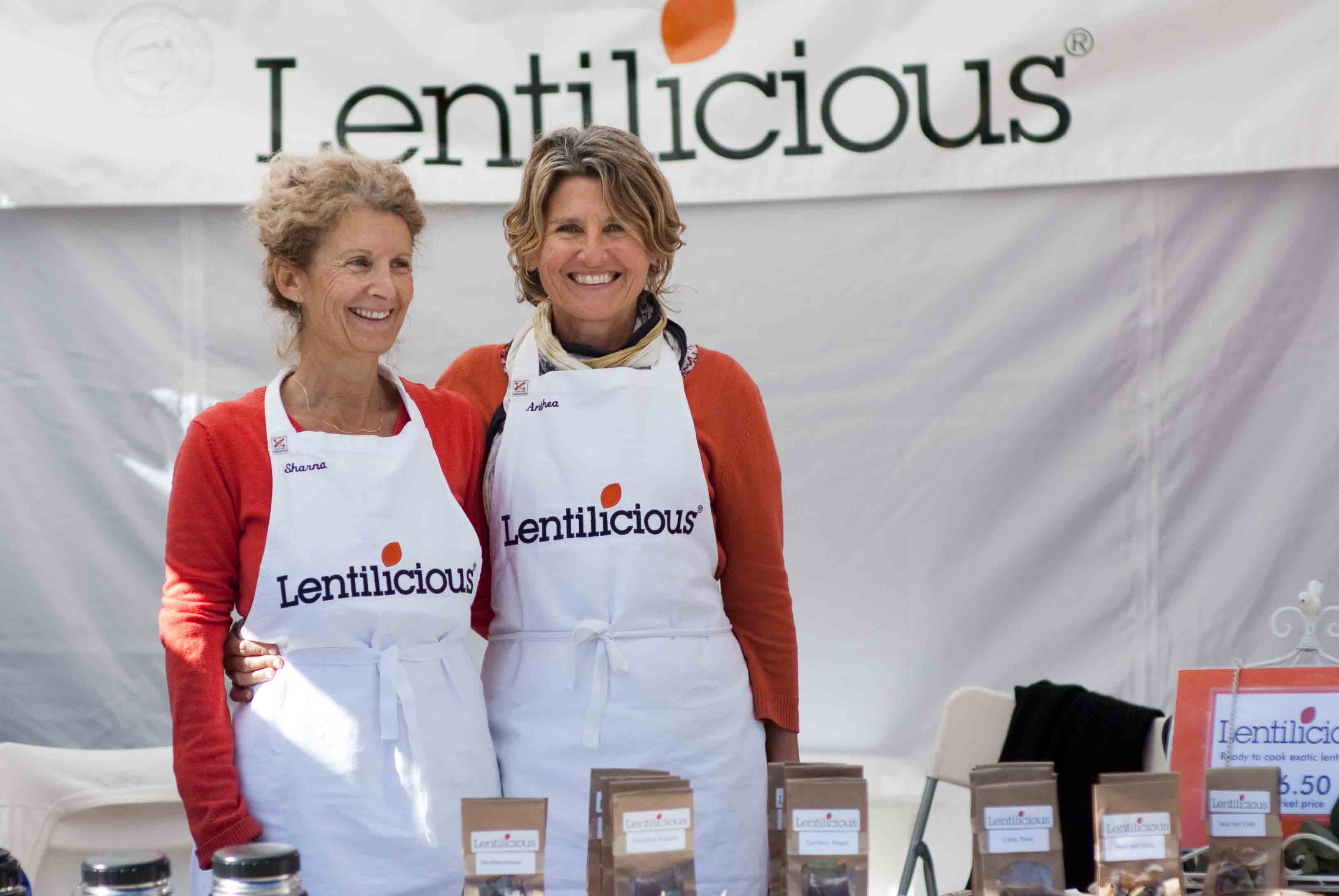
hello belly lovers, I am still waiting for some recipes and info to come in to finish this show post, but meantime here’s a lovely pic of the Lentilicious girls and one of their recipes.  To find info about the inaugural Northern Rivers Food Celebration go to http://www.lismoreshow.org.au/

Or to last Monday’s post

Sharna and Anthea

CORN AND LIME FRITTERS

1 packet Lime Time Lentil Mix

1 1/2 cups wholemeal plain flour

1 teaspoon baking powder

1 cup corn kernels (about 1 cob)

1 tablespoon chopped fresh coriander

1/2 cup milk

2 tablespoons sunflower oil or ghee

1. Cook Lentilicious mix following packet instructions, allow to cool.

2. Sift flour and baking powder into a bowl, stir in lentil mix, corn and coriander.

Slowly add milk and mix until smooth. Allow to stand for 30 minutes.

3. Heat a little oil or ghee in a large frypan. Add 2 tablespoons batter to pan and cook until bubbles appear on surface.

Turn and cook other side.

* Serve topped for breakfast with eggs and roast tomatoes or make smaller fritters and serve as finger food topped with ricotta and chutney.

Makes 18 fritters

Lentilicious:

PO Box 594 Mullumbimby NSW 2482


www.lentilicious.com.au

belly October 4 – loving and cooking in Italy

Victoria Cosford

For today’s belly radio show sister Tess had a lovely long chat with Victoria Cosford, author, restaurant reviewer, cooking teacher, and food  writer for the Byron Shire Echo,  about her book Amore and Amaretti.  My movie-pitch description of the book is Bridget Jones’s Diary meets Anthony Bourdains Kitchen Confidential under the Tuscan Sun – but with much better recipes and more realistic descriptions of Italy.  It covers a period of over 20 years of visits to central Italy, when Victoria was quickly swept up into cooking in various restaurants and tempestuous  affairs with Italian cooks.  Victoria isn’t 100% sure about my movie pitch description, but she did admit that she has Scarlet Johansen picked out for the lead role.  A very good choice as you can see.

A few snippets :

– we are starting a campaign to get local butchers to cure pig cheeks – “guanciale” in Italian – join in and ask your butcher

– Victoria’s advice on finding good restaurants in Italy : if you are somewhere where you have eaten well, ask the waiters where they eat.  In Perugia, just go to ‘Vecchia Perugia’, and tell them ‘la Veeky’ sent you

– the recipes in her book look like good home cooking because that was the specialty in most of the restaurants where Victoria worked, apart from the odd ‘amburger’, so they are well and truly tried and tested

– if you like the sardine recipe, try the same or a similar crumb mix on opened mussels and bake

Victoria shared a sardine recipe from her book (see below), on the grounds that it is extremely popular with friends so there must be something to it.  Of course sardines are also very good for you and a good sustainable fish.  Victoria was also today’s guest for the fresh report, some favourite veg at the moment are spinach and silverbeet – do as Italians do, and make the most of the delicate white stems of silverbeet, great steamed with a light dressing or pan cooked or baked  with plenty of cream and parmesan.  Just like asparagus, also in season.  And I love Victoria’s way with artichokes.  She trims and slices them, and sautes them in olive oil with chopped onions and garlic, then adds risotto rice and keeps going with a normal plain risotto recipe.  but we both agree that it is hard to find good artichokes around here, let us know if you know of good sources.  I’ve also just found a good info source for seafood in season on the Sydney Fish Market site.  One of our favourite fish, Spanish mackerel, which can be expensive in Australia, is at peak availability in October.  See here for more information.  We have several mackerel recipes on belly, I fell in love with this fish in the U.K.  (Yes I know, normal people fall for the culture, the green green hills…).   I certainly did not fall for its pretty face though.

BELLY BULLETIN

Lots of foodie events coming up, so today’s bulletin is a bit of a what’s on, including more lovelorn women tasting their way around Italy.

Byron Bay Writers Festival are putting on a special  premiere of Eat Pray Love with a  screening at the Dendy Byron Bay cinema this  Wednesday, 6 October. Elizabeth Gilbert’s Eat Pray Love was a publishing phenomenon, as the cliche goes, the story of a woman’s           quest to travel the world and rediscover herself. Mainly by going to beautiful places and making love to beautiful men in the movie version. Julia Roberts is in the lead role and the ‘eat’ part is set in Italy of course. According to reviews the food is beautiful too. Bookings advised.  At Dendy box office or phone 6680 8555.
There will be Champagne which I suspect means lovely Aussie bubbles as we are still being very free with that word ‘champagne’ decades after our winemakers have stopped using it for our sparkling wine,  and a theatre snack from 6pm, screening at 7pm and you get to meet Candida Baker the new writers festival director.
The 200th Octoberfest has just finished in Munich Bavaria, because of course it starts in september, but this saturday 9 October you can do octoberfest at the  Lismore Workers Club
For more information  Contact Lismore Workers Club
you get a 2 course German Oktoberfest Dinner * Fun German Entertainment * German Games & Competitions AUTHENTIC GERMAN BEER. In Munich someone was testing odour eating bacteria, because the event is now smoke free and they need to find new ways to get rid of the smell of sweat and stale beer that used to be covered up by cigarettes, but Octoberfest does last 2 weeks in Germany and attracts millions of people – probably better off with the Lismore version.
If you live in the Nimbin area, there is a Local Food Self Reliance Slide Show
on Thursday 14 October from 7.30pm at the Tuntable Falls Community Hall
Bookings are essential. For more information and to make bookings please contact the Nimbin Food Security Project Manager on (02) 6689 1692
They have received $50 000 funding through Northern Rivers Food Links for a village Showcase Project. International community development facilitator and trainer Robina McCurdy will show  projects from around the world and help identify new ways that the Nimbin Community can work towards local food self reliance.
In a couple of weeks , on 21st to 23rd october there will be a Northern Rivers Food Celebration at the Lismore Showground.
Over three days, visitors can enjoy local  produce, meet the growers and producers, and discover the great biodiversity of the region from macadamias, to tropical fruits, chocolate, coffee, organic meats, biodynamic muesli, fruit and vegetables, artisan breads, and cheese.The Food Celebration will be the largest regional show in Australia, and include a Sustainable Living Expo.
There will be demonstrations by local chefs, and schools will participate in a competition,  cooking exclusively with local produce.
To book a site phone Leanne Clark on (02) 6621 3413
New Brighton Farmers Market will be staging a bake-off as part of the Sydney International Food Festival -this year they have encouraged Farmers Market and regional NSW involvement .
Get creative using market produce. Go to the market on Tuesday, October 5, 8-9.30am and purchase specified surprise seasonal products to create either a sweet or savoury dish.  Entry is free, one entry per person.
Take your creation to the market the following Tuesday, October 12, for display and judging, 8-8.30am.  Prize presentation at 10am.
There will be both chefs’ prizes judged by Manfred Rudolf from the ‘Yum Yum Tree Café’ New Brighton and Steve Tuckwell from ‘Contis’, Brunswick Heads and a peoples choice prize judged by a small panel of market regulars, all prizes are NBFM vouchers.
Enquiries and entry registration : 6677 1956 [ah] Tony Hinds
UPDATE – bake-off at New Brighton has been cancelled due to a lack of bake-offers, but will happen at the Mullumbimby Farmers Market (on every Friday morning).  You will find the Mullumbimby details if you click on the New Brighton link above.

SARDE AL BECCAFICO – Baked Stuffed Sardines


2 slices day-old rustic bread
2 tablespoons sultanas

Australian sardines

2 tablespoons pine nuts
80 – 100 grams mortadella, as finely chopped as possible
(optional)[ndsis – you can use any cured pig bits or no pig,
but Victoria loves the unctuousness of mortadella]
2 tablespoons grana or parmesan, freshly grated
Grated rind 1 lemon
2 fat cloves garlic, finely chopped
2/3 bunch parsley, finely chopped
Salt and pepper
750 grams fresh sardines, filleted and butterflied
Bay leaves
White wine
Olive oil
Milk
Preheat oven to 200 C. Soak bread in milk briefly, then squeeze dry. Place in a bowl together with sultanas, pine nuts, mortadella, cheese, lemon rind, garlic and parsley, season with salt and pepper and combine well. Place about a teaspoon of mixture in the middle of each sardine and arrange on baking tray with  a bay leaf between each. Sprinkle wine over the top and drizzle with olive oil. Bake for 10 to 15 minutes. Serve as part of an antipasto.
This is a recipe from Victoria Cosford’s book ‘Amore and Amaretti’ – Wakefield Press 2010
available at Mary Ryan’s ABC Shop and Collins Books (used to be Book City) both in Byron Bay
EDIBLE QUOTES
We love a good food quote on belly and Amore and Amaretti is bristling with fabulous Italian sayings.
My fave:
“cio’ che si mangia con gusto non fa mai male “- whatever you eat with pleasure can never make you ill – which is basically my whole eating philosophy.  Victoria’s is the much darker:
“non c’e’ amore senza amaro” – there is no love without bitterness
And speaking of amaro, the Italian for bitter, I love amaretti, Italian biscuits which literally mean ‘little bitter ones’, used a lot as ingredients – and I was looking forwards to amaretti recipes in “Amore and Amaretti”, but Vic says the title came from her publisher, and she doesn’t really like amaretti much – though she advises you to try pumpkin and amaretti ravioli.  So look forwards to a big amaretti rave from me soon on belly, first I need to experiment with one of the weirdest recipes I’ve ever seen, chocolate, amaretti, ricotta and eggplant cake.  And a few hours after first seeing that peculiar recipe from the Naples region, I ate a similar chocolate eggplant dish from a new Byron restaurant – oddly compelling, but no amaretti.
Sister T

belly show 20.09.2010 : eat me – food writing at the 2010 Byron Bay Writers Festival

bucolic brain food at the writers festival

This was a special belly dedicated to a session on food writing at the Byron Bay Writers Festival.  The session was called “Eat me : writing food glorious food” – chaired by Joanna Savill, with authors Victoria Cosford ,Luke Nguyen, and Ramona Koval.

Giorgio Conte – Cannelloni

Joanna Savill

Joanna Savill is inaugural director of the Sydney International Food Festival. She presented one of the best ever food series on Australian TV – The Food Lovers’ Guide to Australia  – and she is co-editor of the Sydney Morning Herald Good Food Guide. She also writes for many newspapers and magazines on food and hosts events like the Melbourne Food and Wine Festival and a Taste of Slow.  And she laughs – a lot.  At least during this session, which was full of funny stories about childhood and families.  Audio of this and other sessions is being uploaded to the Byron Bay Writers Festival site.

All their books sound great, full of stories and a lot more than basic recipes.
Victoria Cosford :

Amore and Amaretti, Wakefield Press
a memoir of cooking and loving in Italy.

“Amore and Amaretti is a little different from the usual tale of people who travel aboard to find love and a      farmhouse that needs renovating in Tuscany or some other beautiful part of the world. For starters, it has great       descriptions of restaurant life and the dishes Cosford experiences – so enticingly described that you can           almost  taste them.”
Christine Salins  www.foodwinetravel.com.au

Ramona Koval
:

Jewish Cooking Jewish Cooks

Published by New Holland

“Jewish Cooking Jewish Cooks is a collection of delicious, well loved, tried and true Jewish recipes from around the world            particularly Europe. It is also a collection of stories – all of which revolve, like much of Jewish life and tradition, around the subject of food.

From the most simple to the most celebratory of Jewish dishes, Ramona Koval presents a thriving, contemporary food culture founded on ancient tradition and laws that stretches beyond centuries and continents. Recipes range from latkes to lox, borscht, blintzes,  and kugel to cabbage rolls, and compote as well as many vegetarian dishes.”
http://www.jewishaustralia.com/jewishcooking.htm

Luke Nguyen :
Secrets Of The Red Lantern: Stories And Vietnamese Recipes From The Heart
by Mark Jensen, Pauline Nguyen and Luke Nguyen

“If this book may be classified as a food memoir, it also rises above genre by virtue of the elegant prose used to relate the moving story, as well as through the recipes that feel part of the creators’ hearts.  Either aspect of the book can stand alone: the saga of this family is compelling reading on its own, and the recipes (more than 275 of them) are all enticing. ”
Diana Farrell Serbe, here

The Songs of Sapa by  Luke Nguyen,  Murdoch Books

“As with many food tomes these days, this as much a travel book as a cookbook, each destination evoked by the dishes of the region…full of warmth and enthusiasm for the people, the food and the places. There’s also the occasional toe-curling account of experiences like swallowing whole a still-beating snake heart…”
Kerry Boyne, http://www.eatstreets.com.au/articles/book_reviews/the_songs_of_sapa

Thanks to the northern rivers writers centre for bringing all wonderful writers to town and allowing belly to record this session – thanks to sound guy Phil from SCU for his assistance – and if you’d like some more Monday 4 October Victoria Cosford is coming on belly with me to talk Italian food.  And thanks to Marina and Lesley at Red Ginger for the abacus won by lucky subscriber Jenny.

And to finish all those great stories about food and families, a refreshingly sour EDIBLE QUOTE by the wonderful American food writer M.F.K. Fisher, from ‘An alphabet of gourmets’.

“F is for family…

The cold truth is that family dinners are more often than not an ordeal of nervous indigestion, preceded by hidden resentment and ennui and accompanied by psychosomatic jitters.”

But hei, even that would make a good story.  If you have a good (or bad) food story to tell, get in touch with the bellysisters.  You don’t have to have written a book or a blog, but if you have, especially if it is something not for mainstream publication, we’d love to hear your stories and share your flavours with the bayfm listeners.
Sister Tess

Apricot Rail – Pouring milk out the window

d.i.g. – Hot cakes

belly 6 September 2010 – springing into asparagus, TV chefs and happy pets

From today I will try taking the radio show posts straight from the show running sheet, so you can see something closer to what went to air.

It’s the  first belly of spring, also the first belly of the month when we usually have a look at what’s in season around Oz,then today’s guest  tells us all about allergies and elimination diets you can try in order to diagnose allergy – no not for you, for your cat,dog,cow,canary,chook,ferret – Matt the Vet will discuss the food allergies that your beloved companion animals may have,  + food news, and a great recipe from Luke Nguyen’s new cookbook

[the belly cat has decided to sit on the laptop to supervise this one, and the belly dog on my feet-screen getting very hairy]

Cheeseburger in Paradise by Jimmy Buffett

DRAW for our lovely subscribers – Lentilicious 2 packs of lentil mixes(thanks Sharna and Anthea)

Right now there are so many TV food shows, so many, old ones dug up, and from all over the world – well mostly the UK but I saw one from New Zealand last week,had a very pretty lake view in it. And Kids Masterchef is starting next Sunday – Anyone with kids knows it should be really fun to watch, they are so passionate about food. One of the best is ‘cheese slices’ which reflects the cheesy obsession of Will Studd, cheese providore to many of Australia’s best restaurants and Qantas business and first class. One of my cheese spies – we’ll call him “deep cheddar” – tells me Will gave the program to the ABC very very cheap, just to improve our cheese knowledge presumably. A true cheese evangelist. And more importantly, Will has bought into our North Coast paradise, so hopefully there will soon be even more wonderful cheese all around us. Cheese slices is on ABC1 on Wednesdays. And Luke Nguyen’s Vietnamese food show has come back very quickly to SBS, so have a look if you missed it first time round. I’ve got  Luke’s recipe – caramelised mackerel with pineapple to share with you.

CARAMELISED MACKEREL WITH PINEAPPLE – KA THU KO KHOM

This recipe is a marriage of many different elements, balanced together
perfectly. It is a lighter version of the popular traditional dish of caramelised fish,
ca kho. I have balanced the salt with the pineapple, the fish sauce with sugar and added
dark soy sauce for colour. If you don’t often use pineapple in cooking, give this a try; you’ll
be pleasantly surprised.
When using a clay pot for the first time, make sure you immerse it in cold water for a few
hours. This will ensure that it does not crack over intense heat. Clay pots release earthy,
smoky flavours into your food and they maintain their heat well.

2 garlic cloves, finely chopped
4 spring onions (scallions), white
part only, bruised
2 tablespoons fish sauce
1/4 teaspoon dark soy sauce
1 teaspoon oyster sauce
2 tablespoons sugar
3 mackerel cutlets (600 g/1 lb
5 oz in total)
2 tablespoons vegetable oil
300 g (101/2 oz) pineapple, cut into
bite-sized pieces
200 ml (7 fl oz) chicken stock
(page 328)
1 tablespoon fried garlic
(page 329)
1 tablespoon garlic oil (page 329)
2 spring onions (scallions), green
part only, sliced
1 small handful coriander (cilantro)
leaves
1 bird’s eye chilli, finely chopped
1 Lebanese (short) cucumber,
sliced

In a bowl, combine half the garlic, the white spring onion, the fish sauce,
dark soy sauce, oyster sauce, sugar and 1/2 teaspoon salt. Coat the fish with
the mixture, then cover and place in the fridge to marinate for 15 minutes,
reserving any leftover marinade.
Place a frying pan over medium heat with 1 tablespoon of the vegetable
oil. Add the pineapple and stir-fry for 1 minute, then remove from the pan
and set aside. Add the remaining oil and heat over medium heat, then
brown the fish cutlets on both sides.
Remove the pan from the heat and transfer the fish to a chopping board.
Chop each fish cutlet into four pieces with a heavy cleaver. Transfer the fish
and pineapple to a clay pot and pour in the reserved marinade. Place the
clay pot on the stovetop, turn the heat to high and bring to the boil. Add
the chicken stock and bring back to the boil, skimming any impurities off
the surface. Reduce the heat to low and simmer for 20 minutes, or until the
liquid has reduced by half.
Add the remaining chopped garlic to the pot along with the fried garlic,
garlic oil and 1/2 teaspoon freshly ground black pepper, and stir to combine.
Spoon the sauce over the fish. Remove the clay pot from the heat, garnish
with the spring onion, coriander and chilli, and serve with a side bowl of
cucumber and jasmine rice.

serves 4–6 as part of a shared meal

Caramelised Mackerel with Pineapple

Recipe and image from The Songs of Sapa by Luke Nguyen, published by
Murdoch Books, photography by Alan Benson.

I played the belly interview with Luke  last week, and the last few minutes this week, where he suggests using any firm fish as substitute for the mackerel.  If you don’t have a clay pot, I think you can try using any deep heavy bottomed pot.  Also maybe just add more fresh garlic to the recipe if you don’t have a big bottle of garlic oil handy. The crispy (but not burned) fried garlic would definitely add lovely texture to the dish.  And make sure you use beautiful ripe fresh local pineapple.
Luke and his partner/photographer Susanna Boyd also mentioned the Little Lantern foundation they are setting up to help kids in Vietnam.

And straight on to the watermelon man and what’s in season in Oz in September.

Asparagus – in season from now to December, some Australian growers go til march.  The season a bit slow this year. It has been cold,wet where most asparagus is grown, a lot comes all the way from Peru right now. According to the Australian Asparagus Council, 93% comes from around a small town called Koo Wee Rup, S-E of Melbourne. Yes there is an Australian  Asparagus Council, the website is asparagus.com.au, lots of facts and recipes, though a lot of their recipes look a bit dodgy. Asparagus is very easy and quick to prepare, it is the shoot of a feathery plant in the lily family. The Roman Emperor Augustus had a saying “faster than cooking asparagus ” for doing something very very fast. The worst thing you can do is boil the hell out of it, but you can bbq it or put it with rich flavours like eggs and cheese, baked in the oven, or use in cold or hot soups, usually reserving the tips to add whole at the end. Or stir fry or very quickly steam. The ancients thought it is so good for you that it deserves ‘officinalis’ in its name, meaning medicinal. It does have a lot of folate, vitamins b and c and anti-oxidants. Unfortunately it doesn’t grow easily around here. I’ve tried in the veggie patch and mine gave a few spears then went to asparagus heaven. I’ve now found out that you shouldn’t pick every spear that pokes up, just the first few from now to November, maybe December, then let the plant form leaves and grow strong, especially the first couple of years.
– some other veg and fruit : artichokes, choose heavy and not wilted looking, they are the flower bud of a big thistle, you don’t want to eat wilted buds.
avocados – one more recipe, from farmer Chris Casagrande in the Byron Shire Echo : a chocolate dip for bananas, to freeze or use as cake icing. Mash avocados with cocoa and a little lemon – he swears it’s great.  Also broad beans, young garlic, spring cabbages,lots of greens, pinapple,lots of citruses including blood oranges and cumquats. locally I’ve seen good rhubarb, papayas,lots of strawberries, new season pecans and rice.

Grapefruit,juicy fruit by Jimmy Buffett

The Meat Lovers song from Dr Siggy, aka Greetings from Switzerland

– Matt Allworth aka Matt the Vet gave us some great information about food allergies in pets and elimination diets we can try at home if our favourite animals start to have symptoms like itchy feet, intestinal disturbances or rashes.  Some of the most common allergens are beef for dogs and fish for cats. Vegetarian animals can also develop allergies.  Oh and we discovered that it’s a bad idea to try to turn your ferret into a vegetarian.  For lots more info see http://communityvet.net/2010/03/diy-elimination-diet-for-the-dog-an-cat/

And Matt was a great barrel girl

Lena Horne – I want a little doggie

The BELLY BULLETIN

Imitation is the sincerest form of flattery – enterprising Chinese have been making fake Australian wine, from small Boutique labels to Penfolds. Investigators have found wine labelled Benfolds, or Penfolds bin 888, which is a lucky number in China. The copies have very similar bottles and labels to the originals. China is Australia’s fastest growing export wine market.
And global champagne sales have risen by about 40% in the first half of this year, so you can stop worrying about those poor champagne makers who were doing it tough in the GFC. And the bonuses that are again flowing into the pockets of investment bankers are obviously being put to good use.
In local news, Tweed tourism have just launched a seafood discovery tour, that you can download or pick up at a tourism office, and follow your fishy way from Cabarita to Corrumbin. Restaurants, fish shops, picnic spots,oyster farms and even crab catching tours.
seafooddiscoverytrail.com
Or go to sustainfood.com.au for lots of local food stories and links, including right now an initiative you can join called the Grow your own food challenge, which over 12 weeks encourages as many people as possible to register the amount of garden space they are devoting to food production. At the same time gardening expert Phil Dudman will give a week by week guide to establishing your own food garden. The challenge has already started, but you can join at any time, and there are already gardening videos online.
And congratulations to The Byron Beach Cafe which has won “Best Tourism Restaurant & Catering Service” at the inaugural North
Coast Tourism Awards

EDIBLE QUOTE – As for butter versus margarine, I trust cows more than chemists.  Joan Gussow

Seaman Dan – Follow the sun

Love and chocolate cake, sister T

bellysisters at the farmers market

hi, if you’d like to chat to a live bellysister, sister T will be collecting subscriptions with a lot of other bayfmrs at tomorrow’s Byron Bay farmers market  – you can have a live fresh report with each subscription (not singing the watermelon song though).  And sister Rasela is  there talking good rrrraw foods.  Other bayfmrs will be at most of the local weekend markets and farmers markets until the end of the month.

So get thee to a market, bellysister!

16 August 2010 – e-books,love and polenta

A pretty crazy show on day one of our major subscriber drive aka radiothon.  Sister T was answering phones for the previous show, Andrew Davie’s luscious Lighthouse Lounge, chatting up subscribers, and she ain’t a morning girl (why do you think we’re sponsored by a coffee company?)  Sister B had been to the gim for the first time in a loooong time and looked like she had been run over by a cement mixer.  And our lovely guest, presenter Karin Kolbe from Bayfm’s ‘the spin cycle’, is learning to surf.

She had all the glory ot standing up and all the pain of a solid fall in a few short seconds, and turned up full of painkillers.  But also full of beans, great info on her and TOOT’s (Train on our Tracks) campaign to bring back train transport, which would also make our food more sustainable.  And on where e-publishing,  is going, as she is a publisher and ‘internetty person’.  We look forwards ot electronic cookbooks with a stack of extra features as soon as publishers and authors get more creative.  And she shared her favourite, tried and tested cake recipe, from a tattered exercise book – with alphabetical tabs though, obviously an organised woman.

POLENTA AND YOGHURT CAKE

Ingredients :

300 g. plain yoghurt

100 g. polenta

grated rind of 1 orange

125 g. softened,chopped unsalted butter

220 g. caster sugar

3 eggs

200 g. self raising flour

½ tsp bicarbonate of soda

85 g. chopped raisins

80 g pine nuts [or try macadamias in our area – n.d.sr.T]

citrus syrup :

1 lemon and 1 orange (preferably organic)

200 g. caster sugar

30 mL Cointreau (more is more, says Karin)

and cream to serve!

KK says that this cake is magic because first off you put the yoghurt and polenta and grated rind together to chat for an hour in a bowl.

Heat oven to 180C.

Toast nuts well in a little olive oil in a pan on low heat, it makes them come alive, but careful not to let them burn.

Cream butter and sugar until light and fluffy, then add the eggs one at a time, beating well. Sift together the flour and bicarbonate and fold gently into the butter mixture. Toss the raisins in a tbs of flour. Add yoghurt/polenta mix to batter, fold in nuts and raisins.

Butter and flour a 2 litre/21 cm kugelhopf (holey) cake mould. Pour in cake batter and cook 30-45 minutes, until a skewer comes out clean.

While the cake cooks, make the citrus syrup.

Make small threads of zest from the orange and lemon and juice them. Put all ingredients except Cointreau in a saucepan, bring to the boil, lower heat and reduce volume by half. Turn off heat and add Cointreau.

To assemble, turn cake onto a rack for 10 minutes, then slide onto a plate and and pour hot syrup on top. Serve with cream.

Don't you love those spattered old recipe collections? Instead of star ratings they have spatter & scribble ratings


WHAT’S ON

for farmer’s and weekend markets please go to our markets page, but here’s a couple of other local events:

Organic farm share meetings – remember the people from herdshare, who were in the news a while ago with their scheme to own a bit of a cow so you can have your own organic, maybe even raw, milk – now calling themselves farm share

info meetings

NORTHERN NSW

Murwillumbah – Mon Aug 16, 7pm to 8:30pm

South Golden Beach – Fri Aug 20, 1pm to 2:30pm

Broken Head – Fri Aug 20, 6pm to 7:30pm

more info on website – http://organicfarmshare.com

BARISTA COURSE
TUESDAY 17th OF AUGUST
4.00PM TO 7.00PM
$75
call the Byron Youth Service – 6685 7777

Thanks again to everyone who subscribed to Bayfm today – we are getting together a few tasty bits and pieces for a post radiothon draw for belly supporters, and anyone listening on the first show after radiothon.  Also while you call in, tell the volunteer answering the phone if you’d like to go on the belly listeners page that we are assembling, leave an email address and the sisters will get in touch.

To go in the big prize draw you need to call (02) 6680 7999 by the morning of 29 August 2010.

Details on bayfm site.


LOVE FOOD

whole and split nutmeg

In honour of the ‘love your radio’ fortnight we are talking love foods for 2 weeks – keeping it seasonal for the Australian winter, unlike the summery Valentine Day recipes – and we wanted to change a bit from the constant oysters, strawberries and chocolate that our lovers serve us up.  Did you know you can make sexy pumpkin soup?   Just add freshly grated nutmeg at the beginning of cooking.  Nutmeg was considered an aphrodisiac by the Arabs and the Chinese.  Apparently you can also rub nutmeg oil on the genitals to ‘excite sexual passion’, but you might just give yourself a nasty rash.  I put a few drops of mace (the covering of the nutmeg ) essential oil in the bath a few years ago and had to get out very quickly.


Byron Bay writers festival report, flatmates, Rob’s olives

A new bellysister joined Sister Tess for this belly show, the lovely Sister Robert.  Sister Rob came to Byron from Sydney for the 2010 Byron Writers Festival.  He went to several foodie events at the Festival, including a workshop by Vietnamese Australian chef Luke Nguyen and local writer Victoria Cosford’s launch of her first book, “Amore and Amaretti”.  As well as several non-food related events, just for balance.  Sisters T and R agree that the foodies were by far the most charming and best behaved people at the Writers Festival.  Victoria’s launch was packed and very lively, there were tears, wine and delicious food, and a heartfelt introduction by Joanna Savill. Joanna and Victoria studied Italian together in Canberra, and Joanna  first invited Victoria to join her in Bologna (and then tried unsuccessfully to stop Victoria from smiling back at the hordes of men who followed her around).  Victoria read delicious extracts from her book, we played a snippet from her visit to Enoteca Pinchiorri in Florence.  The audience was in pain, you could hear the sighs.  Luke Nguyen is a very charming man.  One chairperson’s researcher summed him up as “cook, Vietnam, good guy”.

In contrast, Brett Eason Ellis decided to be a very naughty boy at his first ever writers festival.  Ramona Koval from the ABC reminded us that she has 3 grandkids and she doesn’t believe in letting naughty boys play too many silly games.  It sounds like he was just after the Australian holiday.  And Gretel Pinniger aka Madam Lash made photographers happy by pretending to burn her biography, and looking ready to eat her biographer – not in a good way.  And various panellists were talking as usual about climate change, population and other environmental concerns, sounding desperate enough in the leadup to this Australian federal election to incite revolution. Or “a social tipping point”.  Or at least a vote for the Greens, or anyone game enough to whisper that we need to change from a growth model to a steady state one.  Look it up, to some of us belly sisters it sounds like the last chance to stop the veggie patch from going underwater.  Meantime, the sun shone on the whole festival and it was easy to revel in the beauty of the North Beach site and all the wonderful brain food.  There were even a few more panellists discussing their topics rather than just plugging their books, or we were just lucky to pick panels with good chairpeople.
Meantime, back in the kitchen, Luke’s cooking workshop was very interesting and hands on. It was great to find out that we can get most of the ingredients for Vietnamese food locally.  And who knew that soft shell crab is available frozen at the fish shop?  A few good tips :

Use a dusting of potato starch for deep frying for a light crunchy texture
Use a chopstick to check oil temperature (lots of bubbles=hot)
Less is more – food will keep cooking after you take it out
Buy the best, light, first press fish sauce you can find
Rice paper rolls – don’t leave them in water to soften, just a quick dip is enough
Don’t overfill
And – lots of herbs is barely enough!

Sister Rob did our first ever cookbook review, of Luke’s “The songs of Sapa”, even after hearing local writer Alan Close take to task reviewer Rosemarie Sorensen for a negative review 19 years ago!  Rob says he sometimes forgets to actually read recipe books rather than just focus on the recipes,
·    Luke’s book also offers insights into Vietnamese culture e.g his father’s story from fighting in the war.
·    The recipes are good although some ingredients may be hard to find.

Some of Luke Nguyen’s recipes are online, see here

Sister Tess did an interview with Luke and his partner/photographer, Susanna Boyd, and recorded several sessions of the festival, so listen up to belly for more – and remember our major subscriber drive/radiothon is starting, subscribe online here.  Most of us bring you great radio for free, but the gear and rent have to be paid, so please help if you can.  You can even nominate your favourite show (hint?)

Sister Rob was lucky enough to have a mother who was a skilful and enthusiastic cook.  He was asked to bring his favourite cookbook on belly, and he turned up with a very well used (trashed!)
scrapbook of recipes, the oldest were handwritten 70s gems from his mum (aww).  Like many of us, Sisters T and R both discovered that not everybody knows what good food tastes like, let alone how it is made, when they had…..(horror music)…. flatmates!   A chance to share war stories : Rob’s most memorable was hearing a squeak, opening the crumb tray under the toaster and finding a dead mouse.  Sister T’s was the special occasion roast chook a flatmete splurged on – but she didn’t know that you take the chicken out of the plastic bag before you put it in the oven.  We’d love to share your best stories on air if you comment on this post, or email us
belly@belly.net.au

Rob also made the best ever pickled olives – yes starting from raw olives – get in touch if you know where to get some in the Northern Rivers.

SISTER ROBERT’S HOME PICKLED OLIVES

On a recent visit to sister R, sister T had the pleasure of tasting the best home pickled olives ever.  Sister R has helped friends harvest olives both out in the country and in central Sydney, of all places, so he’s learned how to get them from bitter little fruits to delicious, long lasting snacks.  This is a traditional home skill of Australians of Mediterranean descent, but somehow very Anglo sister Rob does a better job!  He also focused on methods that use the mildest possible ingredients to remove the olive bitterness.  And if you want to just remove excessive saltyness from shop-bought olives, or just improve their taste and keep them longer, jump straight to the oil steps.

“Well there are many, many methods for pickling olives but here I give the two methods that have worked well for me loosely based on my friend Paul’s [see buthkuddeh link below] method:


Method 1
– Good for green and for black firm olives

1.2. Give each olive a small slit with a sharp knife or bash with the bottom of a bottle to break the skin only
2. Soak olives in plain water changing the water fully each day.  You need to do this long enough for the strong acid flavour to leach out. Taste an olive and see how bitter it is. Think about an olive you have liked and what degree of bitterness or otherwise it had. When the olives taste ok move to the next stage.
3.  Prepare brine solution by placing a fresh egg into a bucket with water and keep adding salt and stirring it in slowly until the egg floats to the surface and shows a circle of shell about the size of a five cent coin.
4. Soak the olives in the brine until the olives taste salty enough for you. Don’t change the brine solution until you are happy with the level of saltiness of the olive. Give the olives a bit of a tumble each day.  Do not forget them in the brine otherwise they will undergo cellular collapse and go soft.
5. When they are ready for bottling, drain them and wash them to get excess brine off.
6. Sterilise some old bottles or preserving jars. Pop the olives in. As you do you can add whatever flavourings you like – thinly sliced garlic is always welcome, as is crushed dried oregano, or a split red chilli, , Sage and thyme go well, peppercorns too.   Fill the jar with a good quality olive oil. Don’t fill it with brine like I did once as the olives will have that cellular collapse you don’t want. Leave them in the pickling oil for at least 3 -4 weeks before eating.

Method 2 – To end up with dry salted black olives only

1.Again, start with nice firm olives, but make these ones also nice and plump.
2. Get a white plastic bucket with tight fitting lid and make holes in the bottom and the lid.
3. Put a layer of salt on the bottom of the box.  Toss the olives on top – don’t slit them.  Cover with another thick layer of salt and repeat the process.
6.Leave untouched for three or four days. Then, each day, mix the olives and salt together by turning the bucket over.
7. What should happen is that the salt will get wetter and go a nice mauve colour as it drains the moisture out of the olive.
8. As the moisture drains out, and put some new salt in and mix it with the olives.
9. When the olives have shriveled up and are nice and salty (check those olives!), take them out of the salt, wash them, dry them and store them in an airtight container in a little oil just coating the olives. You can at this stage put in some finely chopped garlic, crushed oregano, and maybe some chili flakes.
Websites for further research:
www.buthkuddeh.com.au (look for ‘olives’ under recipe link)
www.sbs.com.au/food (search on olives and Steve Manfredi)
www.abc.net.au (Gardening Australia factsheet on olives)

EDIBLE QUOTE

Today’s came from Luke Nguyen’s cookbook  The Songs of Sapa, which has lots of traditional Vietnames sayings and their meanings scattered among the recipes.

When drinking water, remember where it flowed from; when eating fruit, remember who planted the tree.

In life, always be thankful for how you got there, and remember who helped you get there.

July 19 radio show: tasting the Byron Bay Writers Festival

Today Srs T and B were having such a good time talking with the Director of the Byron Bay Writers Festival and the Northern Rivers Writer Centre, Jeni Caffin, that we ended up spending most of the show with her.  It turns out that the whole staff of the NRWC (about 4 people who work enough for 20) are completely food obsessed – that explains all the great food events at the festival.  And the way they make sure the many volunteers get tasty and healthy food on their shifts.  And Jeni’s 19 year old cat wears a small tea cosy as a hat right through winter – who knew?
The 2010 Festival will include breakfasts lunches and dinners with writers, a cooking workshop with the Red Lantern’s Luke Nguyen, a book launch by popular local food writer Victoria Cosford, and plenty of sessions that touch on food, especially “Eat me: writing food, glorious food” on the Saturday.  Jeni’s advice is  to look out for these authors : Monica Trapaga, Ramona Koval, Luke Nguyen, Victoria Cosford, Juanita Phillips, Joanna Savill and Simon Marnie.
Go to the Festival site for author biographies and details of all the events.
And of course here’s the eggplant tart – a tartless tart, well tested by everyone at the writers centre, guaranteed to work and be delicious.

Jeni's glamorous cat, Perfect Tiger, recommends wearing a stylish tea cosy in winter

EGGPLANT TART


For a round tart made in a dish about 8 inches across and about 2 inches
deep you will need approximately:
3 medium eggplant;
2-3 large brown onions;
a little balsamic vinegar and sugar to taste to caramelise the onions
a large cup of grated parmesan;
herbs to taste, whatever you like, I use basil and parsley
olive oil with crushed garlic in it, to taste
Cut the stem end off and slice the eggplant in 5mm widths lengthways,
discarding the first skin slice on each side. Brush both sides with garlic oil
Put baking paper or alfoil down and grill each side till lightly golden and
transparent
Cook the onions, balsamic and sugar slowly till caramelised. Lightly grease your tin
Lay the eggplant slices, overlapping to fill gaps,
Put caramelised onion, cheese and herbs mixed in between each layer of eggplant
Press down firmly each layer of eggplant. Last layer should be eggplant slices
Bake in moderate oven for 45 mins, allow to cool down to eating temperature
before putting a plate on top and inverting it.