Author Archives: sister T

vegan & glam with Anthea

On air on Byron Bay’s Bayfm 99.9 community radio on 13 August 2012


Today  Anthea Amore from Organic Passion Catering , Sister Tess, and a cameo appearance by taro fiend Sister Carolyn to launch the 2012 subscriber drive – at least the belly bits – with lots of delicious local ingredients.

Do you have a favourite local ingredient?  Something that gets you excited when it comes in season, something that you cook a million ways or you just chomp into before you even get it home.  Something you grow maybe.  Something you have grown up with or something you have discovered after moving here.  Belly is celebrating local ingredients and the things our rainbow tribes do with them during the celebration of local community radio of the bayfm subscriber drive.  If you call in to subscribe while belly is on air, tell our volunteers what it is (briefly please – lots of extra people come to help out but the lines get very busy).  Or please leave a comment below, or email belly@belly.net.au and we will share your pick with the belly listeners.  Mine are kale, macadamias always, pecans right now, dragonfruit, fabulous organic eggs from the market, the lemon myrtle, kaffir lime, bay tree (well, bush)  & curry leaf plant in the garden that are always ready with flavoursome leaves no matter what I do to them.  And betel leaves for glamorous Thai nibbles,  I killed that a few times but now it is going strong.  Well worth seeking out.


Anthea Amore (I am so jealous that Amore is her real family name) is a very clever, even sneaky vegan/vegetarian caterer and blogger.  Please go to organicpassioncatering.blogspot.com.au

for lots more of her recipes, and details of upcoming events.  She proudly sources all local ingredients, mostly from local markets and stores.  One of the thinks that struck me about her food, especially the canapes,  is how beautiful it is.   Anthea keeps meat eaters in mind when putting menus together – the sneaky bit comes from just not telling people they are eating vegetarian, and often vegan, food until they start telling her how good it is, she says.   I must admit she lost me a bit at the idea of vegan Parmesan though.

I also like the idea of cooking a basic dish that is vegan, and providing non-vegan condiments, like cubes of feta or other cheeses, on the side.  And I look forwards to trying smoked tofu, lots of ideas on her site about using that.


Sister Carolyn, who was in the original hungry sisterhood that set up belly, has been having fun growing (she lives near Nimbin, so plenty of good wet soils) and cooking with taro.  Try adding taro to your next lentil dhal, Carolyn says it makes it much more rich and fat in texture.


CURRIED PARSNIP SOUP RECIPE – by Anthea Amore


Anthea's curried parsnip soup


Makes = 4-6 bowls


I’m always on the look out for an interesting new dish. I’m just not satisfied with the same old flavour combinations year in, year out. This soup came about a few years ago while I was cooking for a local cafe. I had to cook a different soup every single day throughout the winter, quite a challenge, especially when using organic and seasonal produce. I’d start most days staring at the same produce and have to come up with a new soup recipe to interest our regular customers, some of whom ate our soups five days a week! This situation forced me to explore different combinations, produce-wise and herb and spice-wise. Some how this recipe unfolded one cool cosy winter lunchtime and it was a serious hit.

Parsnips whisper winter to me. I didn’t really discover them until I lived in England for a year. On those cold wintry English days and nights, parsnips brought comfort and warmth, like a log fire or thick woollen hat and gloves. One of my favourite parsnip dishes back then was to roast them in the oven, doused with vanilla paste, spicy tabasco sauce, olive oil and salt. I whisked those ingredients in a jar or mug and drizzled it over the diced or wildly cut julienne style lengths, leaving the parsnip tails to curl and crisp up. So good. The spiciness of the tabasco with the sweetness of the cooked parsnips and the woody perfume of the vanilla is such a perfect combination. Yum!

This soup has a depth of flavour and a different trio of flavours going on like the above roasted parsnip recipe. It has the earthy bitter flavours of the curry spices as well as the slight tanginess with the lemon and a neat little bite from the Tabasco. That gives you the trio of bitter, sour and spicy, three of the five main flavours. Parsnips themselves have quite a complex and unique flavour ; cooked parsnips taste sweet and aromatic, and slightly earthy as you would expect from a root vegetable. They have a fragrant flavour that reminds me of parsley or even eucalyptus. And they have a soft texture which is almost creamy when cooked to perfection. The colour of this soup is a bright yellow which is both happy and warming – a soup to cheer up a cold winter’s day. Serve it with warm toasted Turkish bread, with a drizzle of good olive oil.


500gm parsnip, roughly cut

200gm potato, diced

1 medium onion, diced

1 small clove garlic

1 tsp cumin seeds

1 tbs madras curry powder

1 tsp coriander powder

1 dsp good salt or season to your taste

1/2 tsp freshly cracked pepper

juice of a lemon (right at the end)

splash of tabasco *optional

400ml tin coconut milk or cream

1 1/4 litres filtered water


Put your parsnip and diced potato in to boiling water and allow it to cook for 10 minutes. Then add the onions, garlic, curry spices and seeds, and pepper and simmer. Cook until tender and soft. Then remove the soup from the heat, add the coconut milk and blend with a stick blender. You can add more water to thin the soup to your liking (I like my soups thin with a little body but not watery thin). You may need to add a pinch more salt if you do this. Taste, and you will know.

Serve with warm fresh bread or chunky pieces of Turkish or sour dough toast drizzled with olive oil. Yum.

Please note: if you don’t have a stick blender and think about using your normal blender. BE CAREFUL! Heat creates a pressure and can explode the lid off your blender covering you and your kitchen in HOT soup. Try hand mashing instead, much safer.


CUSTARD APPLE AND VANILLA MOUSSE WITH PASSIONFRUIT RECIPE – by Anthea Amore


Anthea's custard apple and vanilla mousse


Makes = 4-6 tumbler glasses


Looking for desserts in winter? They don’t all have to be cooked or warm, especially with some of these milder winter nights up here on the North Coast or even after a heavy cooked meal, something light and sweet can do the trick! This is a little beauty. Simple as, delicious, and uses a couple of the seasonal fruits.

Custard apples are a well-balanced food having protein, fibre, minerals, vitamins, energy and little fat. They are an excellent source of Vitamin C, a good source of dietary fibre, a useful source of Vitamin B6, magnesium and potassium, and with some B2 and complex carbohydrate.


1 cup of soaked cashews (preferably over night)

2 cups custard apple flesh (remove the seeds)

1 vanilla bean, scrape of it seeds

1/4 cup light agave

pinch good salt

1 1/4 cups filtered water

1/4 cup orange or mandarin juice

4-6 passionfruits (one per dessert)

2 tbs psyllium husks


Place the soaked cashews in a blender with the filtered water and blend until creamy. Add the remaining ingredients and whizz until soft and fluffy.

Please note: this dessert is best made just before you want to eat it or an hour before. The custard apple and cashews can tend to brown. But once topped with passionfruit you can’t really tell.


EVENT – ORGANIC LOVERS SOIREE


If you’d like to experience Anthea and Jonathon’s food & wine :

*Organic Passion Catering and The Organic Wine Merchants would like to invite you to a wonderful celebration of organic food and wine. *

*There will be a wonderful selection of gourmet vegetarian canapes and a selection of wine and beer to taste and experience.*

*Where& When? Friday 24th August at the Santos Mullumbimby Balcony (upstairs) *

*Starts: 6:30 – 9:30pm*

*How much? $55pp ~ **Booking essential* www.organicpassioncatering.com* *M: 0422 383 151*

The theme for the night is Vintage Glamour with Kelly Knight (trio) playing vintage jazz with the decor to match! Feel free to dress up and have a bit of fun.  Jonathon will be talking about organic wine.


MUSIC


Julia Rose – Gina

The jukebox joy boys – Do you think I’m pretty

Rebecca Ireland – grandmother

Rebecca Ireland – apples

the lucky wonders – on a night


love & chocolate covered parsnips, sister T


sunshine & soup

Well it just sounds good doesn’t it, sunshine and soup.  And that’s what we had on the first belly of August, with a slightly worn out (post Byron Bay Writers Festival)  Sister T and the wonderful novelist Charlotte Wood in the belly kitchen, talking food writing and a lovely sunny inspiring festival.  We were joined for in season goodness by Miss August, Alison Drover, “wrapped up like a strudel” (many layers).  And yes we talked soup, because the nights are still cold enough to enjoy, in Charlotte’s words, the solace of soup.


Charlotte Wood is the author of several beautiful novels, The Submerged Cathedral, Pieces of a Girl, The Children, & Animal People, & has edited the collection of stories Brothers & Sisters. She is now working on her next novel, but her last book is a collection of essays on food and cooking, and simple recipes, called “Love and Hunger – thoughts on the gift of food”. She has just been a guest on several panels at the 2012 Byron Bay Writers Festival. She was the special guest with the wonderful Gail Jones last Saturday in Byron at a dinner entitled ‘Australian literary treasures’.


Charlotte Wood graciously allowing Sister T to point a phone at her, the morning after a very busy Byron bay Writers Festival


SPICY MUSSEL BISQUE RECIPE – by Charlotte Wood


from “Love & Hunger : Thoughts on the gift of food”, Allen & Unwin 2012


Adapted from Jared Ingersoll’s crab bisque recipe.


Serves 4


1 teaspoon each cumin, caraway and coriander seeds

1/4 teaspoon fenugreek seeds

150 ml vegetable oil

1 & 1/2 large red capsicums, seeded and chopped

4 cloves garlic, squashed

2 ripe tomatoes, chopped

1 stick celery, roughly chopped (It may be worth peeling this first if you can be bothered

1 medium fennel bulb, roughly chopped

1 red onion, chopped

1/3 cup soft brown sugar

Pinch chilli flakes

Salt and pepper

1.5 kg black (or ‘blue’) mussels

1 large glass white wine

600 ml chicken stock ( I use homemade – if you use packaged, omit seasoning the soup until the last minute, if necessary)

1/2 bunch coriander, leaves and stem separated

Crusty bread, to serve

Optional : 2 tablespoons harissa – I love Yalla harissa and keep a pot of it in the freezer for digging into it to add extra kick to all kinds of dishes. If you don’t want this or can’t find it, you could perhaps double the spice mix and chilli at the beginning for some extra kick.


1. Preheat oven to 180 C.

2. Toast the spices in a dry frying pan until fragrant, then grind in a mortar and pestle or spice grinder.

3. Heat a deep roasting tin in the oven or on the stove top and, when hot, add the oil and all the vegetables except coriander leaves.

4. Sprinkle the spices over the vegetables with the sugar, chilli flakes and seasoning, and mix well. Roast in a moderate oven for about 1 hour.

5. Meanwhile, scrub and de-beard the mussels, then place in a covered pan with a big glass of white wine and simmer over a medium heat for about 10 minutes, or until the mussels are opened. Remove them from the pan to cool, reserving the cooking liquid. When the shells are cool enough to handle, remove the meat from the shells and set aside.

6. When the vegetables are soft, smell good and are a little coloured, remove from oven. Transfer the vegetables and the mussel meat into the large bowl of a food processor and puree until smooth – or keep it coarse if you prefer a more rustic texture.

7. In a sizable pot add the stock to the mussel cooking liquid, then add the puree and simmer gently for about 15 minutes.

8. Add the chopped coriander leaves and harissa if using, stir to combine, and serve with crusty bread.


PHARMACY IN A BOWL SOUP RECIPE – by Charlotte Wood


from “Love & Hunger : Thoughts on the gift of food”, Allen & Unwin 2012


Serves 8


Feed this to anyone who has a cold – they will feel better instantly.


Olive oil

5 cloves garlic, finely chopped

1 brown onion, finely chopped

2 small red chillies, finely chopped

1 stick celery, finely chopped

1 leek, finely chopped

1/4 white cabbage, finely chopped

1 red capsicum, roughly chopped

3 carrots, roughly chopped

3 litres chicken or vegetable stock

1 head broccoli, roughly chopped

1 x 400g. can tomatoes

1 cup Puy lentils

Salt and pepper

Grated parmesan, to serve


1. Saute’ the garlic, onion, chilli, celery, leek, cabbage, capsicum and carrots in batches in the oil until well browned.

2. Put the chicken stock in a big pot on the stove and bring to the boil, tossing in all the sauteed ingredients.

3. Add broccoli and tomatoes, and simmer until all vegetables are tender.

4. Reserving stock, remove vegetables with a slotted spoon and puree in a food processor or blender until smooth (or roughly blended, depending on how rustic you like your texture).

5. Return pureed vegetables to stock and add lentils. Simmer for 15-20 minutes or until lentils are tender (more if you want them falling apart). Season well with salt and pepper.

6. Serve with a sprinkle of parmesan.


the Macbelly : authors Wayne Macauley and Mungo MacCallum

On air on Byron Bay’s community radio station, bayfm 99.9 on 30 July 2012


Yes I know I have been a bit slow putting this up for you, but I have been so busy and excited with this, the week of the 2012 Byron Bay Writers Festival, and such interesting books on the crazy world of food featured this year.  I feel like a labrador puppy with 3 tails to wag, surrounded by books and food and people who think and talk and give my brain a healthy little workout.

First up, here’s the interview audio,  but as I say every week as I put more and more on these posts – MORE COMING!


WAYNE’S (DARK AND YES, FUNNY) WORLD


I was just on the phone with Jim Hearn, author of  High Season, who is a local and has agreed to come on belly for an extended chat on August 20.  He is on a panel with Wayne Macauley on Sunday at the festival, called “Cooking your way to salvation”.  Cooking your way to perdition more like, judging by their 2 stories.  Jim’s review of Wayne’s novel “The Cook” is brief :”Fucking awesome book!!”

The Cook is the story of a very young man, Zac, who dreams of becoming a famous chef, with a TV show and the most  successful and exclusive restaurant in the world.  I asked Wayne to read one of the passages where Zac is dreaming of his restaurant, as he works on the veggie patch he is making for a very rich family that has taken him on as a private chef.  It is one of the less bloody versions of his restaurant.


wayne macauley white walls


And here’s the full interview audio.  Wayne talked about ambition and butchery, class in Australia, service and servility, Patrick White and osso buco.


Wayne Macauley with Sister T – audio


IN MUNGO’S KITCHEN


Mungo MacCallum has written book number 8, and it’s not about politics.  He’s seen the light and written about the much more enjoyable topic of food.   He has been cooking,  and occasionally feeding and sharing cooking tips with politicians, for many decades.  His book : “Eat my words : A Memoir of politics, pig-outs and pickles”, will be launched by Tom Keneally on Friday (4 to 5 pm, the lakehouse, North Byron resort, i.e. the festival site).

It is the belly party pick of the festival, and it is free and open to all.


Mungo MacCallum with Sister T – part 1 : tofu terror


Mungo MacCallum part 2 : hunters, smoked mullet & a book launch


On belly safari in Mungo’s pantry (& kitchen & herb garden)


Mungo’s recipes coming soon I promise!


Gay Bilson & Francisco Smoje

On air on Bayfm 99.9 Community radio, Byron Bay, on 23 July 2012


WRITER, COLLECTOR, RESTAURATEUR, LEGEND, GAY BILSON ON WRITING ABOUT FOOD

Gay Bilson

Today we start a month-long banquet of writers on belly with Gay Bilson, a woman who says she was a late bloomer in gastronomical matters, and attempted to retire early.  Somehow she has managed to run two legendary places in the history of Australian restaurants.  First with then husband Tony Bilson at Tony’s Bon Gout in the ’70s, haunt of politicians, gourmets and other reprobates; then for 18 years as owner and restaurateur  at Berowra Waters Inn on the Hawkesbury river, where the journey, the building, the place were as memorable as the wonderful food.  And then at that little known spot, the Sydney Opera House, at the Bennelong restaurant.  However, at a previous Byron Bay Writers Festival she has said that she has always wanted to write a book – restaurants were just a “25 year glitch”  With “Plenty – Digressions on Food” (Penguin, 2004),  she turned out a book that is very beautiful both as an object and for the writing.  It is one of my favourite books on food, and won a bunch of awards including the Age book of the year.  One of the many passions that shines out of “Plenty” is Gay’s love of reading.

Her latest book is “On Digestion”, part of Melbourne University Publishing’s “Little Books on Big Themes” series.   The Writers’ Centre tells me Gay’s titles are out of print, but you can find them at our local library, which even has an interesting little book on Australia’s culinary history: “Acquired Tastes”, with a contribution by Gay.

This year as well as appearing on Writers Festival panels, she is running a workshop titled : “What we talk about when we talk about food”, on Tuesday 31 July.

“What is it we are addressing when we write about food? What should we be addressing? What do you want to address? What words best serve your purpose?

If food is a shared material, economic and cultural concern for all people, then we need food journalism to include serious and informed writing about food security, food waste, food pricing, food distribution, food and health, and, especially, agriculture and all that agriculture entails – climate, soil, labour, the uses to which land is put.”  (Workshop description from festival site, click on link for more) i

One thing that is missing from the workshop info – very important – Gay would like all participants to bring something to eat together, and has promised to bring something she has made.

Gay Bilson “has been a frequent contributor to The Monthly and continues to write for Australian Book Review. Her essays have been published in Voracious (Hardie Grant, 2011) and Island magazine, University of Tasmania, 2012.  She is now a local, having recently moved to Bangalow.” (from the festival site)

So today on belly Sister T  talked about food writing with Gay Bilson, a woman who notices the sound of charcoal and the sandwiches of fictional detectives, a collector of fallen nests and beautiful bowls, a mailer of soup and maker of tripe tablecloths.

And we had fun having a good old growl about the lack of respect given to people and writers who are interested in food.  If you meet Gay at the festival, it might be an idea not to call her a ‘foodie’.

If you are going to that great feast of thinking, talking, reading and writing that is the Byron Bay Writers’ Festival, you can catch Gay Bilson on:

Friday 9am – “collectables : the bounty of our desires”

Saturday 12.30pm – “real food”

Sunday 2.15pm – “nests”

For more information on 2012 Byron Bay Writers Festival authors, tune in to bayfm and listen to to Karena on Arts Canvass,  on air Thursdays 9 to 11.  Every week until the festival, she will be doing interviews at 10.20 am.  And subscribe before the end of July to go in a draw for 2 lots of 3 day festival passes.

This week on Arts Canvass Karina is talking to:

Alex Miller – ‘Autumn Laing’

Arnold Zable – ‘Violin Lessons’

Ailsa Piper – ‘Sinning across Spain’

Jonathon Parsons – Byron Writers Fest Director

Dev Lengel – Byron Writers Fest Sculpture Show


FRANCISCO’S HIDEAWAY


And then we are off to the beautiful Coorabell Hall, saved by a bunch of heroic music and life lovers for all sorts of interesting events, and currently hosting a mini-series (only 3 so far) of POP UP DINNERS by Argentinian Chef Francisco Smoje.  The pop up restaurant is a relatively new concept that has already been abused and misused in the big cities, but pretty new around here, and this looks like the real deal.  Francisco says :

“I might give people a hint of which produce I will use found in a friends gardens or local markets. You don’t have to go through the intellectual process of choosing what you are going to eat. Everyone on the table has the same flavours in their mouth. Its one of the things I love most, it’s like going to a friends house, but you never call your friend and ask ‘hey what are you cooking for me?’ you just go and relax and enjoy what they have prepared.”

“When people come to my dinners, it’s usually only my partner Emma and myself that work the floor. The food is shared on the table, we never change the plates till desert and people really respond to this.”

“I like the fact that everyone comes at the same time and eats at the same time as if they were one group of friends. Everyone has the same sensations with the food at the same time. It’s not like going to a restaurant when you’re at one table having a starter and your first glass of wine and you’re all loud and next to you is a couple that’s having a desert and want to talk mellow. Here it’s like everyone goes onto a roller-coaster at the same time and experiences similar things, and I think that’s really special.”

Today on belly we will talk about the fun and the challenges of doing a pop up restaurant, and as many of Francisco’s adventures as we can fit in, from his Argentinian childhood, to exploring the 3-hat restaurants of Australia at 21, to his North Coast experiences with growers and food producers (I especially want to hear about the Mullumbimby butcher), and providing tasty food and eye candy as a movie caterer.

Francisco’s Table opens at Coorabell Hall on the following Sundays the 15th July (yes already gone), 5th August and 26th August.  [Francisco has now decided to do the dinners about every 3 weeks for a while, maybe with some guest chefs in future].

To book & more info see here

And if you are on facebook, details and an olive recipe : www.facebook.com/FranciscosTable

Here is a chorizo and sweet potato recipe.

And Francisco has promised us a panna cotta recipe, very popular at the first pop up dinner.

Here it is now – enjoy.


CARDAMON-VANILLA PANNA COTTA WITH CITRUS CARAMEL

By Francisco Smoje


[note : you need to start the day before you want to serve this]


PANNA COTTA

1 L cream

1 vanilla pod

10 cardamom pods

120 gm sugar

4 gelatin sheets


CITRUS CARAMEL

1/2 cup sugar

1/2 cup water

1/2 cup mandarin juice


For panna cotta – crack cardamom pods and cut vanilla pod lengthways, place in a pot with cream and sugar, simmer for 15 minues for flavours to infuse being careful of not boiling.

Soak gelatin in cold water, strain cream, squeeze gelatin and mix into strained cream until dissolved.

Cool mix by placing in a bowl on top of ice water and stir with wooden spoon.

Place into moulds and refrigerate overnight.

For caramel – place water and sugar in a small pot, boil until caramel stage (about 8 minutes) quickly add mandarin juice and reduce temperature and simmer until caramel coats back of a spoon.  Let caramel cool down.

To serve run a knife carefully around panna cotta and submerge panna cotta mould in a bit of hot water for 10 seconds or so to help unmould. Place in a bowl and spoon over some of the caramel.  If desired you can add a sprinkle of roasted almond flakes.


BELLY BULLETIN


In the bulletin today just a big ‘congratulations’ to local legend Helena Norberg-Hodge, filmmaker  and food activist, for winning the Japan based Goi Peace Award.  She is the first woman and the first bellysister to win the award, given for her “pioneering work in the new economy movement to promote a more sustainable and equitable world”. The citation reads in part, “Through your outreach and educational activities advocating for localization, you have contributed to the revitalization of cultural and biological diversity, and the strengthening of local communities and economies worldwide.”  More about Helena here


MUSIC

Thanks to Gay Bilson for bringing us music from one of her favourite composers, Dmitri Shostakovich

Prelude & Fugue no 3 in G major, and Prelude no 1 in C major, pianist Tatiana Nikolayeva

Koechlin, Evening Song, pianist Tamara Anna Cislowska

Astor Piazzolla, Marron Y Azul and Contrastes

Fulana, Encerrada en la Ciudad

Gotan Project, El Capitalismo Foraneo


love and chocolate covered mandarins, sister T

getting lemony with Tegs and Nicky

A big thank you to guest bellysister Tegs for sistering the belly today and inviting one of our favourite cooks, animal lover and Bay Fm co-office manager with the lovely Lina, NicKy.  Nicky also shares her tunes, and shaggy dog stories, on Fridays at 9am on bayfm, Byron Bay’s one and only community radio station – see here.


here are Nicky’s recipes for you :


BAKED CHICKEN WITH LEMON, POTATO AND GREEN OLIVES


1KG roasting potatoes cut into chunks

1 red onion peeled and segmented

1/2 a cup of green olives (Sicilian)

1 lemon, sliced

2 bay leaves

1/2 cup chicken or vegetable stock

1.7 Kg chicken, jointed, or chicken pieces or breast

1 Tbs olive oil

sea salt and ground pepper

flat leaf parsley, chopped to serve


Pre-heat oven to 180 degrees celsius. Place potatoes, onion, olives,lemon and bay leaves in roasting tin and pour over stock. Place chicken pieces on top. Drizzle with olive oil and seasoning. Roast 50 minutes or until chicken is golden. Remove chicken and put on warm plate, cover with tin foil. Turn up oven to 200C and return roasting tin for 10 minutes to brown other stuff. Place chicken back on top, sprinkle with parsley and serve. YUM!

Hint: I par boil the potatoes first for 10 minutes to soften.

If you use chicken breast, cover the pieces with the peeled onion and place potatoes on top, so as not to dry out the chicken. That way, the potatoes roast better as well. You don’t have to remove chicken, just leave in and roast.


LEMON LAYER PUDDING


grated rind and juice of one lemon

50G butter

100G sugar

2 eggs, separated

50G self raising flour

300 mL milk


1. Add the lemon rind to the butter and sugar and whisk the mixture until pale and fluffy. Add the egg yolks and flour and beat well. Stir in the milk and 30-45 ml (2-3 tbsp) lemon juice.

2. Whisk the egg whites until stiff, fold in and pour the mixture into a buttered oven proof dish.

3. Stand in a shallow tin of water and cook at 200C, (400F, gas mark 6) for about 45 minutes, until the top is set and spongy to the touch. This pudding will separate into a custard layer with a sponge topping.


food books ain’t what they was & eating the whole cow

On air on Bayfm 99.9 community radio on July 2, 2012


Well maybe not the hair…or the skin.  Though I read that buffalo hide is a popular ingredient in Bhutan.   Here on the North Coast of NSW we feed our minds each year with a large serve of writers, at the Byron Bay Writers Festival.  And each month Miss Alison Drover feeds our bellies with in season deliciousness.  For July she is thinking about eating a whole cow, particularly the tail, a.k.a. oxtail, more versatile than I ever realised.  And yes you can vegetarianise the recipes.  Mooo.  (That’s ‘good’ in cow)

Today on belly, Jonathan Parsons, director of the2012  Byron Bay writers festival, talked about the authors who have written on food & will be on panels at the festival, no traditional cookbook writers but some very interesting takes on the world of food, Gay Bilson is teaching a workshop, & there will be a few dinners seasoned with great writers. In the second half of belly, miss July warmed us up with in season deliciousness, & we met a 9 year old food blogger who is now up to about 7 million visits on her site.


WHO IS COMING TO THE 2012  BYRON BAY WRITERS FESTIVAL

(Excerpts from the Festival website, full details here)

Charlotte Wood has been described as “one of the most intelligent and compassionate novelists in Australia” (The Age), and “one of our finest and most chamaleonic writers” (The Australian).  Her latest work is a book of contemplations on cooking, Love & Hunger: Thoughts on the Gift of Food.

Wayne Macauley is a highly acclaimed writer…His most recent novel, The Cook (Text, 2011), has been nominated a Pick of The Week (The Age & Sydney Morning Herald), Review of the Week (Sunday Age), Must Read (Sunday Herald Sun) and Book of the Week (Brisbane Sunday Mail), receiving many four and five star reviews. It has been listed as ‘Favourite Australian Fiction’ on ABC Radio National, a ‘Book of the Year’ in the Weekend Australian, ‘Best Fiction of 2011’ at Readings Bookshop and ‘Best of This Year’s Releases’ in the Sunday Herald Sun.

Mungo MacCallum has established himself as one of Australia’s most influential and entertaining political journalists, broadcasters and commentators.  He is the author of eight books on politics. His latest book is Eat My Words, which will launched at this year’s Festival on Friday 3 August at 4pm.  [ “Because every other bugger is doing it”.]

Jim Hearn is a researcher, writer and chef. As a chef, Jim has worked in commercial kitchens for over twenty years. Jim wrote High Season: a memoir of Heroin and Hospitality, after he quit his job as head chef at Rae’s on Watego’s in Byron Bay and enrolled in the writing program at Southern Cross University as a mature-age student. Louise Thurtell picked up the manuscript for High Season through Allen & Unwin’s Friday pitch session.

The wonderful Gay Bilson will present a workshop on food writing, called “What we talk about when we talk about food.  Details here.

And there are three literary food events, details here.  Jonathan says he loves those sorts of events at festivals because that is where the best conversations happen.

Also check out Charlotte Wood’s blog, “How to shuck an oyster”, all sorts of meditations and investigations of the world of food.  I was an instant fan.  There will be a permanent link from the belly site, but for now see here.


MARVELLOUS MARTHA


Have you heard about a 9 year old Scottish girl called Martha Payne? This year she started a blog to talk about the lunches provided by her school. Some days she loved them, but often she came home hungry. Some days the meals were too small, or just not good, which is why the blog is called Never Seconds. For example, she says the kids were not allowed fruit unless they had finished everything else on the tray. It quickly became a sensation, with kids sending pictures from schools all over the world, and Martha started to raise a lot of money for school lunches in a poor community in Africa through the blog. Soon the local council, in charge of providing the food to schools, dragged Martha from maths class and told her she could no longer take photos of her lunch. This caused such a swell of support and protest that the Argyll and Bute council reversed its ban and the blog now is up to about 7 million visits.  As most artists know, getting banned is great publicity.   But it’s an impressive effort if you are only 9 years old.  If you or your kids are bored during the holidays, maybe a little writing project is the answer.  Martha is also on holidays, and has asked schools from around the world to be guest bloggers on Never Seconds.  But even if nobody you know will ever darken the doorstep of a school again, those lunch tray pictures from around the world are very interesting, a window into other places.  Putting food into our own mouths and bodies is an intimate, important and literally visceral thing.  The food consumed by primary school kids feels like something that is building the people of our future, as much as everything they learn in class.

The Byron Bay Community Centre is also running a whole heap of classes for kids during these school holidays, including cooking classes with Ali, aka our wonderful seasonal bellysister Alison Drover.  It is called Kid Around.


NOSE TO TAIL EATING – BY MISS JULY, ALISON DROVER

On Belly today we discussed the‭ idea of eating everything from‭ ‬“nose to tail‭”‬ which simply put means considering that when we eat‭ ‬we should not be looking at wasting a life just for some choice eye fillet steaks.‭ ‬ Imagine a cow that just was made of eye fillet steaks‭!‬ There are other parts of the animal that are food for us and also contain‭ ‬varying nutritional‭ ‬benefits i.e.‭ ‬livers,‭ ‬marrow in bones of the oxtail and so worth and by discovering what these parts are and how to cook them we are ensuring that when an animal is killed is has fed as many people as possible and very little has been wasted.

Consider the other types of the animal in winter and chat to your butcher or farmer about stocking some of these cuts and making them more available.‭ ‬If you and a group of your friends shops at the butcher share recipes ideas so that it makes it worthwhile for the butcher to keep these cuts i.e.‭ ‬more customers and in turn you will be helping the planet too.

Oxtail is the tail of the cow‭…‬ amazing meat cooked slowly and one of the best bones for stock.‭ ‬Enjoy‭…

Reading‭ ‬– perhaps after you you have  eaten‭ ‬http://www.theecologist.org/green_green_living/food_and_drink/1299412/nose_to_tail_eating_its_sustainable_but_can_you_stomach_this_type_of_meat.html


JULY BEST IN SEASON


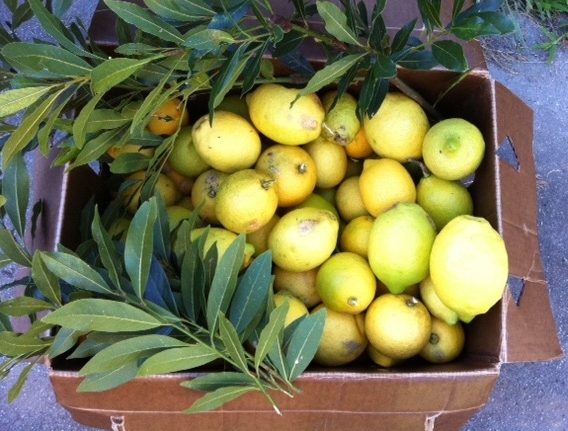
beautiful ugly lemons - photo Alison Drover

Time to celebrate citrus‭ ‬– make marmalade,‭ ‬compote and try candied fruits.


Soup making time so that you can snuggle up earlier at night.


FRUIT

Bananas, Carambola, Chestnuts, Custard apples, Fuji apples, Grapefruit, Kiwifruit

Lemons, Limes, Mandarins, Nashi, Navel oranges, Packham pears, Panama passionfruit

Pears, Persimmons, Pink lady apples, Quinces,

Red delicious apples, Rhubarb, Ruby red grapefruit


VEGETABLES

Baby fennel, Baby red capsicums, Beetroot, Broccoli, Brown onions, Brussels sprouts

Cabbage, Carrots, Cauliflower, Celeriac, Celery, Chinese greens

Dutch carrots, English spinach, Fennel, Gai lan‭ (‬Chinese broccoli‭)

Garlic, Ginger, Jerusalem artichokes, Kumara or sweet potatoes, Leeks

Parsnips, Potatoes, Pumpkin, Rosemary, Sage, Silverbeet, Spinach, Witlof


A tale of winter‭ ‬ – Miss July‭’‬s Oxtail Warmer


Miss July, blue with cold but fearlessly collecting ingredients

Enough for‭ ‬2‭ ‬but make more for the freezer


an oxtail‭ ‬-‭ ‬cut into joints

flour‭ ‬-‭ ‬a little for dusting the oxtail

cayenne pepper

ground black pepper

salt

butter‭ ‬-‭ ‬thick slice

carrots‭ ‬3,‭ ‬peeled and roughly chopped

1‭ ‬fennel chopped roughly‭ (‬optional‭)

onions‭ ‬-‭ ‬about‭ ‬2,‭ ‬peeled and roughly chopped

celery‭ ‬-‭ ‬a rib or two,‭ ‬chopped

seasonings‭ ‬-‭ ‬garlic and bay leaves‭ (‬4‭ ‬or‭ ‬5‭)‬,‭ ‬plus one or two from:‭ ‬orange peel,‭ ‬juniper berries,‭ ‬thyme

tin of chopped tomatoes local please or if in season fresh tomtaoes

a bottle of strong red wine‭ (‬like an Aussie shiraz‭)


-Preheat oven to‭ ‬160C.‭ ‬Trim the meat of fat and toss each joint into flour that you have seasoned with the cayenne,‭ ‬mustard powder and ground black pepper.

-Melt the butter in a roasting tin and seal the meat.‭ ‬Turn each piece as it colours,‭ ‬then add the carrots,‭ ‬onions,‭ ‬celery and some chopped garlic and let them colour a little,‭ ‬in the rapidly disappearing butter.

-Add the bay leaves,‭ ‬then pour over the wine and tinned tomatoes,‭ ‬and add in any extra seasonings‭ ‬-‭ ‬a few strips of orange peel,‭ ‬8‭ ‬or‭ ‬10‭ ‬juniper berries,‭ ‬or a few sprigs of thyme.

-Bring to the boil,‭ ‬cover with oiled greaseproof paper and place in the oven for an hour.‭ ‬After an hour the meat will be brown‭; ‬then turn the meat over and leave for a further hour.‭ ‬The sauce will have reduced and become intensely flavoured‭; ‬there will not be a great deal of it,‭ ‬especially if you haven’t added the tinned tomatoes,‭ ‬but it will be strong and sticky.‭ ‬With the tomatoes,‭ ‬there will be more sauce with less intensity of flavour,‭ ‬but also extremely tasty.

-Serve‭ ‬with mashed potato,‭ ‬crushed tinned cannellini beans,‭ ‬or mashed root vegetables.


Miss July has some free cooking classes coming up, all ages these ones, through the Byron Community College and the

Love Food Hate Waste‭ ‬campaign, details here.


by Alison Drover.


BELLY BULLETIN

– In Byron Bay, the YAC this Thursday July 5 is having a fundraiser with non-alcoholic gluhwein & other goodies, music,performances. It goes to support their work with young people, starts at 5.30 pm. There’s also a 1 day barista course for young people on July 17.

In Sydney, Michael Pollan, author of “The omnivore’s dilemma” & “in defence of food” , will be speaking at the Opera House on July 10. He is one of the people changing the way we think about food through his journalism. Someone please get him to this area.  Info here

& in Coorabell, at the hall, Argentinian chef Francisco Smoje will be hosting 3 pop up dinners, starting Sunday July 15. What’s a pop up dinner and who is Francisco? Tune in to belly on the 23rd of July to find out. Or check out his site.


MUSIC


I wrote a novel, by The trouble with Templeton  (his name is Thomas Calder, he’s from Brisbane, and who was Templeton? The bellysisters don’t know)

Manana, by Bustamento, Nicky Bomba’s new band (that’s the day some of us will finally start to write a novel)

The Never Seconds Song, by the totally fabulous Scottish Falsetto Sock Puppets, they wear kilts, they beat up the daleks, check em out on YouTube

Motion, by Hinterlandt, another fab solo Australian artist, to finish belly for another week.


Love and chocolate covered novelists, Sister T

(not so) scary food : puff pastry and artichokes

On air on Byron Bay’s Bayfm 99.9 Community radio on 25 June 2012

I decided to call today a scary belly because both puff pastry and artichokes are foods that can be a bit scary to handle for even an experienced cook. But so wonderful to eat, and fun to work with once you make friends.


DEANNA’S EASY AS PIE – PUFF PASTRY

Deanna’s easy as pie series has been all about baking from the kitchen of a good home cook, learning the secrets of various types of pastry and dough. Today she made even one of the scariest pastries of them all, puff pastry, sound achievable by a first timer. So much that I might even try it myself – like most of us I have relied on (strictly all butter – mmm) store bought puff pastry, which turns a marathon into convenience food.


There are two main types of puff pastry.  The main difference with ‘rough’ or ‘quick’ puff is that you don’t need to put the dough to chill in the fridge each time you work it.  It isn’t as light and flaky as the full deal, but still delicious.  Deanna recommends using a puff lid on your favourite stews and casseroles, turning a homey dish that her kids aren’t too excited about into something special.  See her beef pie below.

Puff is very versatile, used in everything from very complex dishes, sweet and savoury, to the humble sausage roll and meat pie.  If you make a fully enclosed pie, use shortcrust for the base.  Deanna also spoke about croissants, but she isn’t completely happy with her rough puff ones, and is still experimenting.  She made both types of puff pastry for the first time just before coming on belly to tell us all about it.  She spent the weekend covered in flour but as you can see the results are pretty good.


ROUGH PUFF PASTRY – by Deanna


250 g plain flour

250 g cold butter, chopped

1 tsp salt

150 ml very cold water

Place sifted flour and salt in a large bowl. Use fingertips or pastry cutter/knives to rub butter into flour

Make a well in the middle and add the water. Mix gently until a dough forms.

Wrap in cling film and rest in fridge for 30 min.

Roll out the dough on a lightly floured surface. (approx 20x 40 cm) You should be able to see streaks of butter in the pastry.

Fold a third of the dough into the centre, then fold the bottom third up over that. Rotate a quarter turn and repeat process. Repeat the round 4 times.

Chill the dough for one hour in the fridge.


LONG TEDIOUS  (BUT WORTH IT)  PUFF PASTRY – by Deanna


Exact same proportions as above.

Place the flour and salt in a large bowl. Place 25-30 g of butter into flour and rub in until resembles fine breadcrumbs.

Add the water and stir until a dough forms. Turn onto a lightly floured surface and knead until just smooth. Cover with cling film and chill in fridge for 30 minutes.

Roll out the dough to rectangle approx 20×40 cm. Place butter between two sheets of cling film or baking paper and roll out until flat and several centimetres smaller (both length and width) to dough rectangle.

Lay dough on floured surface with short end facing you. Remove butter from cling film/baking paper and place in centre of dough. Fold bottom end over the butter and then opposite end over the top (butter should now be in dough “envelope”)

Rotate one quarter turn and press edges together. Use a rolling pin to lightly tap butter and roll out dough to approx 20×40 cm rectangle repeating folding process as above. Cover with cling film and chill for 30 minutes.

Remove dough from fridge and repeat rolling and folding process 2 more times as above, chilling for 30 more minutes.

Repeat rolling, folding, chilling process a further 2 times. Dough should be folded and rolled a total of 6 times.


Tips: for puff pastry the ingredients should be as cold as possible. The chilling is necessary to ensure the butter doesn’t melt into the dough, and layers remain separate.

Oven must be hot when the pastry enters so the pastry is allowed to puff before the butter melts

The folding process creates lots of layers so as it cooks steam lifts and separates the layers resulting in a flaky pastry. Yum.


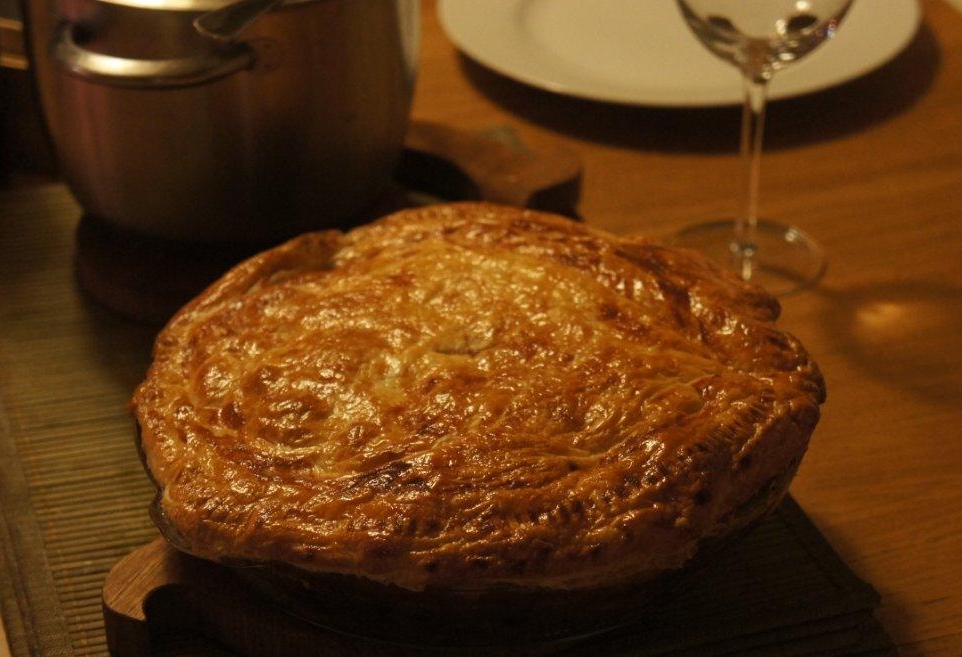
Deanna's Beef Bourguignon Pie - photo Paul Sudmals, baking team photographer and taster


BEEF BOURGUIGNON PIE – by Deanna

2tbsp vegetable oil
1 kg chuck steak trimmed and cut into 5 cm cubes
300 g smoked bacon, rind removed, sliced
Dollop of butter
12 shallots
250 grams mushrooms
30g plain flour
2 cups dry red wine (technically should be a burgundy)
250 ml beef stock
2 thyme sprigs
1 -2 rosemary sprigs (beef bourguignon recipes usually just call for thyme, but I like fresh rosemary in mine)
1 bay leaf
2-3 garlic cloves crushed
Salt and pepper
2 sheets ready made puff pastry or 1 quantity  homemade puff pastry (see recipe)
1 egg beaten

1.    Heat oil in large flameproof casserole, add beef in batches and cook over a high heat until browned all over.  Remove with a slotted spoon and drain on paper towels
2.    Add butter, bacon, mushrooms, garlic and shallots and cook until bacon crisp and shallots softened.  Drain on paper towels
3.    Add the flour and cook stirring for one minute.  Gradually add wine and stock, stirring until thickened.
4.    Return beef, bacon and mushrooms to pot (you can add the shallots at this point, but I usually leave until later otherwise they fall apart).  Add herbs and season to taste.
5.    Bring to the boil, cover and place in preheated oven at 160 for 1.5 hours.
6.    Add shallots (if not already in) and cook for another hour.
7.    Allow mixture to cool before pouring into pie dish.
8.    Cover with store bought pastry sheets (or home made puff).
9.    Crimp edges to seal around pie dish and make a cross in the middle to allow contents to steam
10.    Baste puff pastry with beaten egg.
11.    Place pie in 180 degree oven and cook for 20 minutes or until pastry is puffed and golden.


ARTICHOKES


You probably eat artichokes every day for breakfast, but many people find artichokes a bit intimidating to tackle, with their leathery and spiky appearance. Often in shops they are also quite old. You can keep them several days in a plastic bag in the refrigerator, but don’t buy them unless they are plump and glossy – it is the flower bud of a thistle plant, you don’t want to eat a dried up droopy flower.


Artichokes originally came from North Africa or Sicily, they were very popular in ancient times when Sicily was a Greek colony. Later, they were popular at French and Italian courts, helped along by a reputation as aphrodisiacs. They are still everywhere in Sicily, my parents lived there for a while and their house was surrounded by dusty green artichoke plants, so we had many lovely huge salads of young small artichokes.

Artichokes should be a spring veg but I see lots of good ones turn up in winter in our shops. It is a great healthy liver cleansing and diuretic veg, you can have them as a bitter herbal tea but it is much more fun to eat them.

I think the best way to make friends and get to really know the edible bits of these armoured buds is to eat them raw, dipping each slice in a bowl with olive oil,vinegar or lemon, a little salt and pepper (you could choose melted butter or mayo if you wish). This is a traditional way to eat them, and since you have to use your hands, may explain the sexy reputation.

Remove the outer leaves, all but about 5 cm of stem, wash well, start eating leaf by leaf, scraping the soft pale part at the inside bottom of the leaves. Gradually you will find that you can eat more & more of each, until the inner tender leaves are completely edible. Don’t eat the fluffy middle, called the choke (some modern varieties are chokeless). You will be left with the soft base of the bud, that’s the heart, all edible and delicious.

With very young small ones you can eat the whole thing, slice thin, eat raw in salad

Or steam, remove choke and stuff (breadcrumbs,garlic, anchovy,herbs, or just drop in a raw seasoned egg) and cook sitting at the base of a pot in liquid, batter and deep fry, make puree. You can eat a bigger percentage of the leaves when cooked, but often some remain hard and need to be discarded while eating. You can also eat the peeled, cooked stem of a fresh artichoke.

They are easy to grow perennials if you have lots of room and sun in your garden, and sandy soil, although I am not sure they can cope with our sometimes relentless rains. They also become a lovely flower if you miss the eating stage.

BELLY LAB RECIPE – ARTICHOKE MAYONNAISE, by sister T


I was busy in the belly lab over the weekend, adapting a Peter Gilmore recipe from his sumptious cookbook (named after his 3-hatted Sydney restaurant),  Quay. I got it from the library really just to look at the beautiful pictures. The recipes are pages long and require lots of unusual equipment and ingredients. However, many of the mini-recipes within each masterpiece are surprisingly achievable, and he combines many flavours in ways that are new to me and I can’t wait to try. For example, his artichoke mayonnaise. Artichokes and eggs love each other, it is a great idea, but I don’t have a temperature controlled combi-oven, vacuum bags and a vacuum sealer. Also I wanted to use raw oil and herbs. I am happy to report the result was delicious, my main taster calls it the best mayo I’ve ever done, very light and delicate. Good on prawns, fish, scallops, a steak, boiled potatoes or eggs.  Or on a grilled choko of course.


2 plump artichokes

2-3 heads and stems of young garlic (in markets now) or use a whole head of normal garlic – it will be very mild, you can use more if you wish

about 1/2 cup of chopped parsley (or try chervil or tarragon)

2 very fresh free range eggs – yolk only

lemon juice to taste

good olive oil to taste


Remove outer leaves of artichokes, cut off top 3-5 cm of petals, peel stems. Cut into segments, remove choke, wash well. Keep artichoke pieces in acidulated water so they don’t go black while you work. Wash young garlic or divide other garlic into cloves.

Steam garlic and artichokes separately until very soft.

Squeeze out garlic from skins, or remove any hard bits from young garlic.

Remove very hard bits of leaves from cooked artichoke – just scrape with a knife to make sure you don’t include too much fibre.

Chop in a food processor with a little olive oil until you have a very smooth paste – I did one lot of whizzing with the very soft bits and another lot with the slightly harder parts of the artichoke (but not the really hard ones) to try and get the most out of them. Allow to cool.

Make a mayonnaise with the egg yolks, olive oil, and lemon juice. Add herbs and artichoke puree, and salt and pepper to taste.

All quantities are approximate, just have a play. And maybe try other steamed veg purees next time. You could also fold the artichoke/garlic puree through mashed potatoes, or use in a pasta or beef or fish sauce with lots of butter.


Or to make the recipe even easier, use a couple of cloves of raw garlic and puree well drained tinned artichokes, just make sure it is a brand with a bit of taste – but do not use mayonnaise from a supermarket jar, horrible stuff. The bellysisters will give you 10 Hail Marys as penance if you do.


EDIBLE QUOTE


A French term today for someone who is very tender hearted, gets emotional and cries easily : coeur d’artichaut, artichoke hearted


MUSIC


My House, by The Little Sisters

Pot Of Honey, by The Mid North

Puff the Magic Dragon, by Peter Paul and Mary

Just Be Good To Me, by the Blackbirds

The La La Song, by Krista Pav

The Rhine, by  Sarah Collyer


love and chocolate croissants, Sister T


Rambling vines & perfect pulses in the Seedsavers veggie patch

On air on Byron Bay’s community radio station, bayfm 99.9, on May 28, 2012

On a lovely sunny day in May I visited Jude and Michel Fanton, directors of the wonderful biodiversity foundation, Seedsavers.  We had green tea perched on the very second hand cement blocks which edge their garden beds.  The tea was a discovery during their recent travels, liasing with seed, permaculture, and other green groups around the world.  Summer is too hot to garden around here they say.  But right now is the perfect time.  Walking around the veggie patch with Jude until the mosquitoes drove us away, I started to feel much better about my “failures”, all those plants that will just not thrive in our humid, and occasionally very hot climate.  And about taking the easy way out in the garden.  The people who taught lots of us about collecting, drying and saving seeds now even often let the plants sort it out on their own, and somehow manage to have an exciting, varied and mostly vegetarian diet from their not particularly large patch, even though they go away from Byron Bay so often.  Jude calls it ‘using the soil as our seed bank’.  I also love the expression ‘bandicooting’, which means foraging around the patch getting bits and pieces at various stages of maturation.  The best idea of the day though was the solution to all those sad, mouldy zucchini plants that coastal gardeners normally need to bathe in asses milk and prayers to have any hope of picking a few sad little fruits.  Just give up on them altogether and grow pumpkins, which are basically weed hardy around here.  Pick the flowers, the shoots, and the half grown pumpkins, skin and all, to use as zucchini.  I had to ask Jude to repeat that one.  Yes half size pumpkins, so of course depending on the variety we are talking a whole lot of sizes, can be cooked as if they were zucchini.  I will certainly be going into the belly lab and investigating that one.


Jude had many more ideas on growing and using vegetables that grow easily in our area.   If you would like to follow us around the veggie patch, click on the audio links below.


Horseradish, gingers, leeks, shallots, mustard and more


Cambodian basil, chufa, sweet potato, thymes and more


Pumpkins, chokos and more


When the dark and the mosquitoes drove us away from the veggie patch, we went inside and Jude talked about two of her favourite perennials, pigeon peas and lima beans, which are some of the staples in her diet.  They also make very attractive barriers around the vegetable garden.  Lima beans are a vine, and pigeon peas a very attractive small tree.  Jude grew her lima beans on an old metal bunk bed frame.  Possibly and idea if you can’t get your large unwanted items to the tip?  Of course make sure they aren’t made of something that will leach nasties into your soil.


Click on the audio links below to hear Jude Fanton talk about two of her favourite pulses.


Lima beans


My friend the pigeon pea


MUSIC – EUROVISION YEEI


If you like stuff that’s so bad it’s good you’ve got to love Eurovision – and some of it is actually just good.  Not much admittedly.  The second place getters this year had to feature on belly – they danced and sang and baked biscuits!  And they were totally gorgeous Russian grannies.


In fifth place, a song that was just wild and beautiful, sung by a woman who had stepped straight out of a dark fairytale – and a pretty fab way to wear dreads.  Go Albania.


I also love the costumes and wild cockroach dancing by the Moldovan entry.   Check it out,  may have to play it soon, but it’s all about the look really.


Also on belly this week:

Walk the earth, Bianca Meyer

And Dirtgirl, a belly fave, Good Morning and Dig It


Love and chocolate pigeon peas, sister Tess


Le belly en rose – guavas and sister Ros

On air on Byron Bay’s community radio station, bayfm 99.9, on May 21, 2012


A big thank you to the wonderful Sister Ros Elliott, who took the mike to you to find out some of of your favourite winter comfort food as the socks and jumpers come out of hiding all around the Northern Rivers, chatted about food security, and gave our ears a taste of beautiful rosy guavas.  To give your palate a taste too, try her recipe below.  And look out for Ros again on belly on June 4.


GUAVA CUSTARD FLAN – PHOTO AND RECIPE BY ROS ELLIOTT


Sweet pastry for 24cm flan tin


3 large (600g) guava, all seeds removed & chopped

1/2 cup thickened cream

4 eggs

2/3 cup castor sugar


Process all ingredients till smooth.

Pour into uncooked pastry case and bake 1 1/4 hours in moderate slow oven.

Test custard cooked by inserted knife comes out clean.

Brush top of custard with guava jam and decorate with fresh guava crescents.


[For a belly shortcrust pastry recipe, by  our pie-eyed  bellysister Deanna, see here]


tree cabbages and food forests

On air on Byron Bay community radio bayfm 99.9 on May 14, 2012

Today belly was all about bio-diversity, about getting down and dirty and protecting our food supplies, and sharing our knowledge. And enjoying the delicious fruits of our labours of course. Shortly Jude Fanton, director of Seedsavers, told us about food networks they recently visited in New Zealand, Europe and Malaysia. Portuguese cabbage forests and monkeys that help make our fruit more delicious, among other stories. Then Suveran Dewsnap, head gardener at Starseed, talked about his dream of edible food forests, eating weeds, and adapting to our environment. To finish the show, two more wonderful artists from the very tasty food themed exhibitions at the Ballina Community Gallery.


FRESH REPORT : persimmons finishing, strawberries starting, lots of mandarins, dragonfruit, passionfruit
mint & fresh young ginger -maybe time for healthy  cold busting juices.  Week 3 markets include Mullumbimby this Saturday, Uki and Nimbin on Sunday.


SEEDSAVERS ON TOUR


Jude Fanton  is director with husband Michel of Seedsavers, founded in Byron Bay in 1986 to protect non-hybrid,traditional seeds and plant varieties, and to set up and assist non-profit seed networks and exchanges, here and abroad. These days they travel a lot, learning and teaching ways to protect biodiversity with like minded people all over the world. Their latest journey was to New Zealand, and last summer they travelled in Portugal, Spain, France and Malaysia. There are more than 700 videos of their travels, and lots of seedsaving advice, on the Seedsavers YouTube channel here.


Listen to the Seedsavers travels in Europe and Malaysia


listen to Jude Fanton’s New Zealand travels


CALDO VERDE RECIPE


Jude spoke about caldo verde, the Portuguese national soup, or even national dish.  It means green soup, and is based on cabbage, preferably kale (or Portuguese tree cabbages).   Even if you can’t get hold of any tree cabbages, kale is pretty easy to get now (at least if you are lucky enough to live around here).  Just soften some chopped onion in olive oil, then add chopped garlic.  Then potatoes and stock or water.  If you like meat, traditionally some chorizo sausage goes in now, and some towards the end.  Cook until the potatoes are almost ready and falling apart, whizz the soup smooth if you prefer, then add lots of finely shredded kale and more chorizo.  The kale should still keep a bit of texture, not be really soft.  You can also add herbs like mint and parsley towards the end of cooking.


FOOD FORESTS


Suveran Dewsnap is head gardener at Starseed Gardens , a non profit organisation with all sorts of interesting projects, on among others, bio-char, aquaculture, hemp, and his passion for many years now, food forests.


Listen to Suveran on belly


Starseed Gardens will have workshops on planting a food forest , in Byron Bay in June.  This is what Suveran says about the importance of food forests.

“The beauty of food forests, in my view, is not just that they provide a variety of produce on an ongoing basis, when established, but, more importantly, as a permanent resource ( as opposed to annual cropping ). They are an ongoing propagation resource base that would be so vital in the event of a food supply crisis, with most tropical and subtropical perennial staples being easily reproduced by cuttings and tubers (sweet potato, cassava, Taro, Arrowroot and yam ) or abundant seed (as in the case of perennial legumes such as Lima beans ) Thus with some collaboration and a local knowledge base communities around the shire would be able to provide themselves with abundant food, relatively quickly. This, in my view, is the essence of food security. In the event of a natural disaster or disruption to the transport system there is probably no more than 2-3 days food on the supermarket shelves, and so, in an increasingly uncertain world, I now feel a sense of urgency to share the knowledge I have accumulated, and will be running a series of workshops around the country over the next 12 months, starting at Starseed gardens on the 1st-3rd of June. This workshop will cover various strategies for achieving a secure locally produced food supply including perennial food crops, the development of a food forest network across the shire, edible weeds, community collaboration, planting hardy plants for winter and preparing the ground for spring planting, followed by a comprehensive food forest planting workshop from August 31st to Sep 2nd which will include a range of seeds and cuttings to begin creating other food forests throughout the district.”


RECIPE – TARO WITH MISO AND TOFU, from Suvi

adapted from a recipe on www.justhungry.com


Suveran brought a bag of taro roots – some to plant, some to eat.  Lucky subscriber Bridget, who won them, is attempting to goat-proof a spot for the taro patch.  He suggests this recipe.  You can buy taro easily in local shops and markets.


5 or 6 smallish peeled taro roots

1/2 block firm tofu, crumbled

1 cup Japanese dashi stock or water

2 tbs white miso paste

1 tbs soy sauce

1/2  tbs raw sugar


Cut the taro into chunks.  Bring to a boil taro, dashi or water, tofu and sugar.  Cook on medium heat until almost all liquid is gone, then add the soy sauce and the miso (thinned to liquid consistency with a little water).  Simmer on low heat for a few minutes.  Serve hot or cold.


BELLY BULLETIN


Coming up this Thursday 17th & all weekend, the Noosa International Food Festival, chefs from all over Australia, Hong Kong and Turin, lots of good music.    On the June long weekend ABC Delicious magazine is organising a Byron Bay gourmet extravaganza, lots of visits to local producers and restaurants. ( See here) They both sound good if you have a fair bit of cash to spare.

On in Ballina right now and  free :

From Wednesday 2 May – 27 May 2012  (from the Gallery website)

“Table Manners: a spectacular installation of handmade ceramic dinnerware by ceramic artists Suvira McDonald, Malcolm Greenwood and Sue Fraser; textile artist Kirsten Ingemar; Ikebana artist Di Morison and food stylist Monique Guterres-Harrison (Seaweed Cuisine). Curated by Suvira McDonald.

Short and Sweet: exquisite pastel drawings depicting kitchenware and high tea treats by Katka Adams.

Produce-d: watercolours of farmers market produce by Karena Wynn-Moylan. Each Saturday for one year the artist visited her local farmers market (the Bangalow Farmers Market) and photographed her basket of produce. These were then translated as beautiful watercolour paintings and published in a recipe book, with recipes from market stall holders.

Food for Thought: still life paintings and mixed media by Barbara Zarletti and Peter Mortimore. Their contrasting styles offer exquisite views of quiet arrangements of food and kitchenware.”


Last week on belly we talked about food and painting with the presenter of the Bayfm arts show, Karena Wynn-Moylan. I hope you have a chance to check out last week’s post here with karena’s beautiful paintings and lots of seasonal recipes from her artistst’s cookbook.  Today I  played  interviews I recorded at the exhibition opening night with 2 other artists, Kirsten who works with fabric,and sound, and Peter who made great collages in honour of his mother’s old cookbooks.


Listen to Kirsten


Listen to Peter


MUSIC


Apart from the fado track, all the music today was thanks to the great community radio resource, airit,  maintained by Amrap, which supports Australian musicians, and community radio stations.   No money at all from the Federal government in this year’s budget, very disappointing, but they say they will keep the music coming. Senator Conroy is the one to contact if you want to support amrap.


Foreign Language by Flight Facilities, from Foreign Language Remixes

Fado Curvo by Mariza, from Nu Europe

Maybe When The Sun Comes Down,  XTREMIX By Cloud Control Richard In Your Mind

Forest Eyes  by Jinja Safari , from the Jinja Safari EP

Words and images by  Great Earthquake, from  Drawings


love and chocolate covered cabbages,  sister tess