Category Archives: RADIO SHOW POSTS

Lovely waste free February and easy as pie shortcrust pastry

Our lovely seasonal bellysister,  Alison Drover, is wearing her very loving and very waste free Miss February apron with matching bikini today, and we welcome episode one of Mullumbimby baking legend Deanna Sudmal’s pastry making series to the belly kitchen.  We are starting super easy with shortcrust, and even playing with store-bought pastry.  Is it enough to tempt you to try making your first ever pie for someone you love?


Deanna's Cherry Pie

Recipes and tips below by Deanna Sudmals


CHERRY PIE

1 quantity sweet shortcrust pastry for double crust pie (see related recipe)
4 cups fresh pitted cherries
¾ cup white sugar
2 ½ tbsp arrowroot (tapioca) flour
1 tsp vanilla extract
Juice of half a lemon
One egg, beaten

Place a baking tray in the oven, and pre-heat to 200 degrees.
Mix cherries, sugar, arrowroot, vanilla and lemon juice in a large bowl and allow to sit for 15 minutes. Roll out bottom crust of pie and place in pie dish.
Baste inside of pie with beaten egg. Fill pie with cherry filling.
Now get creative:  for Valentines day, I cut out small heart shapes in the rolled out top crust with a small cookie cutter to allow the pie to vent.  You can also vent the pie using a knife or fork, can cut a hole in the centre of the pie, or if you are feeling really creative, you can make a lattice top to your pie by covering it with strips of pastry in a criss cross pattern.  Crimp the edges of the pie using either your fingers, or making indentations with a fork around the outside of the pie.
Brush the entire top crust with beaten egg.

Place the pie in the oven on top of the hot baking sheet and bake for 15 minutes.  Reduce the temperature to 160 degrees and cook for a further 25 to 30 minutes or until the pie is golden and the  cherry filling is bubbling.  Allow to cool completely before serving. Really nice with vanilla ice cream.

Enjoy!


SHORTCRUST PASTRY TIPS

•Don’t overwork the dough.  Mix until just together.
•Place on a preheated tray in oven to firm up the crust.
•Make sure to keep butter cold and mix with ice cold water.
•If making pastry by hand, remember that your hands are warm (the finger tips are the coolest part of the hand) so mix quickly with fingertips to avoid butter getting warm
•Chill for at least half hour and then take out of fridge to relax a bit before rolling.
•Make sure your surface is clean and well floured.
•When blind baking make sure you prick the base with fork so it doesn’t rise up.
•Roll in one direction only and then flip.
•Bring up pastry on rolling pin and lay on tray, leaving a bit extra to allow for shrinkage
•If you want to change the amount of pastry (more or less) remember the ratio is half butter to flour
•For a fruit pie that contains moisture (eg. Apple pie) baste the inside of the bottom crust to ensure the finished pie does not become soggy
•Glazing the finished pastry with a beaten egg gives a nice shiny golden appearance


BASIC SHORTCRUST PASTRY


300g flour

150g cold butter cubed

4-6 tbsp ice water


For a savoury pastry: add a pinch of salt

For a sweet shortcrust pastry, add 2 tbsp icing sugar

Blend flour, salt or icing sugar and butter in food processor until mixture resembles fine breadcrumbs. Slowly add ice water and pulse until just combined. Using hands, gently knead together until pastry comes together in a ball. Separate into two portions, flatten into disks, cover in cling film and chill in refrigerator for 30 minutes before rolling out.

NOTE: be careful not to over work the pastry or it will become tough.

If you do not have a food processor you can make the pastry by hand by using your finger tips to squash the butter in with the flour, working quickly to ensure the butter stays cold. This process can also be done by “cutting in” the butter using two butter knives. Note: the pastry will not be as smooth done by hand as the food processor method, as with the food processor the butter has been cut through the flour more evenly.


Make sure you tune in to Bayfm on the first Monday in March for more delicious Easy as Pie – shortcrust.


Miss February’s Seasonal Bounty

words by Alison Drover

www.forkinthefield.com

www.alisondrover.com

Passionate Miss February! Loving not wasting….


VALENTINES DAY

We love food that is why we listen to Belly but we are all guilty of wasting food as well. Be inspired by being thrifty – help save the planet with every mouthful visit www.lovefoodhatewaste.com to see how you can help.  Also http://www.lovefoodhatewaste.nsw.gov.au/.

Email us with your recipes for using left overs. (belly(at)belly(dot)net(dot)au)

Passionfruits on the vines hanging glory to be used. I can see my Mum whisking wildly on the floor surrounded by dishes at one of the many dinner parties making passionfruit flummery with real cream drizzled over it.

The bowl was a air spun glass bowl which I still have and is reserved for my flummeries.


SEASONAL IN NSW


Avocado

Banana

Blackberry

Blueberry

Chilli

Cucumber

Eggplant

Fennel

Fig

Grapes

Green Beans

Guava

Kiwifruit

Leek

Lemon

Lemongrass

Lettuce

Lychee

Mango

Mangosteen

Okra

Onion

Orange

Peach

Pear

Peas

Plums

Radish

Rambutan

Raspberry

Rockmelon

Squash

Tamarillo

Tomato

Watermelon

Zucchini

Zucchini Flower


On our doorsteps…..


• Tomatoes – use them any way you can bottle, sauce, soup and salad – be forgiving for the farmers and the rain a few bruises are okay

• Passionfruits

• Cucumbers

• Herbs – nourishing

• Chillies

• Eggplants bountiful


PASSIONFRUIT FLUMMERY

You can use gelatin leaves or powder for the recipe.


1/2 cup caster sugar

2 tbs plain flour try and use organic

115g (1/2 cup) caster sugar

2 tbs plain flour

1 tbs powdered gelatine

250ml (1 cup) water

2 oranges, juiced, strained

1 lemon, juiced, strained

125ml (1/2 cup) passionfruit pulp

Whipped cream, to serve

2 tbs passionfruit pulp, extra, to serve


1.Place the sugar, flour, gelatine, water, orange juice and lemon juice in a medium saucepan. Whisk well. Bring to the boil over medium heat, stirring constantly. Simmer for 2 minutes.

2.Pour the mixture into a heatproof bowl and place in the fridge for 1 hour or until the mixture begins to set around the edges. Stir in the passionfruit and transfer to a large bowl. Use an electric beater to beat for 15 minutes or until the mixture is thick and pale.

3.Pour the mixture evenly into four 310ml (1 1/4-cup) serving glasses. Cover the glass tightly with plastic wrap and place in the fridge for 1-2 hours or until the mixture is set.

4.Serve topped with whipped cream and with extra passionfruit pulp.


MUSIC


Oh Well, That’s What You Get Falling In Love With A Cowboy – Lanie Lane

Love Letter – Clairy Browne & the Bangin’ Rackettes

If I Knew You Were Coming I’d Have Baked a Cake – Bob Hope and Bing Crosby

Love Is Blind – Annie Lennox

Hooray for Love – Ella Fitzgerald

Nakutamani (I Am Longing For You) – Paul Mbenna feat Nicky Bomba


love and triple chocolate shortcrust pie, Sister T


nutrition during preconception

Crazy gremlins won’t let me space this out properly so that it is more enjoyable to read, they have decided they want to get warm and snuggly with the words instead and remain all squishy sqaushy, so i hope it is not too crammed for you to cope with and just as soon as i am able to cope with re-entering it all … i will … i promise !
Talofa … Sister Rasela having a wander through the land of preconception on this weeks bellylicious show.
Whether you are planning a bump or two or like last weeks guest, FIVE !!! .. if you simply have an insatiable appetite for information and knowledge, perhaps you might know someone who needs a bit of help in the area of preconception or maybe you are reading this because you love listening to the show and wanted to find out more about who and what we are about through our website – either way, it’s great to have your eyes on loan today and your ears each Monday if you are a BayFM listener. Thank you.
Food is such a crucial part of our lives, not only through tastes and flavours but through the life giving properties it possesses when it is grown, prepared and eaten correctly, at the correct times and in the correct amounts. Only YOU know, in all your beautiful uniqueness, what is best for you at what time of your life, all i am here to do is help facilitate the knowledge and information i have learned and practiced in the hope that you gain something from what i share.
Preparing your body to bring a healthy baby into the world is very important, not only if you are struggling to fall pregnant but also if you want to give your baby THE best start to life you can. Our incredible bodies have the capacity to be unbelievably adaptable and healthy babies are born every day to parents that may not be healthy themselves, so not only are you preparing your baby for the best start in life, you will could well be preparing your own body, mind and spirit for your new life as a parent. If you are struggling to maintain a healthy body before your pregnancy then just think of how much a 9 month pregnancy can further deplete your stores of nutrients. You may find that you don’t have to take illness, depression and tiredness for granted, you may find you are able to improve your own energy levels and wellbeing by starting off on the right foot long before the nursery is painted and the sleepless nights begin…. surely it’s worth a try ? That’s up to you to decide.

spot the difference ...

Preconception care aims to ensure that there’s an adequate supply of all the nutritional factors, which are essential for the health of sperm, ova and foetus and an absence of those factors which are known to compromise general health or which are harmful to germ cells and to foetal development. Since ova are susceptible to damage 100 days before ovulation, and sperm formation takes approximately 116 days, the pregnancy preparation for both parents should be a minimum period of 4 months before an intended conception (or longer for those hard core hedonistic party folk).
Complete preconception health care involves identification and detoxification of heavy metals, avoidance of environmental toxins such as smoking and pesticides, treatment of allergies, treatment of infection and treatment of reproductive or fertility problems. Nutrition and nutritional supplementation addresses many of these factors and can help to provide the essential nutrients for healthy foetal growth and development.
I have to say that what you are about to hear is just here to help guide you if you are planning a pregnancy. Even if you’re not planning to, there is a lot of info coming on key nutrients and what foods to find them in. Always remember that changes are best made and longest kept if you make them gradually. Enjoy what you are doing for your body, give it the love it deserves especially IF you have spent years taking it for granted. I personally have known a few couples who have opted rather early on to spend a fortune on IVF because they haven’t conceived soon enough but then are still drinking alcohol and looking for a bit of an ‘easy way out’. IF you haven’t looked after yourself up until now, I believe your body has the right to say bugger you! I’m not giving you what you want until you start looking after me and give me something back … fair enough too don’t you think ??!!

belly beautiful

Important needs include:
Detoxification
Nutrition
Avoidance of toxins/pollutants
Various diagnostic tests
Exercise
Stress/anxiety reduction
Positive thoughts and loving vibes from friends and loved ones maaaaan
BOTH PARENTS NEED TO BE COMMITTED (not to a mental asylum)
Goals to achieve before conception is attempted:
Adequate nutritional status – where you are at. Blood tests etc.
Adequate protection/detoxification from toxins
Minimum 4 months good nutrition – diet/supplementation if there are deficiencies
Minimum 4 months abstinence from all drugs including caffeine, alcohol, nicotine
Adequate exercise program
Regular cycles/balanced hormones – contraceptive pill
Adequate sperm count/motility/morphology – downstairs is working
Adequate stress management
Bodies and minds need time to repair and rest and adjust to a change in lifestyle. Honour this.
Benefits of preconception health care:
The presence of all the factors required for the creation of a healthy foetus
The absence of all factors detrimental to this very creation
Ensure a normal, healthy, full-term pregnancy ((help prevent miscarriage, premature birth and stillbirth)
Can assit in the Mother being free of post-natal depression
Successful and long term breastfeeding
Factors contributing to increasing levels of infertility:
Stress and anxiety
Poor diet/nutrition
Sexually transmitted diseases and genito-urinary infections
Pollution/toxins
Drugs
Previous use of contraception programs
Previous terminations
Greater age of prospective parents
STARTING PRE CONCEPTION CARE
Supplements and suggested daily doses – The recognition that supplements are necessary to meet nutritional needs during reproduction is not a new concept, however it is important to ensure that the right combination of supplements taken is complete and well balanced.
SUPPLEMENTS SHOULD NOT BE USED IN PLACE OF AN IMPROVED DIET AND A HEALTHIER LIFESTYLE!
This is where it gets tricky because without a consultation I have no idea of your current nutritional status so I can only give you an idea of beneficial vitamins and minerals and their role in the reproductive system. If you want more specifics you should see a Naturopath or health professionl of which there are many in and around this beautiful Shire of ours. Personally I am not in favour of huge amounts of supplements as the liver has to metabolise these synthetic substances, unless there is a severe deficiency where food alone will not meet the required amounts.
VITAMIN A/BETA-CAROTENE
High doses can cause BIRTH DEFECTS – this is a concern for women taking nutritional supplements containing Vitamin A. Please check with a health professional if you hav thoughts, doubts or further questions on this !!
Important as an antioxidant, keeps fallopian tubes healthy (mucous membrane maintenance) necessary for health of testes, for sperm production and is needed for the conversion of cholesterol to the male hormone testosterone.
A need for both pre-formed and pro-formed Vitamin A is required to enable the full absorption of this nutrient. It is a fat-soluble vitamin therefore an adequate amount of good fat is required in the diet for it to be utilised. Very interesting considering there are so many people sucked into the marketing ploy of all that ‘fat free’ advertises to be !
PRE-FORMED VITAMIN A FOODS –
Liver is very high in Vit A and should probably be avoided altogether
Organic eggs
Organic butter
Cod liver oil (in appropriate doses)
PROVITAMIN A FOODS
Sweet potatoes or yams
Cantaloupe rock melon
Spinach
Carrots
Butternut squash
B-COMPLEX VITAMINS
These vitamins include B1, B2, B3, B5, B6, B12, PABA, Inositol, Choline and Folic Acid
Recreational drugs and prescription drugs and alcohol severely deplete B Vitamins. B5 is hugely beneficial for stress (liquid B’s are great)
Deficiencies of all of the B Vitamins have been associated with fertility problems, miscarriage, neonatal and perinatal death, foetal abnormalities, and low birth weight babies
B Vitamins are needed for a large number of bodily functions including the manufacturing of sex hormones, the metabolism of EFA’s and the production of the correct balance of oestrogen and progesterone
Male fertility is dependent on B5 for healthy testes and B12 to increase sperm count and motility.
Inositol is required for healthy prostate
Supplementation before and during pregnancy reduces the risk
B5 (PANTOTHENIC ACID) FOODS
Raw Crimini Mushrooms
Cauliflower
Broccoli
Turnip greens
Sunflower seeds (raw)
Tomatoes
Strawberries
Grapefruit
Yoghurt
Eggs
B9 FOLIC ACID
Essential for the formation of DNA and RNA
Requirements for Folic Acids doubles during pregnancy and is required for 3 months pre and post conception to prevent neural tube defects and anencephaly
B9 FOODS
Liver
Kidney
Leafy green vegetables
Cauliflower
Note: Overcooking destroys much of the folic acid
VITAMIN C (Ascorbic Acid) and BIOFLAVONOIDS
Ascorbic Acid accumulates in both the ovary and the testes and is a key compound in gonadal physiology. Both organs depend on this nutrient for sex steroid hormone production
It’s also an antioxidant that protects against the toxicity of lead, pesticides and other environmental pollutants and against mutagenic activity
Good levels can help protect against genetic abnormalities
Important in the role of iron absorption
Assists the adrenal function by supporting and replenishing stores
Sperm motility and ability
Improves semen parameters- even a marginal deficiency can cause oxidative damage to sperm, resulting in reduced sperm motility and viability
Necessary for the maturation of the pre-ovulatory follicle
VITAMIN C FOODS
It is important to maintain the variety between all foods containing Vitamin C
Guava
Papaya
Red/green bell pepper
Orange
Broccoli
Potato baked with skin (more than in an orange !!)
Cabbage greens
Raw spinach
Mango
VITAMIN E
Is an Antioxidant
Helps regulate oestrogen levels
Useful in the treatment of PMS and lumpy breasts, deficiency can lead to spontaneous abortion and if severe, a total lack of sperm
Improves sperm motility and effective in the treatment of low sperm count
VITAMIN E FOODS
Almonds
Avocado
Hazelnuts
Mango
Olive oil
Safflower oil
Sweet potato
Wheat germ oil
CALCIUM
*Should be balanced with magnesium*
(2:1) Calcium/Magnesium – The synchronistic effect … Certain vitamins and minerals need each other to function at their best for absorption and assimilation
Adequate calcium stature is important for conception – required for the formation of fertile mucous and can also improve the ability of the sperm to swim through it
High Ca sources
Sardines with bones
Moderate amounts of cheese
Plain yoghurt
Med Ca sources
Figs
Cottages cheese
Bok-choy
Broccoli
Kale
Tofu
Almonds
Tahini
MAGNESIUM
A mild Mg deficiency may cause free radical damage to the sperm
Necessary for the production of oestrogen and progesterone
Reduces stress
Relaxes muscles (Dark Choccie is better and higher in antioxidants)
Mg FOODS
Halibut
Tuna (Fish now days can have very high levels of mercury. The bigger fish eat smaller ones and so run the risk of becoming more contaminated)
Artichokes
Bananas
Dried figs
Barley
Buckwheat GF
Oat bran
Almonds, brazils, cashew, pine nuts
Pumpkin seeds
Spinach
Tomato paste
Fe – IRON
Iron supplementation is only appropriate when a proven need has been established (check ferritin levels/iron stores –through blood test)
*Only 40% of women have iron stores within appropriate range before they conceive*
Fe FOODS
Red meat
Liver (although this is extremely high in Vit A and would be better avoided in pregnant women)
Pulses (lentils and beans) GF (always pre-soak and cook with strip of wakame to ease digestibility)
Dried fruit
Green leafy veggies
Nuts and seeds
Fortified breakfast cereals
MANGANESE
A severe lack can be the cause of infertility as it can lead to a total lack of sperm
Ma FOODS
Pineapple
Cooked brown rice GF
Spinach
Whole grain Rye (GF if 100% pure)
Tempeh GF
Oats
Spelt
CHROMIUM – 3
Upper levels are recommended for those with sugar cravings
Deficiency has an ability to depress nucleic acid synthesis
Ch FOODS
Sweet potato
Apple
Organic Egg
Tomato
Broccoli
SELENIUM
Selenium is either not present in the foods due to soil deficiency or destroyed through over processing
Deficiency results in impaired reproductive performance in ALL species studied
Good for use in heavy metal detoxification
Prevents oxidation of sperm
Se FOODS
Brazil nuts (by far the highest source)
COPPER
Both a deficiency and excess can lead to fertility problems
Deficiencies are rare due to copper piping used to receive water
Excess can lead to low levels of Zinc and Zinc deficiency is implicated in many reproductive problems
No foods recommended
ZINC
MOST IMPORTANT NUTRIENT FOR MALE AND FEMALE REPRODUCTIVE HEALTH
Zinc is commonly deficient with 67% of Aussie men and 85% of women having marginal dietary levels
FEMALE REPRODUCTION
Important for Progesterone reproduction
FSH and LH secretions (important hormone release)
Ovarian development
Reduces risk of miscarriage and birth defects. Low birth weight/growth retardation, premature labour, inefficient labour and stretch marks
Adequate amounts of Zinc can help in the prevention of post natal depression (used with EFA’s)
DNA and RNA synthesis
Immune system function
Hormonal activity
MALE REPRODUCTION
Vital for spermatogenesis
For the development of the primary and secondary sexual characteristics
Testosterone production
Prostate function
Sperm count, motility and morphology
Greater biological needs than female (lost in ejaculation) interestingly most teenage boys develop a serious deficiency at that age and it’s linked to their
behavioural patterns, just an interesting piece of info …
Reduced sperm count
Reduced serum testosterone
Zn FOODS
ANIMAL – ORGANIC
Beef
Lamb
Pork
Crabmeat
Turkey/Chicken
VEGETARIAN HIPPIES
Pumpkin seeds (highest)
Milk
Cheese
Beans
Wholegrain cereal
Brown rice
Potato
Yoghurt
ESSENTIAL FATTY ACIDS (EFA’S)
SECOND MOST IMPORTANT NUTRIENT IN REPRODUCTIVE HEALTH
Healthy sperm are dependent on an adequate supply of EFA’s
Developing foetus has high requirements for EFA’s – large amounts are deposited in the last trimester of pregnancy
Formation of prostaglandins – responsible for correct hormonal balance
EFA’s are needed for the full functioning sex glands and for the formation of sex glands that are in the semen
Deficiency can lead to chromosomal defects, subtle brain disorders such as dyslexia
EFA’s
I wouldn’t just recommend people start drinking gallons of oil, this needs to be advised by a nutritional expert so that you are doing what is correct for you and your unique and gorgeous body
Omega 3’s 6’s 9’s and the correct balance of each is dependent upon each individual
AREAS OF IMPORTANCE FOR A PRE-CONCEPTION DIET
Adequate variety of proteins
Avoidance of refined sugars and refined carbohydrates
Avoidance of chemical hormones
Avoidance of excessive saturated fats
Avoidance of excessive salt intake
A good balance of alkali-promoting foods
Avoidance of all allergens
Plenty of fresh, purified water
Avoid all coffee, alcohol and filthy cigarettes
STRESS MANAGEMENT
Look for ways to reduce stress and stop thinking about wanting any or all of the abovementioned
EXERCISE PROGRAM
Look for ways to increase exercise everyday in life (keep dancing!)
LIFESTYLE CHANGES/AWARENESS OF TYPES OF TOXINS
ENVIRONMENTAL
Heavy metals (you can have a hair analysis/urine test)
Industrial chemicals (in the air and water borne)
Agrochemicals (in water supply/spraying)
Domestic (cleaners, renovations/paints/glues/varnishes)
Occupational (hairdressers, motor mechanics, farmers)
DIETARY
Chemically sprayed fruits and vegetables
Food additives, colourings, sweeteners, artificiality
Polluted water
SOCIAL
Caffeine
Nicotine
Alcohol
Recreational drugs – it’s only 9 months at a time in your whole life …. you are giving nothing up, you are giving LIFE instead
MEDICAL
Over the counter – Prescribed
DETOXIFICATION
Should be completed before 4 months preconception period
Sperm and eggs need to mature in a toxin free environment
Gentle detoxification – so not to affect hormonal levels (fasting is inappropriate)
Use of liver detoxification (herbs/nutrition/fantastic Chinese medicine professional)
Use off garlic/onions and other specific foods
Use of antioxidants
Regular bowel movements/adequate bowel flora for example:
Adequate water
Acidophilus/bifidus lactobacilli
Prebiotics and probiotics
Gentle fibre
No laxatives
Bitter herbs/digestive enzymes
Chlorella/wheat grass/barley grass
HEAVY METALS
Lead – petrol fumes/old paint
Cadmium – active/passive smoking
Mercury – dental amalgam/contaminated fish
Aluminium – cookware/antiperspirants/soy milk/antacids
Nickel – body piercing/tooth braces
Copper – excessive in water pipes/OCP (pill)/UD/smoking
Iron – excessive in cookware
RADIATION
Non-iodising radiation (MOST COMMON)
Computer terminals
TV’s microwaves / radar
Radio transmitters / mobile phone transmitters
Ultra violet and infrared lights

Plan B

On air on Bay Fm 99.9 community radio on 16 January 2012


Plan A was to talk to the lovely Andrew Habner, a teacher at Wollongbar Tafe, about their hospitality and commercial cookery courses.  However, one of his family members had a minor road accident the day of the show, one of the many victims of crazy, or just very absent minded, road use at this time of year in Byron shire.  Hopefully Andrew will be able to come on belly sometime soon.  If you have recently studied or are studying commercial cooking at Tafe get in touch, maybe we can get you on the show too.

So plan B was a trawl through the belly archives – payoff for getting them slightly organised recently!.  I hope you enjoyed it.  Unfortunately all my early stuff has music edited into the interviews and for copyright reasons I can’t post the audio here.  But let me know if you enjoyed it, maybe we will play a little more of our old stuff.


A big slice of chocolate cake for all the careful drivers and pedestrians and bike riders is on its way,


Sister T

A little seasonal foraging

On air on Bay Fm 99.9, Byron Bay community radio, on January 9 2012


We have had so much rain and heat lately that everything is growing like mad.  My veggie patch is terribly neglected and yet stuff is turning by itself , lovely self seeded volunteers for the salad bowl.  Miss January even has a little lichen growing around her neck, in a little glass container.  We don’t have a recipe for that yet, but we had a big chat on the show about foraging, picking and eating things that are growing around us.  After the recent mushroom poisoning, we also stress that you should be very careful and make sure what you put in your mouth is safe.  Or at least as safe as the industrially produced ingredients in your average supermarket!


MISS JANUARY’S BEST IN SEASON


•    Apricot
•    Asparagus
•    Avocado
•    Banana
•    Blackberry
•    Blueberry
•    Capsicum

•    Celery
•    Cherry
•    Cucumber
•    Currants
•    Eggplant
•    Honeydew Melons
•    Lettuce
•    Lychee
•    Mango
•    Mangosteen
•    Okra
•    Onion
•    Peach
•    Peas
•    Pineapple
•    Plums
•    Radish
•    Rambutan
•    Raspberry
•    Rockmelon
•    Squash
•    Strawberry
•    Tamarillo
•    Tomato
•    Watermelon
•    Zucchini
•    Zucchini Flower


Forage and friends with Alison Drover “Miss January” from Fork in the Field www.forkinthefield.com


I love January time to read books from Christmas day that blur and impromptu dinners with friends with left overs from Christmas.

Start the need year foraging around your community and see what you can source growing naturally. Take time with friends to share your food skills whether they are bread making, jam making or fish smoking. Share your harvest and respect the planet and plants you pick.


TZATZIKI WITH DILL, MINT AND BORAGE FLOWERS

Ingredients
•    cucumbers
•    olive oil – Australian of course
•    goat or sheep’s yogurt
•    garlic
•    dill
•    Mint
•    lemon juice
•    salt
•    borage flowers

A Greek dish so simple yet such a star especially in summer.  Surrounded by toasted pita bread it is an economical way of accompanying pre dinner drinks or as a side for lamb bbqs or to accompany a warm potato salads it is equally as delicious.
Instruction
Peel a cucumber, cut it in half and remove the seeds. Take a grater and grate the cucumber (keep a bowl underneath it to collect the water) I drink this high in silica cucumbers are great for skin.
Leave it in a colander with a little salt until it has given up some of its juice. Take a handful of the cucumber with gloves and squeeze the water from the it. Continue to do this a few times in order to remove as much water as possible.
Pat the cucumber dry with kitchen towels then fold into a little olive oil and 250g strained yogurt. Season with a crushed clove of garlic and a little dill or chopped mint leaves and a squeeze of lemon juice.


DAVIDSON PLUM

This tree is rare in the wild, usually found in NE QLD and NE NSW. It is cultivated in certain areas of northern NSW and far north QLD. The fruit is about the size of a blood plum with a double flat seed. It is tangy and delicious but extremely sour. Davidson plums can be used in place of blood plum in any recipe but as with most of the bush fruits, the flavour is very intense. If compared to a standard plum you would use only 1 Davidson to 3 other plums.

This means they should be mixed with other fruit so that they do not overpower the dish. Half and half may be a good ratio. They will not lose their colour or break down and become mushy. Davidson plum is very well suited to sauce making, both sweet and savoury.


JAM MAKING – DAVIDSON PLUMS

Davidson plums make great jam.

I have been up early collecting Davidson plums. You have to pick them when they are ripe so in my case it was dropping everything and picking and gathering. The low hanging ones can be shook off and the higher ones will need a stick. They are delicious!


RECIPE

Wash the Davidson plums. Place them in a saucepan and then boil them up with equal parts sugar and add a cup of sugar. The plums are low in sugar so it is important to add pectin to the jam and add more sugar than usual. Jam making is very much about feeling your way around.

Tip for making jam, which is low in pectin. Take muslin like cheesecloth about the size of a handkerchief. Fill it with pips from 2-3 lemons and all the pith, which are the white insides of the lemon. You can remove this by scraping it out with a spoon.

The pith contains the pectin, which is required to set the jam. Tie a knot around the contents and then
add a  piece of string about 30 cm long around the knot and then hang it over the saucepan so it sits in the saucepan and boils with the fruit.

Continue to boil with the bag. The pectin inside the bag is released and helps the jam to set. Take a wooden spoon and squeeze the bag against the saucepan to squeeze out more pectin. Turn the heat up and boil rapidly until the jam reaches setting point – a sugar thermometer will be helpful here (start checking when it reaches 104C). but to confirm this, put a teaspoonful of the jam on to a cold saucer and put in the fridge for a minute or so. If it crinkles when you run a finger through it, and your finger leaves a clear line in the preserve, it’s ready. If not, check it every five minutes or so.
6. Allow to sit for 15 minutes then spoon into clean jars and seal immediately.

Enjoy on toast, on cereal or over a cake or just on a spoon
x  Alison Drover


A FEW FORAGING LINKS


There is plenty of information available on the net about foraging, even though nothing beats a wise local for safe and tasty roadside snacking.  Check out this video to get inspired – it looks like Brissie is a little piece of paradise for foragers.

http://permaculture.com.au/online/campus-blogs/urban-food-foraging-%E2%80%93-coming-to-a-city-near-you – this is  a great article about foraging, with lots of links to more info and tools, and guidelines for ethical – or simply polite – foraging.  In our area, make sure you think about food plants’ potential for becoming invasive weeds in bushland.

http://www.thegourmetforager.com/2010/11/diary-of-an-amateur-mushroom-forager/ – this blog is mostly about foraging in restaurants, but it describes 2 very thorough sessions of mushroom searching

http://www.abc.net.au/radionational/programs/lifematters/not-just-a-weed21-the-rise-of-foraging/3783248 – I think someone at the ABC listens to belly – this is a podcast of a program they did  – about 2 weeks after us – on foraging.   But we did talk about it because it is growing greatly in popularity, from chefs to us curious, or just poor, or environmentally aware home cooks.  And it gives you an excuse for being slack at weeding!


BELLY BULLETIN

First – good news about garlic. About 10 year ago our garlic industry was almost crushed by cheap Chinese imports. 90% of garlic in Australia came from China. According to the SMH, consumers have gone back to Australian garlic. Producers say the local product is not bleached with clorine or fumigated and is juicier. You may remember a series of letters in the Echo a few years ago, about how hard it was to find flavourful garlic in shops. Now luckily there is plenty of properly stinky local stuff in our shops and markets at most times of year. Around Australia, many individual consumers and restaurants are getting their garlic by post from the internet. It means more small producers can survive. One producer, Patrice Newell, estimates garlic production has quadrupled in Australia in the last 5 years, and we grow more than 300 varieties. But you’ve got to feel a bit sorry for Australia Post employees. Only a few weeks ago a Sydney mail centre was evacuated because a packet of extra strong curry powder caused an outbreak of sore throats, coughing and wheezing and fears of a chemical attack. I wonder what other food travels through the mail these days.

January is the time many of us try to start a new diet. The Dietitians of Australia association has found that about 60% of young women tried to lose weight last year, and one quarter of those dieters used what the dietitians consider ineffective fad diets. More than 50 nutrition experts took part in an online survey, which asked them to list their three worst diets. Most thought the lemon juice detox diet, based on drinking lots of lemon juice with cayenne pepper, was the worst, followed by the blood-type diet, and the acid and alkaline diet. DAA spokesman Trent Watson said in a statement.”Women often think they are failures when they can’t sustain such strict and unrealistic diets, The truth is, it is the diets that are failing young women.” Dr Watson said people should ditch the fad diets and focus on regular exercise and healthy eating. His diet advice is simple : eat breakfast every day, limit take-away meals to once a week, choose water as a drink and exercise most days.

If you have small kids you may have the opposite problem, how to get them to eat up. An interesting study has just come out that may help, although it seems based on a very small group of people, but maybe you could experiment on your own kids. Researchers at London Metropolitan University showed 23 preteen children and 46 adults full-size photos of 48 different combinations of food on plates. They found that there are definite differences between adults and kids when it comes to plate appeal. The kids in the study liked more colourful food, more elements on the plate, and the main item towards them on the plate rather than in the centre. Food plates with seven different items and six different colours are particularly appealing to children, while adults tend to prefer only three items and three colours. Kids also like food that makes a picture or a pattern on the plate.

If you are thinking of publishing your own recipes you may want to keep this story in mind. A Chilean newspaper has been ordered to compensate 13 readers who suffered burns while trying out a published recipe for churros, a popular Spanish and Latin American snack of fried sugared dough. People who followed the recipe published by La Tercera newspaper were splattered with hot oil as the frying batter exploded. Most of the victims suffered burns to the arms or face. Chile’s supreme court has found that injury was almost unavoidable for anyone who tried to follow the recipe as printed. The court ordered La Tercera to pay more than $160,000 in damages to the 13 victims.


MUSIC


Oka, Gorilla Villa

Dirtgirl, Chicken Jam

Skipping Girl Vinegar, You Can

Iluka, Eyes Closed

Cumbia Cosmonauts, Our journey to the moon


Love and chocolate coated weeds, Sister T    (mmm, if only cocoa would go feral…)


A delicious pest – sea urchins in Tasmania


on air on bayfm 99.9 community radio in Byron Bay on 19.12.2011

A very spiky belly today, looking into the mysterious world of the sea urchin, those sea creatures that look like balls of spines. I wanted to finish the year with a good news story from Tasmania.  As some of our politicians still argue about whether there is such a thing as global warming, a Tasmanian company has not only seen the evidence, but built a thriving business on the consequences.  Sea urchins from NSW are invading warming Tasmanian waters, but they are being held back by getting turned into a delicacy.


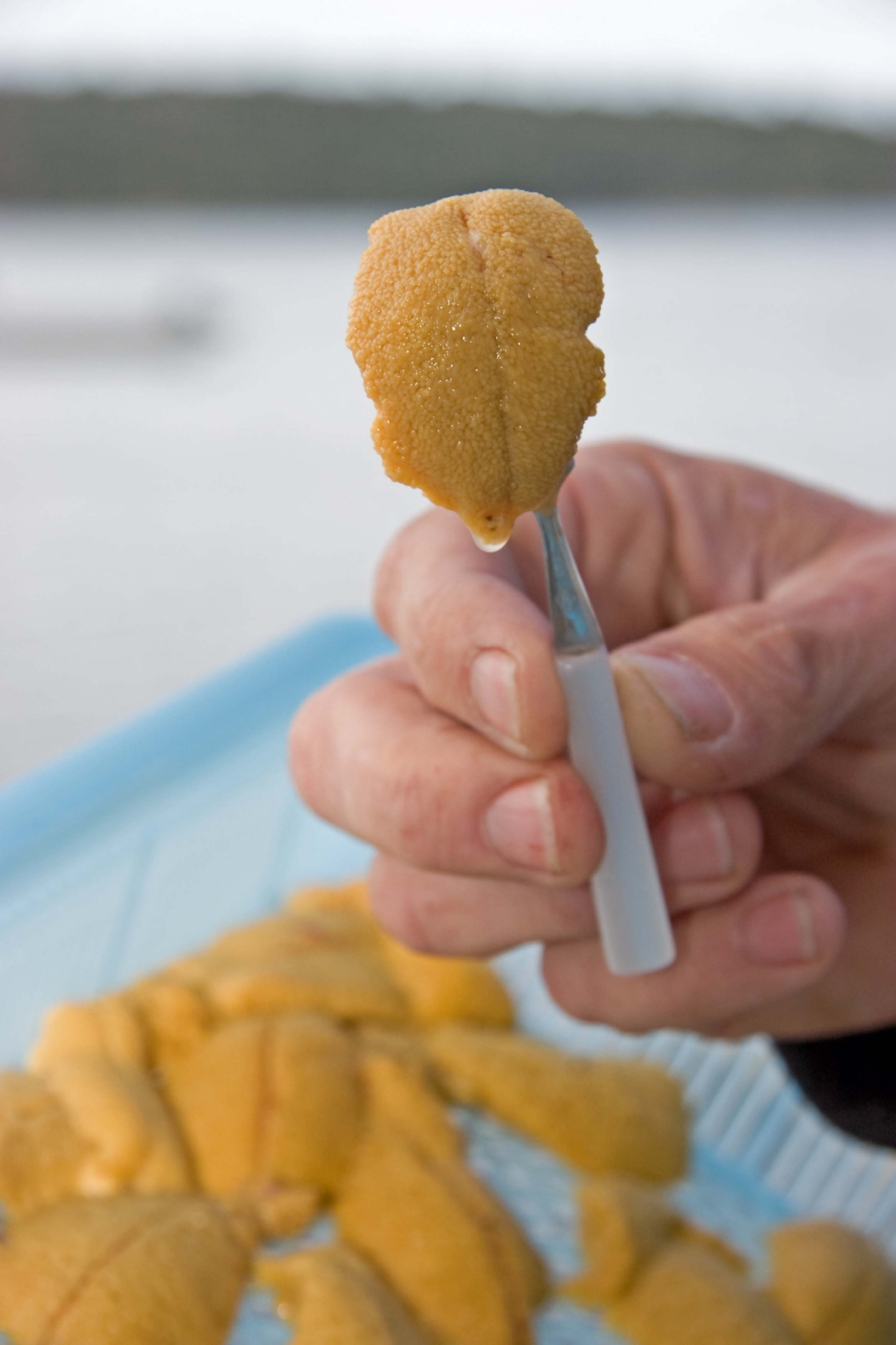
Dave Allen with ready to eat sea urchin roe - photo by Simon De Salis


MARKETS UPDATE

Faith, who has been bringing wonderful bread to Byron FM from the early days, full of produce from her garden in tiny Whian Whian, will be at the Byron Bay farmers market for the last time next week. She doesn’t want to be up all night baking any more, but will keep teaching, so hopefully her skills will not be lost. Enjoy sleeping at night Faith, & thanks for all the pumpkin bread & olive bread & fruit scrolls & seeded spelt & mandarin rolls & panforte.. if you are gluten intolerant you’re probably reaching for an epy pen by now.

And now for the good news… as of last Thursday you can now get fresh pasta at the Byron F.M. The weather is really warming up and lovely strawberries have finished but blueberries are still in full swing. Try making blueberry ice lollies, fun for kids of all ages, by just rinsing them and freezing them. You could also try dropping the frozen berries in drinks. Finger limes are here in time for xmas oysters, more waves of new potatoes, plenty of bananas. According to Craig our banana growing bellysister, farmers who rely on the big stores for sales are getting such low prices they are digging fruit into ground, as customers haven’t yet gone back to bananas and some large supermarkets are often still charging quite high prices. Chokos are back, there are plenty of good leafy veg, zucchini and squashes, plenty of capsicum and a good variety of tasty tomatoes. Good cherries have hit the shops but not markets quite yet.

Some changes with Christmas week markets. On Christmas Eve, there is a Lismore twilight market (2 to 7pm). The week 4 Sunday is Christmas, so the Bangalow market will be on Boxing Day this week. Next week, Byron Bay market also moves to January 2. Some evening/afternoon markets are on for summer : a Thursday produce market in Lismore (3.30 to 6.30 pm); also a farmers market in the Coffs Harbour mall on Thursdays.


BELLY TOUR DE TASSIE

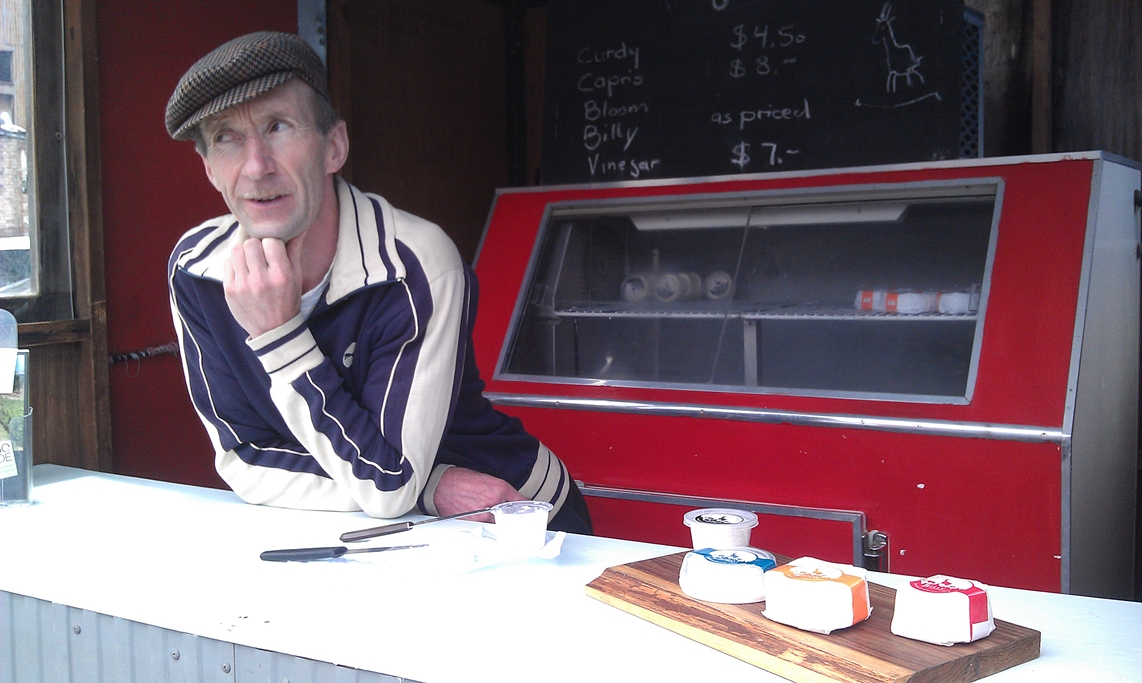
Goat cheese maker at the Hobart farmers market - he has the accent to go with the look too

I finally went to Tasmania last week, & will be going back again soon I hope, it is bellysister paradise.  A very beautiful place,  very peaceful after Byron. And a great food lovers’ destination.  There are the famous apples, wineries, at the moment lots of berries, but also many people trying new things. Much like in this area, but with very different weather & environment of course.  Fresh wasabi roots & saffron for example.  At the Saturday Salamanca market in Hobart you can buy saffron bulbs & Australia’s first hard raw cow milk cheese, from Bruny island, lovely but very expensive.  Salamanca market was the only really busy place we went to, some really interesting stalls among the usual market suspects that you see all over the world, but if you want just interesting food, check out the city centre farmers market on Sundays in Hobart.  Along the coast, oysters and crays just out of the water.  One business, based among the oyster leases at St Helens on the East Coast, has very successfully started to sell a major invasive pest of Tasmania’s waters to

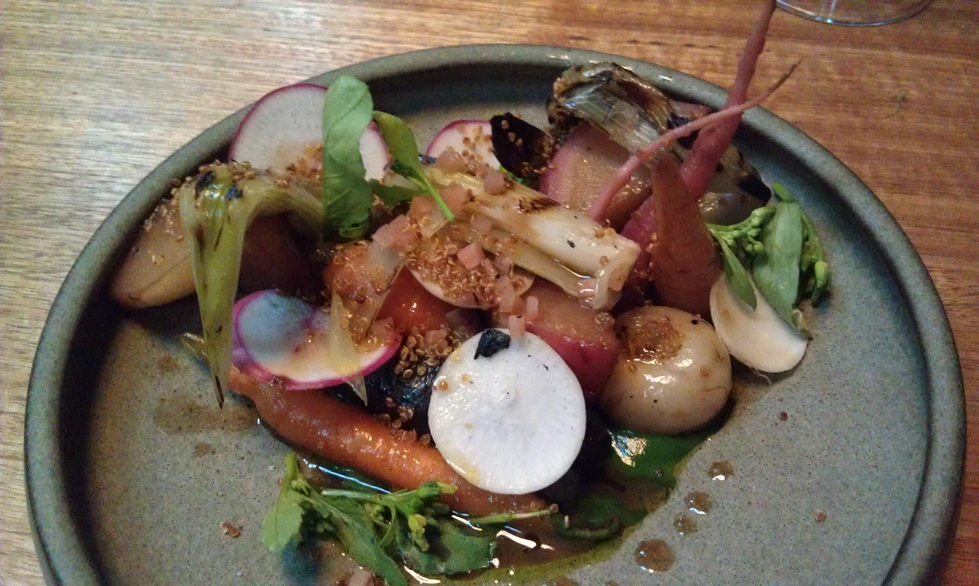
A beautiful garden made with "glazed turnips, carrots + society leek, nettle sauce, lovage oil, toasted quinoa" at les Garagistes. Toasted quinoa is an idea to try, it gives a lovely crunch to the dish.

some of Australia’s best restaurants – sea urchins.

Researchers have found that the oversupply of sea urchins in Tasmania is caused by the interaction of global warming and the overfishing of their predators, mainly large crayfish.  So we should be eating the urchins instead, but not just because they are a sustainable resource. They are meant to be aphrodisiac, possibly because the bit you eat are the sexual organs, and good for you.  But mainly they taste great, although they can be a bit of an acquired taste.  Luke Burgess, chef at Les Garagistes in Hobart, has urchins on the menu pretty much all the time.  He has now started to offer them as an optional extra because lots of customers were leaving them on the plate.  And that is on an adventurous fun menu full of offal and obscure ingredients.  I was even inspired to order tripe there.   If one of the wonderful people who invite me to dinner ask what I don’t eat, the answer is always “tripe”.  I will have to change it to “vegemite”, because Luke’s tripe was my favourite dish when we ate there.  It was very finely cut, an exploration of delicate textures rather than a lesson in cow biology, and the flavour was rich and deep, warmed by piment d’espelette (a Basque chilli),  sharpened with pickled shiitake mushrooms.  I actually got a little annoyed because the guy next to me at the shared table kept asking me questions and I did not manage to finish every speck of tripe while it was hot.  Even though he was a charming man, and the shared seating not only allows you to chat with friendly locals, but to check out everybody else’s beautifully arranged food landscapes.  Do try Les Garagistes if you go to Hobart, there is a no bookings policy but you can probably get in if you go early or late.   There is a lot there that flows along with current trends, from the presentation to shared small and large plates, smoking and curing, to the gleaned & locavore thing (though the oxalys weed in my dessert did taste just like a bit of pureed weed, and not in a good way).  But mostly the flavours work together really well and each element is prepared with great skill.  I finally saw the point in wagyu for example, with a delicious simple smoked brisket (with alexander mayonnaise, a new herb to me).  It is

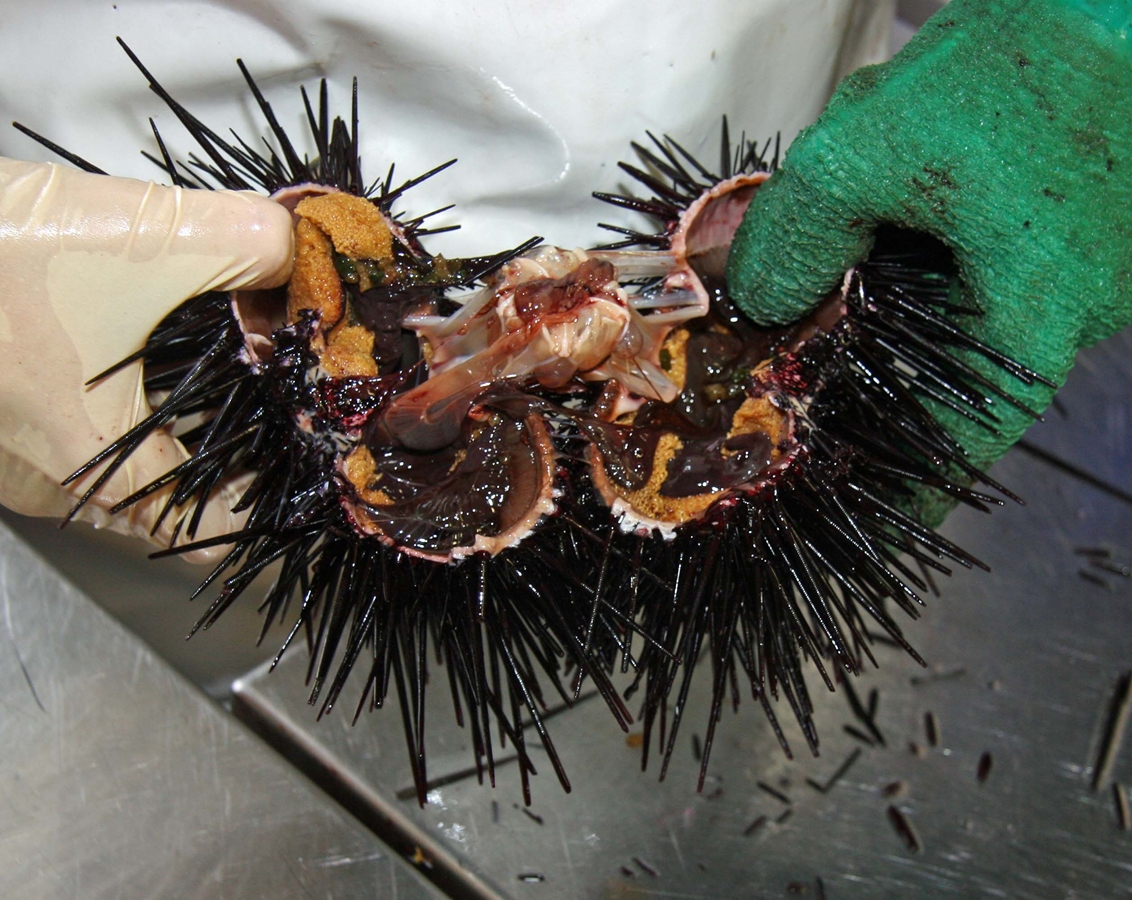
Cracking into a sea urchin - Photo Simon De Salis

fun food to eat if you are food obsessed, lots on the plate to keep you interested, and there is very interesting wine list too, with lots of information about the producers.  Not the place to go if dessert is the highlight of your meal though, but rhubarb granita is certainly an idea to try at home.

The urchins at Les Garagistes, Tetsuya’s and a bunch of other demanding Australian restaurants come from Seafoods Tasmania.  David Allen, who dives for urchins and is one of the owners of Seafoods Tasmania, has seen how hungry urchins are.  They are basically a ball of spines, with their bum up and their mouth down, eating. They love decaying seaweed, but they will eat pretty much anything.

Dave told me about about eating invasive NSW urchins in Tasmania, & the importance of creating regional jobs in the food industries. Tasmania is a lovely place to visit, with many interesting things happening on the food front, but has very high unemployment rates.

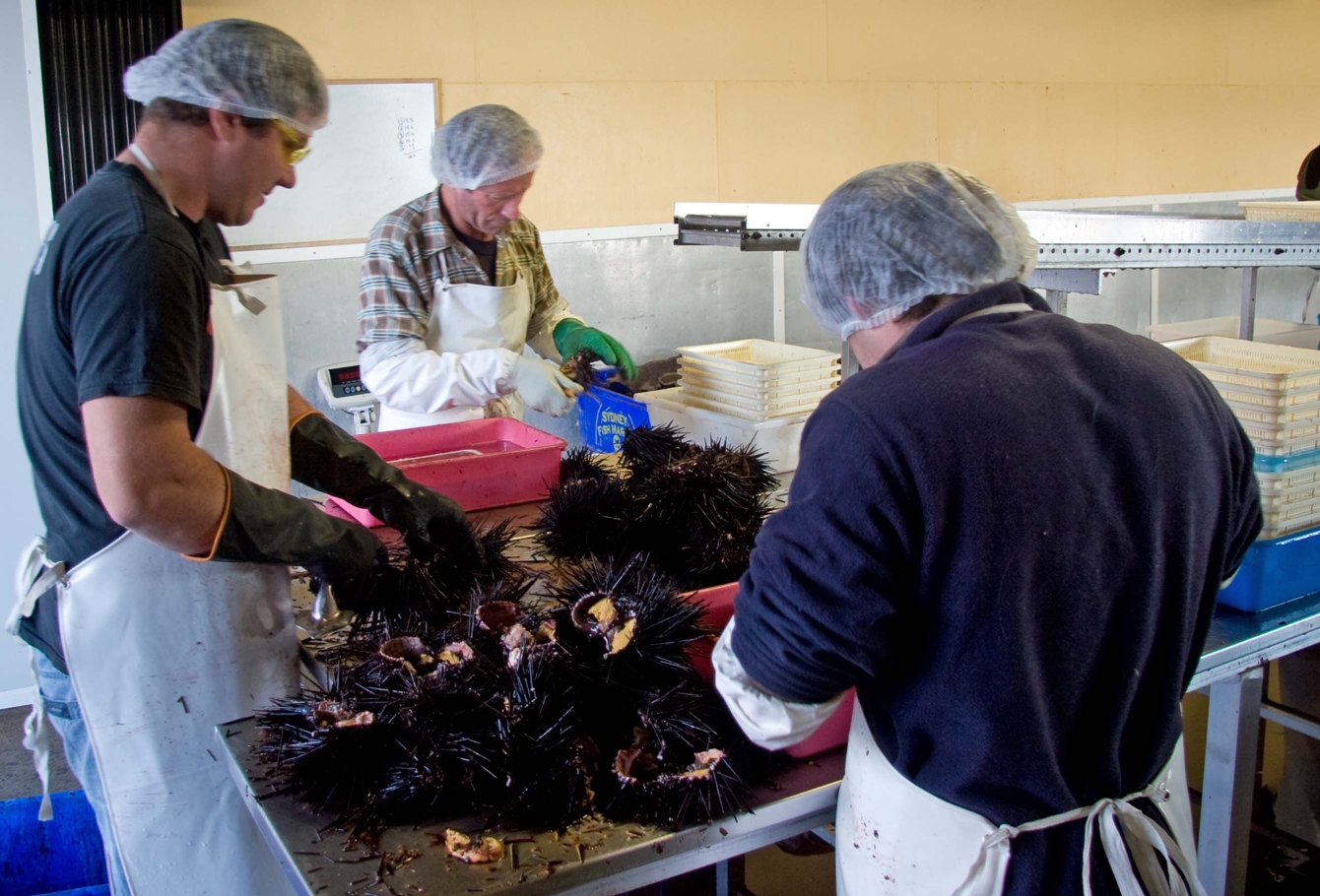
processing sea urchins - photo Simon De Salis

Dave  first ate an urchin about 15 years ago, and spat it out, saying “you’ve got to be kidding”.  They are also a bit  hard to handle. I told him about urchins I bought, all excited at the Sydney fish markets years ago, to share with friends a wonderful childhood memory of fresh urchins in Italy, straight out of the sea.  I opened them up soon after getting them home, and did my best to clean them, but we just couldn’t eat them, they smelled so bad.  I could never face urchins in the shell again, and I never knew if I had somehow stuffed up cleaning them until I asked Dave.  He says even restaurants who serve them in the shell often throw out the insides and use the shell as presentation for roe processed on site, as urchins really don’t travel well.  And the useful part is tiny, only about 8-9% of the whole spiky creature on average.  If you didn’t catch the show, the whole interview audio is below, or check out the Seafoods Australia links to more info.  Tasmanian Regions spring 2011 magazine (available online) also has an article about these tasty little pests.


COOKING SEA URCHINS

sea urchin roe, ready to eat - photo Simon De Salis

Well the best way is probably not to cook them, but to have them raw, as fresh as possible, maybe with a little lemon juice.
Dave suggests with wasabi, added to any sushi, on oysters, natural or as a variation on Kilpatric, or as a sauce on fish or cockles/vongole, or in fish soup.
Maggie Beer has a lovely recipe for urchin butter, made with lemon zest, pepper, butter, and urchins, dolloped on grilled scallops.  (Maggie says sea urchins are her secret indulgence)
Or make urchin butter sandwiches like Dave’s Pacific islander customers, or eggy urchin fritters or omelettes.  Maoris call urchin roe ‘kina’.
Italians make sea urchin pasta, cook fresh tomatoes & onion in olive oil 15 minutes, then add urchins, with chopped parsley and garlic towards the end of cooking.

I made an urchin pasta on the road with coriander & lemon zest & cauliflower & way too much butter mmm.  I bought coriander just because it was the only healthy looking herb (the St Helen’s herb lady was on holidays) but its funkyness really goes well with sea urchin.
The easiest place to try them is at a good sushi restaurant – they turn up pretty often, or ask your fishmonger to get some in – urchins pack a big flavour punch for a very small weight so we can probably make an exception to food miles rules.  And if after all that you are left wondering what they taste like… well they taste like nothing else.  At first they taste of the sea, like a natural oyster, as you get into a piece they are soft and rich, nutty and sweet and have a deep and intense flavour, a little like a really rich seafood soup.


SEA URCHIN AND CAULIFLOWER PASTA – from the belly mobile lab

Steam or microwave some cauliflower, cut into small florets.

Finely chop a little garlic, roughly chop a lot of coriander leaf.  If you want to get fancy, the root is nice cooked in butter and finely chopped in this.

Cook the pasta in lots of water even if you are on the road and have to use two pots.

Mix together hot pasta, cauliflower, coriander, garlic, salt, pepper, a little of the cooking water if the sauce is dry, and way too much butter.  Serve raw cleaned urchin roe separately so everyone can add to taste.  This pasta works even without any sea urchin.  I didn’t forget the parmigiano, you don’t need it.


LINKS TO INFORMATION ABOUT TASMANIA AND SEA URCHINS

We were lucky enough to have a very well informed friend guiding us around some of Tassie’s most delicious and beautiful places, ex Suffolk Park resident Simon De Salis.  He is a very talented professional photographer and now the editor of a magazine called Tasmanian Regions (ex TasRegions).  It is available online here, and has lots of great photos and interviews with people doing interesting things with food around Tasmania.  Thank you very much Simon for the tasty tour de Tassie and the urchin photos, and may the surf gods smile on you.

Seafoods Tasmania has lots of photos and info about sea urchins on their website.

There are lots of urchin videos on youtube, from an urchin eating a biscuit (disturbing), to underwater footage of urchin barrens, a whole Ironchef  ‘urchin battle’, and lots of guys trying to look tough by eating live sea urchins.


SEA URCHIN SAFARI – INTERVIEW AUDIO

Click on the links below to listen to the interview I recorded at St Helens, on the Tasmanian east coast, in the lunch room of the tin shack which currently houses Seafoods Tasmania, with diver and co-owner Dave Allen.  Apologies to the blokes whose lunch was delayed because I asked too many questions, and a big thanks to Dave and Julie for the hospitality and the delicious sea urchin tastings.

what sea urchins eat

why should we eat sea urchins, & who does

sea urchins and global warming

processing sea urchins

why you should choose very fresh urchins & ways to cook urchins

sea urchin seasons & simple ways to eat them


MUSIC

Ludwig van Beethoven – the ode to joy – for Faith the Whian Whianbaker

Bamboo love shack and Moon Shaker, by Water Melon, from the cd “Fish smell like cat”

Lovers who drink the sea, by the Oyster Murders

Passacaglia in C minor by JS Back, from the cd ‘Sea Symphony”, Sydney Symphony Orchestra

Aphrodisiac, by Ganga Giri, a little Byron sound for Simon De Salis

The future’s so Bright…, by Abbie Cardwell


MORE BELLY TOUR DE TASSIE


delicious fruit icecreams at Eureka farm - crabby owner but best icecreams


Since you have made it this far down the page, I’d like to share a couple more tasty places we have come across.   Lucky it is small by Australian standards, we were only there for 5 days!  I’d love to hear your suggestions for the next belly tour, in Tasmania or anywhere else.  One idea we should copy in our area are the farm gate routes, explained in brochures with opening times, seasons, specialties.

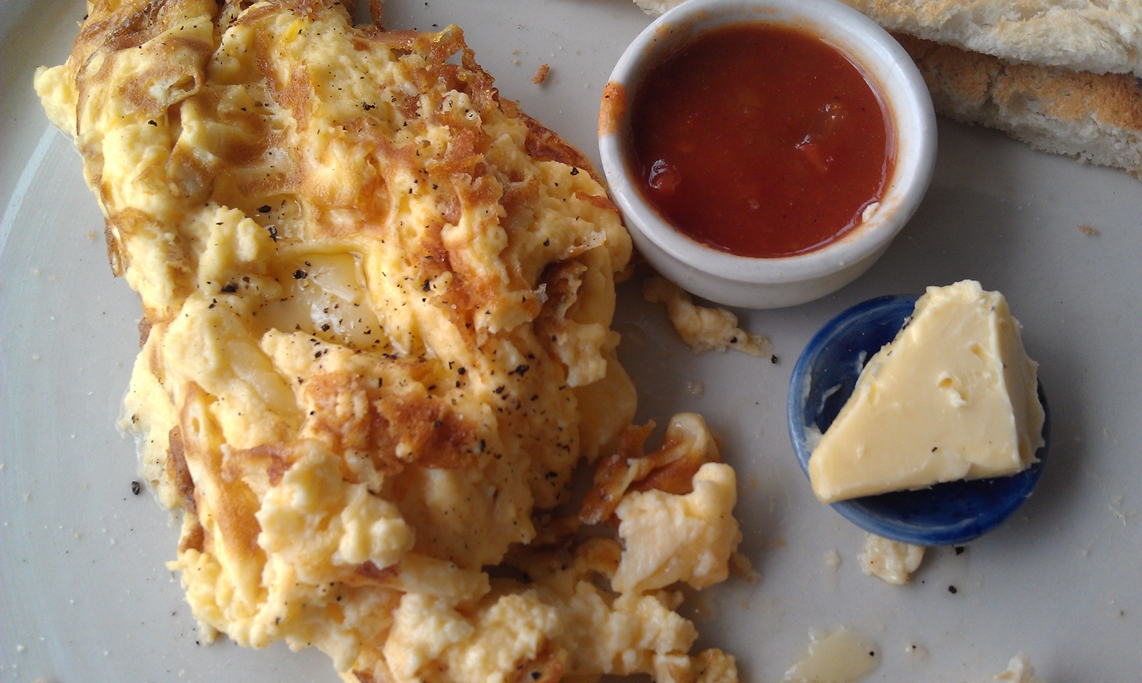
cheddar omelette with chutney - no it didn't really need the butter

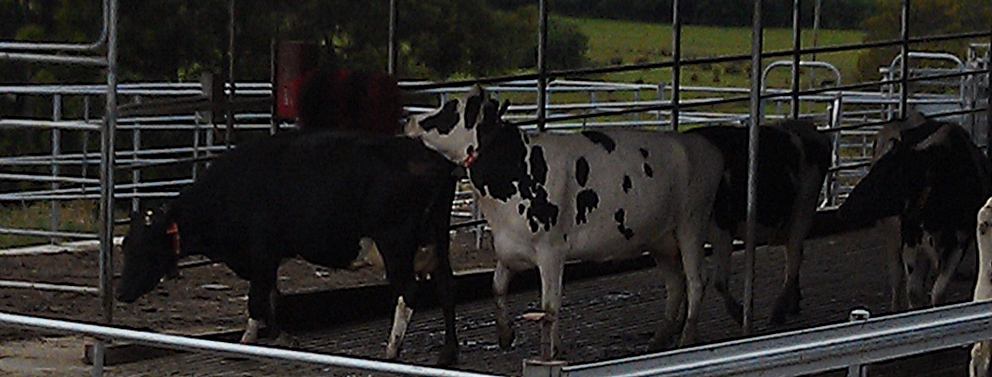
Pyengana cows pushing to get themselves a scratch from the brush roller

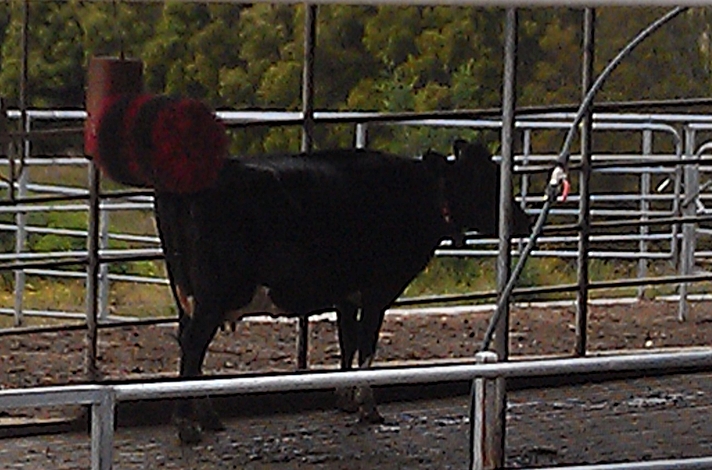
one lucky cow has got the bum scratcher to herself for a minute

just to prove we did something other that eat... a post-cheese waterfall walk


Thank you for listening to belly this year, or making your way to the belly website.   A big thank you to Sis Rasela for a year of belly, & to Alison Drover, our ever changing seasonal bellysister & tandem bike racer & to the very very delicious regular belly listeners, may your pot be always full of good things, & remember, cooks WILL save the world, or at least make it better.

I’m back on January 2nd with a very interesting guest, professor Mike Evans, who has lived and eaten in many interesting places, especially focusing on feasts and food and relationships on the Pacific island of Tonga .  He will tell us how he  somehow managed to not only eat dog, but eat I quote “his own dog –  – by mistake”.

Love and chocolate covered sea urchins (you never know, it might work), have a happy and peaceful holiday season,

Sister Tess


gluten free or not gluten free .. that is the question

Talofa Lava, sister Rasela in the bellylicious kitchen today. Yes, it’s that one hour of the week where we turn the BayFM studios into a tasty treat for your hungry ears … what are we covering today ??

GLUTEN, GLIADIN, COELIAC DISEASE … living with it, learning to live without it, replacement foods and alternatives so delicious they may entice you into a gluten free life whether you need to or not !!

fields of wheat ... pretty but painful for some


I had a panel of guests this wonderful wheat free morning. They all had fascinating and informative stories about gluten and how it has graced their lives with lessons and learning’s, which is what disease can do if you look at it positively and discover more about the incredibly unique and gorgeous body you live in.

Perhaps you already know about gluten inside out or perhaps by listening or reading this you could learn a thing or two from belly, after all this is community radio, deliciously diverse, full of facts, fun and free spirited conversation.

What you choose to do with what you hear or read is entirely up to you because only you can know what’s best for you. We are just here chewing the unsaturated fats and stiring up a pot of bubbling belly broadcasting.

We started with a track from Xavier Rudd and maybe he’s singing about gluten in this track because it’s called FREEEEEEEEEE … all other tracks came from the Bomba vs Laroz album which i highly recommend.

A little lowdown on Coeliac Disease may help you to understand the basics of someone that has to live with this mostly reversable condition. This person could be YOU.

Coeliac Disease is a hereditary disorder which looks to be on the increase and thought to currently affect around 1 in 150 people. Still so many people live with the symptoms and are unaware they have to suffer this way. Those with the condition are sensitive to a part of protein found in wheat called gluten but more specifically GLIADIN which is the protein part of the wheat. It also includes some other grains that between them cause an immune response which damages and changes intestinal villi (vil-eye)  leading to malabsorbtion of nutrients from food amongst other things.

The walls of your intestines are covered with this villi which sort of resemble fingerlike structures, naturally flowing upright from the walls of the intestine. They are meant to allow the absorption of the nutrients we need to survive in between their villi structures.

a computer generated image of healthy intestinal villi ... aint it purty ?


Check out this slide show for a more detailed exploration into your intestines – http://www.medindia.net/slideshow/celiac-disease.asp

Someone with Coeliac Disease like my first guest Mikki has a different story going on down there. The villi in her intestines lays flat if she eats gluten. This is part of the immune response. If the villi are laying flat on top of one another, then the nutrients from food cannot be absorbed.  Inflammation and destruction of the intestinal villi also occurs which reduces the surface available for absorption in the small intestines so it is easy to become malnourished.

Common symptoms include – diarrhoea, abdominal pain, flatulence (farting), muscle cramps and spasms, fatigue and weight loss, and when more severe, anemia, easy bruising and bleeding, and reduced bone mineral density.

!! THE GOOD NEWS !!

Unlike most diseases, damage to the body is almost totally reversible by adopting a gluten free diet and a possible change of lifestyle. Rigorous reading of food labels will be necessary to detect ingredients and hidden wheat additions as wheat is used as a ‘filler’ to bulk out things like sausages for example !! Significant renewal is possible after 1-2 years of consistent effort but villi reversal results can often be seen after only a few weeks.

Many individuals with this disease are also lactose intolerant and so avoidance of most dairy products or at least reduced intake is recommended.

OMG !!! you may be thinking and a few years ago you might have had every reason to wonder what the beejeebers you would have left to eat BUT don’t despair … there are many many alternatives and here to tell us about them we have not one but TWO gluten free creative artists – Dale and Naomi – who are here to chat about their delicious mouthwatering xmas treats they have developed to cater for such needs.

... doesn't have to taste like stale cardboard !!


As the guests lined up and we settled into the show Mikki spoke up first about bringing up her daughter who had Aspergis until she put her on a gluten free diet at the age of 11  and witnessed unbelievable changes. At the same time a listener called in to say it also helps in Down Syndrome and it has been documented that it is very common for people with Schizophrenia to be Coeliac’s, gluten intolerant or allergic to gluten … I’m sure the list goes on. The membrane of the intestine is very similar to parts of the brain and a sensitivity to gluten can cause moodiness and depression as well as agitation. I know this first hand.

I will come back and complete this post shortly but for now i will leave your belly’s rumbling with a link to “Lindt Chocolate Christmas Log”, “Heavenly Christmas Fruit Babycakes”, “Heavenly Gingerbread Stars” and “Star-Topped Mince Pies” all preservative free, chemical free, with natural food colourings, organic eggs, Australian butter, fruit and nuts and of course GLUTEN FREE .

My mouth is truly watering because i have a leaflet beside me with pictures of the above mentioned !!

Here are the luscious links –

Email – glutenfreeXMAS4u@gmail.com

Phone – 02 6680 1797 or 0434 550 811

Last orders Dec 17th. Last baking day Dec 21st.

Yuuuuuuuuum. With love sista r x

cooking up presents

On air on bayfm 99.9 community radio in Byron Bay on 5.12.11

Christmas trees are going up and carols are in the air from Bangkok to Buenos Aires, from Tokyo to Doha. I know because I looked at the Twitter carols thread. Doha is in Qatar, I had to look it up,but even there people are getting into the carols, yes this is your annual belly carols alert. And we are getting into another tradition, presents, which is older than all the Christian traditions of this festival. Especially the giving of food gifts. We are cooking up the presents on belly today, with Miss December & our new baking bellysister Deanna.  Miss December also brought us the most abundant December fruit & veg, and we launched a new series that will turn you into a confident pastry cook. Chock full of goodness today on belly.


Merry Everything from Sister Christmas!


The lovely Miss December, Alison Drover, is sharing her father’s Royal Easter Show winning Christmas cake recipe, and great easy to make cheese biscuits.


MISS DECEMBER’S BELLY CHRISTMAS – TRIED AND TRUE EDIBLE GIFTS


DON’S‭ (‬ALISON DROVER’S FATHER) CHRISTMAS CAKE‭


[This is an old family recipe,from before Australia went metric, so these are Imperial measurements, not American cups if you are looking at Belly from the USA]

1 &1/2‭ l‬bs sultanas

1/2‭ l‬b raisins

4‭ ‬oz currants

4‭ ‬oz mixed peel

3‭ ‬oz dates

1/2‭ ‬cup macadamias‭

1/2‭ ‬cup rum brandy or sherry

8‭ ‬oz butter

1‭ ‬vanilla pod‭ ‬-‭ ‬scraped

1‭ ‬tablespoon grated orange range

1‭ ‬tablespoon grated lemon rind

5‭ ‬eggs

1‭ ‬cup brown sugar‭ ‬-‭ ‬firmly packed

2‭ ‬tablespoons orange marmalade

2‭ & ‬1/2‭ ‬cups plain flour

1/2‭ ‬teaspoon salt

1/2‭ ‬teaspoon cinnamon

1/2‭ ‬teaspoon nutmeg

4‭ ‬tablespoons rum or ‭ ‬brandy


Soak mixed fruit in brandy.‭ ‬Cream butter until smooth,‭ ‬add vanilla and rinds.‭ ‬Add sugar,‭ ‬beat well until mixture is combined,‭ ‬do not overcream or cake will crumble when cut.

Add eggs,‭ ‬one at a time,‭ ‬beating well before adding the next one.‭ ‬Add marmalade and mix well.‭ ‬Add creamed mixture to fruit mixture,‭ ‬mix thoroughly,‭ ‬sift dry ingredients,‭ ‬add in two lots to fruit mixture,‭ ‬mix thoroughly.

Put mixture into a‭ ‬71/2‭ ‬inch square cake tin lined with four layers of greaseproof paper.‭ ‬Spread mixture level.‭ ‬Bang tin on table to settle mixture.

Bake in a slow oven for‭ ‬3‭ ‬to‭ ‬3‭ ‬1/2‭ ‬hour.‭ ‬Remove cake from the oven and test with a skewer.‭ ‬If it comes out free of cake mixture,‭ ‬remove cake from oven.‭ ‬Brush the cake evenly with extra rum brandy‭ ‬-‭ ‬you can use a little less or more than‭ ‬2‭ ‬tablespoons.

Cover immediately with some tin foil then a towel.‭ (‬This traps the steam giving a moist cake‭)‬.‭ ‬When the cake is cold‭ (‬about‭ ‬12‭ ‬hours‭) ‬remove from the tin and‭ ‬wrap in foil.‭ ‬Wrapped in this way it will keep for several months.


CHEESE BISCUITS – By Alison Drover


Ingredients

1oog fresh goat’s cheese or blue cheese

1 & 1/2 tablespoons freshly grated parmesan cheese

1 teaspoon fennel seeds

150g softened unsalted butter

scant pinch of salt

1/4 teaspoon pepper

175g plain flour, sifted


Method

Blend cheeses, butter, salt and fennel seeds quickly in food processor until smooth. Remove to a bowl and fold in flour.  Spoon mixture onto baking paper and roll into a log about 5cm in diameter. Refrigerate for several hours until firm.

Preheat oven to 180 Celsius. Slice thinly and put on baking trays lined with baking paper.

Bake for 10-15 minutes until golden. Cool, then store in airtight tin.


DEANNA’S CHRISTMAS TRUFFLES


BASIC TRUFFLES


200g good quality eating dark chocolate

1/3 cup cream

½ tsp vanilla extract

¼ cup cocoa powder or icing sugar


Combine chocolate and cream in the top of a double boiler or in a heat proof bowl over a pot of simmering water. Stir with a metal spoon until just melted and smooth. Remove from heat and stir in vanilla

Place in fridge to chill for approx one hour or until firm enough to roll into balls

Using approx. 2 tsp of mix at a time, roll into balls, place on a baking sheet covered in baking paper and refrigerate again until firm.

Place cocoa powder in a shallow dish, roll truffles in cocoa powder to coat.

Store in an airtight container in the fridge


PEPPERMINT TRUFFLES


400g good quality dark eating chocolate

2 tbsp peppermint liqueur (or 2 tsp peppermint essence)

70g peppermint chocolate (could be peppermint crisp, or mint flavoured chocolate, but not cream filled or green) crushed,

50g white chocolate chopped


Melt 200g of dark chocolate and cream as in method for basic truffles. When melted, take off heat and add liqueur or essence. Allow to cool for 10 minutes and add peppermint crisp.

Chill and roll as in previous recipe.

Melt remaining 200g chocolate. Place a toothpick in each truffle and dip into melted chocolate to coat. Place back on baking tray and allow to chill in refrigerator.

When chilled, melt white chocolate. Using a piping bag or small ziplock with the corner cut off, place chocolate in bag and pipe white chocolate over truffles. Refrigerate until set.


HAZELNUT TRUFFLES


450 g good quality milk chocolate, chopped

40g butter chopped

20 roasted whole hazelnuts

100g roasted hazelnuts chopped finely

50g dark chocolate chopped


Melt 250g milk chocolate and butter as described in basic truffle recipe, mix in chopped nuts and chill.


When firm, roll into balls pushing one whole hazelnut into centre of ball. Chill until firm.


Melt remaining 200g milk chocolate and place toothpick in each ball. Dip in melted chocolate and allow to set. Melt dark chocolate and pipe over truffles as described in peppermint truffle recipe.


TOFFEE TRUFFLES


140g packet of werther’s original hard toffees


400g good quality milk chocolate, chopped


1/3 cup cream


½ tsp vanilla extract


50g good quality dark chocolate.


Place werther’s in food processor and process until fine crumbs. Melt 200g chocolate and cream as in basic truffle recipe. Stir toffee through chocolate mixture. Chill as in previous recipes, and roll, then chill again. Melt 200g milk chocolate and dip truffles in melted chocolate using toothpick to hold on to truffle. Allow to chill and then pipe melted dark chocolate over top.


WHITE CHOCOLATE COCONUT


450g good quality white chocolate chopped


1/3 cup cream


30g butter


2 tbsp dessicated coconut


2 cups shredded coconut


2tsp coconut essence


Melt 250g white chocolate, cream, and butter.  The method I use for the white chocolate truffles is a bit different when I melt the

chocolate: I heat the cream and butter until almost boiling, and then pour it quickly on top of the white chocolate pieces and stir to melt.

Stir through desiccated coconut and essence. Follow steps for chilling and rolling as in above recipes. When chilled, melt remaining white chocolate and dip truffle in melted chocolate using toothpick, immediately afterwards rolling in shredded coconut. Allow to cool.

Truffle recipes adapted from “Superfood Ideas” December 2007


BELLY BULLETIN


Northern Rivers Food Links would like to connect food businesses who have leftover food going to waste with food aid groups who could put their leftovers to good use. If you have a food business operating in the Ballina, Byron or Richmond Valley local government areas, give them a call on (02) 6681 4772 or email

kim@northernriversfoodlinks.com.au


Shark fins are an expensive delicacy in Chinese restaurants. Scientists estimate between 26 and 73 million sharks are killed for their fins worldwide each year. Hong Kong is the major market, but local campaigns are successfully changing customer habits. About 60% of people there now say they wouldn’t eat shark fin, the price has dropped by 20%, and almost 100 caterers and hotels have signed up to the shark free menu campaign of the World Wildlife Fund, including the prestigious Peninsula group.


Global warming could be getting you drunk. More sun means riper grapes, which means more alcohol in your wine. Estimates are that global warming alone is increasing alcohol content by about 1 degree per decade. Wine writers and judges are also responsible, as many have praised big, full flavoured wines which also have a high alcohol content. Twenty years ago, most wines were 12 to 13%, now many are 15% or more. The smh has an interesting article listing average percentages in many wines, and reports calls to put alcohol content on restaurant and bar wine lists to help customers who are looking for a less potent drop.


If you want to trap a fire ant, give it a hot dog. Introduced fire ants have become a problem in Northern Queensland. They’ve displaced up to 95 per cent of the native ants, they can blind pets, they sting people as they garden or in their swimming pools. Biosecurity Queensland staff are luring the ants to footpaths and nature strips with traps baited with hot dog meat. Field staff put down the hot dog and leave it down for an hour and come back and pick it up and see what ants they’ve got. Spokesman Gary Moreton said “These ants are quite generalist eaters so they like all sorts of things, they like sugars, oils, proteins, and I think probably with those hot dogs, they’ve got a bit of everything in there.”


EDIBLE QUOTE

Irene Kangasniemi, a neighbour of Santa Claus from Lapland “When we are visiting places we don’t bring flowers, we bring food”


MUSIC

Amy Winehouse – I Saw Mummy Kissing Santa Claus

The Temptations – Rudolph The Red-Nosed Reindeer 2:58


Eileen Barton – If I Knew You Were Coming 2:51

W.A. Mozart, “Sleigh Ride”, opus K605 no.3


liberating larders with love and linguistic lashings

Talofa Lava, sister Rasela with you for a scrumptious hour of belly – THE tastiest show on the airwaves, where we bring you stories, info and basically anything tasty, little or large, titbit or trailerload, delightfully dipped and carefully picked, bits and snipets.

As you can imagine it’s a never ending topic as everyone has their own story about food. Today we are joined by Chrissy Butler who has recently moved to the area as a vegetarian chef extraordinaire. Blessed in ways they may not yet be aware of, the homeless and hungry have this lovely lady volunteering her love, time and cooking skills to feed them all in the LIBERATION LARDER.

Just in case you don’t know, the Liberation Larder is located downstairs from the BayFM studios in the Community Centre Fletcher Street entrance and provides a free cooked meal to anyone in need every Monday at around 1.30pm. This meal of course does not miraculously appear out of nowhere. A team of vollies start at around 7am to gather, sort, chop, cook and serve donated food to the people in our community that really need it.

!! HERE’S WHERE YOU CAN HELP !!

LIBERATION LARDER IS DESPERATLEY SEEKING VOLUNTEERS FOR THE PERIOD LEADING UP TO XMAS AS THEY PLAN TO SERVE UP A MEAL ON XMAS DAY … alot of their vollies are away at the moment and it places extreme strain on the few that are left behind so PLEEEEEASE either just wander in and offer your help on ANY Monday or Thursday or organise to help at Xmas time by contacting –

Rhonda – 0431 523 310

Please help if you can, i saw Chrissy yesterday after they had shut up shop and she said she had to do the job of 3 people and was pleading with me to let anyone i know know .. know what i mean ? Happily she was on her way home to put her feet up and you could be too with a warm fuzzy heart, knowing you have done something for and within the community. We are all part of the same community and there are some asking for HELP right now.

Do it if you can …

There is more info to follow in this post relating to “Frauduent Quackery”. This may help you to know whether what you are reading on the internet or hearing people discuss is fact or in fact fiction.

In the words of a tired and yawning bellysister – I’ll be back … badder and better after a bitta sleep xx sista r

Italian regional food

On air on Byron Bay’s Bayfm 99.9 community radio on 21 November 2011

A Sicilian, a Roman and a Piemontese walked into a studio…and started talking about food – it could become the edible version of occupy Wall street, but lucky for the presenters who are on after us we will probably be quickly driven out by hunger.  Well actually the Roman kind of got lost on the way to the forum…Hopefully I will get to talk to Valentina soon, she has done a course at one of my favourite Italian food mags, sites and now school, Gambero Rosso.  But the capo degli amorevoli, wonderful Italian presenter Sergio from the Bayfm program ‘That’s Amore“, that has just returned to the summer broadcast, was on belly today.  Sergio is from Sicily, but has lived in Rome, Pisa and also in Merano, at the border with Austria, while doing his duty as a sweet young conscript in the Italian army.   I am from Piemonte, in the North near the Swiss/French border, but my parents have lived for years in Tuscany and Sicily, so between us we pretty much cover Italy, and many of its wonderful and very distinctive regional cuisines.

We are both keen to talk about some wonderful dishes from our bits of Italy , which are much less known than the standard pizzas and pastas.  We went straight off into singing the praises of caponata, a gorgeous Sicilian summer dish, done in many different ways across the island.  I have seen some very vibrant discussions among Sicilians about the best way to do this dish!


CAPONATA CATANESE – adapted from a recipe by Mimmetta Lo Monte in “Italy a Culinary Journey”

One 500 g eggplant

500g red and yellow capsicums

1 onion

60 g celery stalks and leaves

1 tbs capers, squeezed if in vinegar, rinsed and drained if in salt

6 large green olives, pitted and cut into pieces

2 tbs red wine vinegar

3/4 tsp sugar

6 canned tomatoes, seeded and finely chopped (or 6 very ripe tasty tomatoes, peeled, seeded and chopped)

salt

Peel a 2 cm strip of skin from the eggplant, stem end to bottom and back to the stem. Cut it into 2 cm cubes. Cover with water and 1 tsp salt. Weigh them so they stay underwater. Leave 30 minutes, drain, dry with paper or tea towels. Deep fry in 2 cm of oil on high heat, until dark gold. You may need to do this in batches. Set aside.

Cut capsicum and 3/4 of the onion into 2 cm cubes. Heat 3 tbs of the eggplant cooking oil, add capsicum, onion and celery. Stir over moderate heat for 2 minutes. Reduce to low, cover and cook 8 more minutes. Uncover, raise heat to high, stir until veg start browning. Add capers, olives, vinegar, sugar.

Turn off heat, add eggplant, mix very gently.

Finely chop the last 1/4 onion. Heat 2 more tbs of the eggplant oil in a small pan.

Saute’ the onion, add tomatoes, cook on high heat until they sizzle. If you are using fresh tomatoes, start a little slower and cook them a little longer. Stir in salt to taste and add to the other veg.

Serve at room temperature. This gets better the next day, and will keep well for a few days.

As we said on the show, this is basically the primary layer of caponata, which you can adapt and add to to your heart’s delight.  I have usually had it with pine nuts added.   You can add a lot of seafood, mainly little octopus (octopussies?), but also firm fleshed fish, bottarga (dried mullet roe), prawns, even lobster.  Or artichokes or asparagus.  There is even apparently a chocolate and almond sauce you can add, called Saint Bernard’s sauce, salsa di San Bernardo.  Play around, but try the basic version first.


SERGIO’S GNOCCHI WITH PESTO

This is a dish associated more with the North, and of course pesto is from Liguria, the region of Genova, but Sergio likes to make it as it is a low gluten dish, especially with spelt.  Spelt is called farro in Italian and has made quite a comeback in recent years.  Sergio said he likes to play around with Italian dishes, adding things like miso and tofu to Italian classics.

Gnocchi di Patate (4 people)

Ingredients

1kg Dutch (cream?) Potatoes, 200gr spelt Farina, 1 egg,


Steam the whole washed potatoes with their skin, in abundant water and a pinch of salt.

Let them cool down completely and then peel them, mash them till they are smooth.

Pour them on a floured wooden board, make a dimple in the middle and add the egg to it. Add the sieved flour little by little and mix it manually until it is hard and doesn’t stick to your hands. (Probably you will have to use only 3/5 of the flour)

Work it in long rolls of 1.5cm and cut it in 2cm pieces.

Use a fork to give them the right shape. (With a movement swift but firm). Put them on a well floured plate to keep them separated.

Boil them in an abundant (repeat abundant) salted water. When they rise scoop them with a holed ladle.

Mix the gnocchi with their sauce while still warm.


Recommended sauces: Burro e Salvia (Butter and Sage), Fresh tomato sauce and Basil, but you can try also with Pesto and grated Parmesan.


PESTO GENOVESE

(for 600 gr of pasta)


Ingredients

50 Gr of Fresh Basil leaves

½ glass of Extra-virgin olive oil

6 Tablespoons of Parmigiano Reggiano and 2 of Pecorino

2 garlic cloves

1 Tablespoon of pine nuts

A pinch of salt


For the traditional Pesto you should use a marble mortar and a wooden pestle.

Wash the basil leaves in cold water and place them to dry on a tea towel.

Pound the basil leaves and the garlic (a clove for thirty leaves) in the mortar with a slow circular movement.

When the basil releases its juice, add the pine nuts and then the grated cheeses. Finally add (slowly) the oil.


CORNMEAL BISCUITS – PASTE DI MELIGA By Sister T’s mum Franca Corino

A recipe from close to the mountains in Piemonte, where corn goes not only into polenta but into delicious light crunchy biscuits.  I remember we always used to buy particularly good ones in a little town where we made regular pilgrimages to a big discount shoe shop.  Half price Italian shoes and good biscuits : can a day be any more perfect?  This recipe is my mother Franca’s, from a book we did together, along with other authors from the regions of Italy, called “Italy a culinary journey” (Angus and Robertson 1991, ed A. Luciano) – 20 years old now, which is a bit scary.  [I just checked and you can get it on the internet for a massive $1 and 36 cents, + postage, but that is the American edition so I’m not sure if it would have the metric measurements as well]. The quantities are a little odd because the main market for the book was the US, you can play around a bit with the flour percentages.  Also if you are making this in midsummer in Byron and room temperature is 30 degrees, use your butter straight from the fridge.

315 g plain flour
90 g polenta flour
315 g butter, at room temperature
185 g sugar
2 egg yolks
1 tbs grated lemon rind

Preheat oven to 180 C.
Mix all ingredients lightly until the dough is similar to short crust pastry.  Be careful not to overwork it or the biscuits will be tough rather than crumbly and light.
Roll out to a 1.5 cm sheet, cut into circles with a biscuit cutter.
Bake on a buttered oven tray for 10 to 15 minutes or until golden.
Allow to cool and store in an airtight container.


BELLY BULLETIN


Where our food comes from, how it is produced and by whom, its impact on our lives and environment, the impact on our culture and on food security, will be some of the themes discussed at the Australasian Regional Food Cultures and Networks Conference. It will be held

At Peppers Resort, Kingscliff, on November 29 and 30, and is organised by Southern Cross University’s School of Tourism and Hospitality Management. The conference brings academics and industry together across a number of areas including food production, distribution, marketing, tourism and hospitality to explore key issues and opportunities for regional food.

Southern Cross University Professor Philip Hayward said the conference would specifically address local networking issues.

“Local food and low food miles are desirable. But to make local food industries sustainable we have to thoroughly rethink distribution systems, branding and appellation and how producers network with other members of the local supply chain,” he said.

School of Tourism and Hospitality Management Associate Professor Kevin Markwell said he believed regional food could become an engine for tourism.

” Food styles and products help create distinctiveness between regions which then has flow on effects in terms of attracting tourists

to regions to sample distinctive cuisine,” he said.

More info on the conference website, www.regionalfoodconference.com.au


AND BRIEFLY : 2013 has been declared the European Year against Food Waste, and Sikh immigrants are helping to save one of the most traditional of Italian food industries, Parmigiano Reggiano, as they are very skilled with cows, and willing to work the long hours required to bring us this wonderful cheese.


EDIBLE QUOTESDETTI GUSTOSI

A few of the many many Italian sayings that involve food.  There is a huge list here, although some of the translations are a bit off the mark.

A tavola non s’invecchia – you never get old sitting at the dinner table (not sure if this is because of the good food or the good company)

Non puoi avere la botte piena e la moglie ubriaca – you can’t have a full wine barrell and a drunk wife (both very desirable things)

i.e. – you can’t have your cake and eat it too


MUSIC

A big grazie to Sergio who always picks really interesting and varied music for That’s Amore, and brought all the tracks we played today.

Vacanze Romane – I Matia Bazar

Pronto – Zucchero

Rap Lamento – Frankie Hi-Nrg MC

Pasta al Pesto e Papadan – La banda di piazza Caricamento

Curre Curre Guaglio – 99 Posse


Love and caponata with chocolate sauce, sorella Mariateresa (aka sister T)

Love, fear and dumplings in Shanghai


Today Katrina Beikoff, author of “No chopsticks required: my family’s unexpected year in Shanghai”, was the delicious belly guest.  She  shared her stories and Ayi Tina’s dumplings.


AYI TINA’S DUMPLINGS

500g Pork Mince
Tbsp Soy sauce
Few drops sesame oil
Tsp Ginger
2 Tsp rice wine vinegar
1 clove garlic finely chopped
Handful Coriander inc stalks
Chives or spring onion
Salt
Pepper
Dumpling/wanton wrappers

Dipping sauce:
Vinegar
Coriander
Spring onion

Method:

Mix the pork mince and other filling ingredients.  For extra crunch and a little Chinese cabbage, but Tina (and I) find the coriander stalks are enough.

Assemble various helpers (children) to construct dumplings.  Alternatively, settle in front of daytime TV while assembling dumplings (choose a Chinese soap opera for the authentic experience).

Place about a teaspoon of the pork mixture in centre of round dumpling wrapper.  The trick is then not only to fold wrapper into a half moon, but to tuck in each wing before sealing the semi-circle.  Use water, or a slurry mix of water and corn flour, around the edge of the wrapper to help seal the dumpling.  Pinch the edges together to create seal and give that lovely ripply edge to the dumpling.

Plunge dumplings carefully, a few at a time, into boiling water for about six minutes to cook.

Meanwhile make dipping sauce by adding favourite flavourings to vinegar:  I prefer as much coriander as the vinegar can handle plus a smidge of chilli.

Please note measurements are only a rough guide, adjust sauces etc to taste preference.


MORE COMING, SORRY, VERY BUSY WEEK (OR 2)