On air on Byron Bay’s Bayfm 99.9 Community radio on 25 June 2012
I decided to call today a scary belly because both puff pastry and artichokes are foods that can be a bit scary to handle for even an experienced cook. But so wonderful to eat, and fun to work with once you make friends.
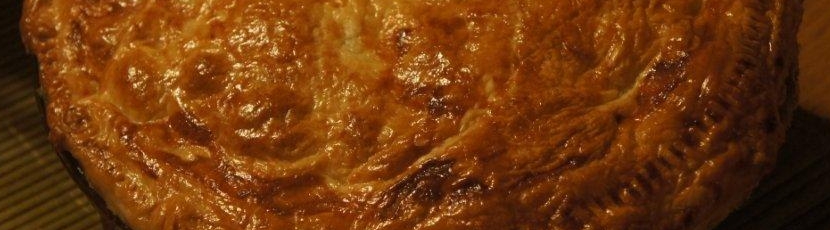
DEANNA’S EASY AS PIE – PUFF PASTRY
Deanna’s easy as pie series has been all about baking from the kitchen of a good home cook, learning the secrets of various types of pastry and dough. Today she made even one of the scariest pastries of them all, puff pastry, sound achievable by a first timer. So much that I might even try it myself – like most of us I have relied on (strictly all butter – mmm) store bought puff pastry, which turns a marathon into convenience food.
There are two main types of puff pastry. The main difference with ‘rough’ or ‘quick’ puff is that you don’t need to put the dough to chill in the fridge each time you work it. It isn’t as light and flaky as the full deal, but still delicious. Deanna recommends using a puff lid on your favourite stews and casseroles, turning a homey dish that her kids aren’t too excited about into something special. See her beef pie below.
Puff is very versatile, used in everything from very complex dishes, sweet and savoury, to the humble sausage roll and meat pie. If you make a fully enclosed pie, use shortcrust for the base. Deanna also spoke about croissants, but she isn’t completely happy with her rough puff ones, and is still experimenting. She made both types of puff pastry for the first time just before coming on belly to tell us all about it. She spent the weekend covered in flour but as you can see the results are pretty good.
ROUGH PUFF PASTRY – by Deanna
250 g plain flour
250 g cold butter, chopped
1 tsp salt
150 ml very cold water
Place sifted flour and salt in a large bowl. Use fingertips or pastry cutter/knives to rub butter into flour
Make a well in the middle and add the water. Mix gently until a dough forms.
Wrap in cling film and rest in fridge for 30 min.
Roll out the dough on a lightly floured surface. (approx 20x 40 cm) You should be able to see streaks of butter in the pastry.
Fold a third of the dough into the centre, then fold the bottom third up over that. Rotate a quarter turn and repeat process. Repeat the round 4 times.
Chill the dough for one hour in the fridge.
LONG TEDIOUS (BUT WORTH IT) PUFF PASTRY – by Deanna
Exact same proportions as above.
Place the flour and salt in a large bowl. Place 25-30 g of butter into flour and rub in until resembles fine breadcrumbs.
Add the water and stir until a dough forms. Turn onto a lightly floured surface and knead until just smooth. Cover with cling film and chill in fridge for 30 minutes.
Roll out the dough to rectangle approx 20×40 cm. Place butter between two sheets of cling film or baking paper and roll out until flat and several centimetres smaller (both length and width) to dough rectangle.
Lay dough on floured surface with short end facing you. Remove butter from cling film/baking paper and place in centre of dough. Fold bottom end over the butter and then opposite end over the top (butter should now be in dough “envelope”)
Rotate one quarter turn and press edges together. Use a rolling pin to lightly tap butter and roll out dough to approx 20×40 cm rectangle repeating folding process as above. Cover with cling film and chill for 30 minutes.
Remove dough from fridge and repeat rolling and folding process 2 more times as above, chilling for 30 more minutes.
Repeat rolling, folding, chilling process a further 2 times. Dough should be folded and rolled a total of 6 times.
Tips: for puff pastry the ingredients should be as cold as possible. The chilling is necessary to ensure the butter doesn’t melt into the dough, and layers remain separate.
Oven must be hot when the pastry enters so the pastry is allowed to puff before the butter melts
The folding process creates lots of layers so as it cooks steam lifts and separates the layers resulting in a flaky pastry. Yum.
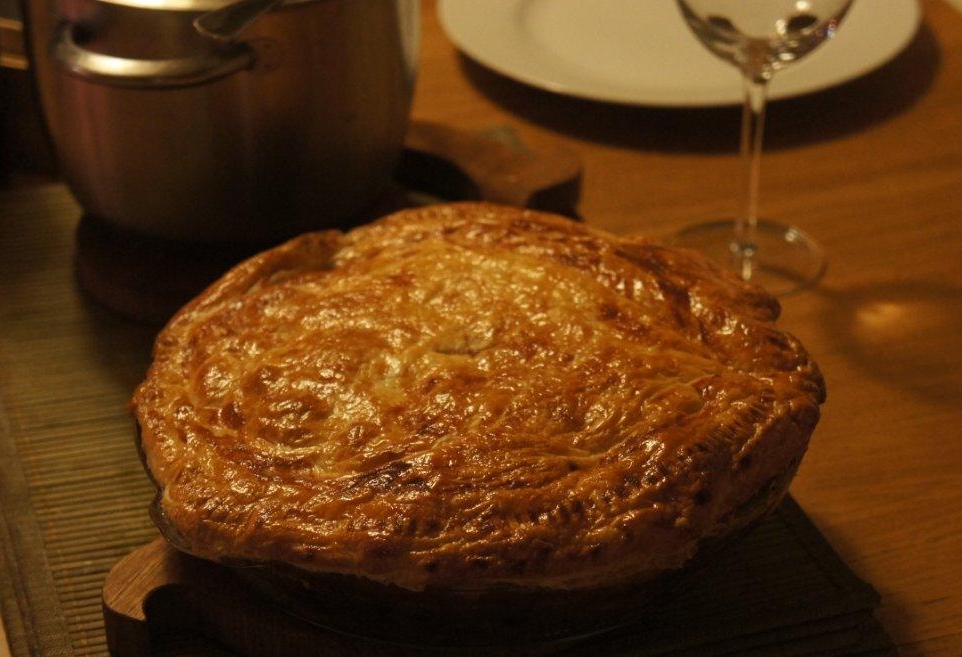
Deanna's Beef Bourguignon Pie - photo Paul Sudmals, baking team photographer and taster
BEEF BOURGUIGNON PIE – by Deanna
2tbsp vegetable oil
1 kg chuck steak trimmed and cut into 5 cm cubes
300 g smoked bacon, rind removed, sliced
Dollop of butter
12 shallots
250 grams mushrooms
30g plain flour
2 cups dry red wine (technically should be a burgundy)
250 ml beef stock
2 thyme sprigs
1 -2 rosemary sprigs (beef bourguignon recipes usually just call for thyme, but I like fresh rosemary in mine)
1 bay leaf
2-3 garlic cloves crushed
Salt and pepper
2 sheets ready made puff pastry or 1 quantity homemade puff pastry (see recipe)
1 egg beaten
1. Heat oil in large flameproof casserole, add beef in batches and cook over a high heat until browned all over. Remove with a slotted spoon and drain on paper towels
2. Add butter, bacon, mushrooms, garlic and shallots and cook until bacon crisp and shallots softened. Drain on paper towels
3. Add the flour and cook stirring for one minute. Gradually add wine and stock, stirring until thickened.
4. Return beef, bacon and mushrooms to pot (you can add the shallots at this point, but I usually leave until later otherwise they fall apart). Add herbs and season to taste.
5. Bring to the boil, cover and place in preheated oven at 160 for 1.5 hours.
6. Add shallots (if not already in) and cook for another hour.
7. Allow mixture to cool before pouring into pie dish.
8. Cover with store bought pastry sheets (or home made puff).
9. Crimp edges to seal around pie dish and make a cross in the middle to allow contents to steam
10. Baste puff pastry with beaten egg.
11. Place pie in 180 degree oven and cook for 20 minutes or until pastry is puffed and golden.
ARTICHOKES
You probably eat artichokes every day for breakfast, but many people find artichokes a bit intimidating to tackle, with their leathery and spiky appearance. Often in shops they are also quite old. You can keep them several days in a plastic bag in the refrigerator, but don’t buy them unless they are plump and glossy – it is the flower bud of a thistle plant, you don’t want to eat a dried up droopy flower.
Artichokes originally came from North Africa or Sicily, they were very popular in ancient times when Sicily was a Greek colony. Later, they were popular at French and Italian courts, helped along by a reputation as aphrodisiacs. They are still everywhere in Sicily, my parents lived there for a while and their house was surrounded by dusty green artichoke plants, so we had many lovely huge salads of young small artichokes.
Artichokes should be a spring veg but I see lots of good ones turn up in winter in our shops. It is a great healthy liver cleansing and diuretic veg, you can have them as a bitter herbal tea but it is much more fun to eat them.
I think the best way to make friends and get to really know the edible bits of these armoured buds is to eat them raw, dipping each slice in a bowl with olive oil,vinegar or lemon, a little salt and pepper (you could choose melted butter or mayo if you wish). This is a traditional way to eat them, and since you have to use your hands, may explain the sexy reputation.
Remove the outer leaves, all but about 5 cm of stem, wash well, start eating leaf by leaf, scraping the soft pale part at the inside bottom of the leaves. Gradually you will find that you can eat more & more of each, until the inner tender leaves are completely edible. Don’t eat the fluffy middle, called the choke (some modern varieties are chokeless). You will be left with the soft base of the bud, that’s the heart, all edible and delicious.
With very young small ones you can eat the whole thing, slice thin, eat raw in salad
Or steam, remove choke and stuff (breadcrumbs,garlic, anchovy,herbs, or just drop in a raw seasoned egg) and cook sitting at the base of a pot in liquid, batter and deep fry, make puree. You can eat a bigger percentage of the leaves when cooked, but often some remain hard and need to be discarded while eating. You can also eat the peeled, cooked stem of a fresh artichoke.
They are easy to grow perennials if you have lots of room and sun in your garden, and sandy soil, although I am not sure they can cope with our sometimes relentless rains. They also become a lovely flower if you miss the eating stage.

BELLY LAB RECIPE – ARTICHOKE MAYONNAISE, by sister T
I was busy in the belly lab over the weekend, adapting a Peter Gilmore recipe from his sumptious cookbook (named after his 3-hatted Sydney restaurant), Quay. I got it from the library really just to look at the beautiful pictures. The recipes are pages long and require lots of unusual equipment and ingredients. However, many of the mini-recipes within each masterpiece are surprisingly achievable, and he combines many flavours in ways that are new to me and I can’t wait to try. For example, his artichoke mayonnaise. Artichokes and eggs love each other, it is a great idea, but I don’t have a temperature controlled combi-oven, vacuum bags and a vacuum sealer. Also I wanted to use raw oil and herbs. I am happy to report the result was delicious, my main taster calls it the best mayo I’ve ever done, very light and delicate. Good on prawns, fish, scallops, a steak, boiled potatoes or eggs. Or on a grilled choko of course.
2 plump artichokes
2-3 heads and stems of young garlic (in markets now) or use a whole head of normal garlic – it will be very mild, you can use more if you wish
about 1/2 cup of chopped parsley (or try chervil or tarragon)
2 very fresh free range eggs – yolk only
lemon juice to taste
good olive oil to taste
Remove outer leaves of artichokes, cut off top 3-5 cm of petals, peel stems. Cut into segments, remove choke, wash well. Keep artichoke pieces in acidulated water so they don’t go black while you work. Wash young garlic or divide other garlic into cloves.
Steam garlic and artichokes separately until very soft.
Squeeze out garlic from skins, or remove any hard bits from young garlic.
Remove very hard bits of leaves from cooked artichoke – just scrape with a knife to make sure you don’t include too much fibre.
Chop in a food processor with a little olive oil until you have a very smooth paste – I did one lot of whizzing with the very soft bits and another lot with the slightly harder parts of the artichoke (but not the really hard ones) to try and get the most out of them. Allow to cool.
Make a mayonnaise with the egg yolks, olive oil, and lemon juice. Add herbs and artichoke puree, and salt and pepper to taste.
All quantities are approximate, just have a play. And maybe try other steamed veg purees next time. You could also fold the artichoke/garlic puree through mashed potatoes, or use in a pasta or beef or fish sauce with lots of butter.
Or to make the recipe even easier, use a couple of cloves of raw garlic and puree well drained tinned artichokes, just make sure it is a brand with a bit of taste – but do not use mayonnaise from a supermarket jar, horrible stuff. The bellysisters will give you 10 Hail Marys as penance if you do.
EDIBLE QUOTE
A French term today for someone who is very tender hearted, gets emotional and cries easily : coeur d’artichaut, artichoke hearted
MUSIC
My House, by The Little Sisters
Pot Of Honey, by The Mid North
Puff the Magic Dragon, by Peter Paul and Mary
Just Be Good To Me, by the Blackbirds
The La La Song, by Krista Pav
The Rhine, by Sarah Collyer
love and chocolate croissants, Sister T