Category Archives: BREADS

slow bread, fermentation and sampling spring

The first belly of spring today and we are fermenting with life, from a light and fresh book review, to festival previews and reports, the odd world of North America in a sister D edition of our belly bulletin, & we are harnessing natural, time honoured bread making to bring wheat back into the lives of many of us who find the average loaf very hard to digest, with slooow baker & fermenter Clive Lawler.
They say you  never forget your first, and it's true:  Clive Lawler was the first guest I interviewed all on my own in the old bayfm love shack, all alone with the buttons and gear of the radio magic panel.  He is a  slow bread maker now based in Brisbane, coming back to this area to present occasional workshops.  His books available online or at Santos Warehouse in the Byron Industrial estate.
When we first spoke he was experimenting with fermented nuts, and making a version of the no knead bread that you can easily find online and on the belly website, we have been making this in our house ever since, but Clive has moved on a long way with his methods since then.  

Listen to the interview audio below for lots of tips on slow baking and fermenting, or get along to his 'playshop' this weekend in Byron Bay.

Where – Starseed Gardens, Byron Bay

When – Saturday 7 & Sunday 8 September

Connect with Clive and check out workshop details and lots more through his Facebook page here

Clive is sending us a couple of his fermented spread recipes soon.


AUDIO
clive1 start

clive part 2

clive part 3

clive end


BELLY BULLETIN  – this week, news from North America by sister D

A recent food poisoning incident at the Canadian National Exhibition‭ (‬CNE‭) ‬in Toronto,‭  ‬Ontario has unfairly been blamed on the‭ “‬cronut‭”‬.‭  ‬223‭ ‬people were affected by food poisoning after eating a calorie laden‭ “‬cronut burger‭” ‬last weekend.‭  ‬The‭ “‬cronut‭” ‬a cross between a croissant and a doughnut was created by Dominique Ansel bakery in New York City.‭  ‬Wildly popular,‭ ‬it has inspired many imitations hence the‭ “‬cronut burger‭” ‬at the CNE.‭  ‬The cronut burger is a heart stopping mixture of a beef patty topped with cheese,‭ ‬served in a cronut bun with a maple bacon jam.‭  ‬Turns out the culprit of the food poisoning was not the cronut after all,‭ ‬but the maple bacon jam.‭  ‬Long live the cronut‭!!!  

In related news,‭ ‬not to be outdone by their American neighbours,‭ ‬a Canadian patisserie in Toronto‭; ‬Calfouti,‭ ‬has created the‭ “‬crookie‭”‬.‭  ‬Yes,‭ ‬the‭ “‬crookie‭”‬.‭  ‬Part croissant and part oreo cookie…only in North America.‭  ‬We could expect no less from the continent that created the‭ “‬turducken‭” (‬chicken,‭ ‬stuffed inside a duck,‭ ‬stuffed inside a turkey‭) ‬and the‭ “‬piecaken‭” (‬pie baked inside a cake on top of another layer of pie baked inside a cake‭)‬.‭  

Good news for coffee drinkers.‭  ‬New research has shown that regular coffee drinking can prevent the recurrence of prostate cancer for men.‭  ‬The Fred Hutchinson Cancer Research Center found that consuming four or more cups of coffee a day is associated with a decreased risk of prostate cancer recurrence in addition to decreased progression of the tumour.‭  ‬It should be noted the study only found an association rather than proof of causation,‭ ‬the authors note that the coffee may hold the protective benefits because of the anti-inflammatory and anti-oxidant properties.‭  ‬More research is needed in this area,‭ ‬but for the time being,‭ ‬drink up‭!

More good news for lovers of hot beverages.‭ ‬ Research has shown that two cups of hot chocolate per day boosted brain blood flow and memory in a sample of elderly with narrowed arteries.‭  ‬The research involved a sample of‭ ‬60‭ ‬people with a median age of‭ ‬73‭ ‬who were not diagnosed with dementia.‭ ‬Harvard Medical School in Boston who conducted the study reported improvements in working memory and an improvement of blood flow to working areas of the brain.‭  ‬Dr.‭ ‬Farzaneh Sorond who led the study said‭ “‬we’re learning more about blood flow in the brain and its effect on thinking skills.‭  ‬As different areas of the brain need more energy to complete their tasks,‭ ‬they also need greater blood flow.‭  ‬This relationship,‭ ‬called neurovascular coupling,‭ ‬may play an important role in diseases such as Alzheimer’s‭”  ‬More research is needed to explore the relationship between cocoa and blood flow and cognitive capacity,‭ ‬but again‭… ‬we say,‭ ‬drink up‭!

Death Valley National Park in the United States are tired of people trying to cook eggs on the floor of the national park.‭  ‬Officials have written on the Death Valley facebook page that maintenance crews have been busy cleaning up eggs,‭ ‬egg cartons,‭ ‬and shells strewn throughout the car park.‭  ‬In a ironical twist,‭ ‬it was actually a Death Valley employee who sparked the egg cooking trend by posting a video of an egg cooking in the‭ ‬127‭ ‬degree F‭ (‬52‭ ‬C‭) ‬heat.‭  ‬The video notes a frying pan should be used however,‭ ‬as the ground‭ “‬makes a mess and it doesn’t work‭”‬.‭  ‬Clearly,‭ ‬the message is not sinking in as tourists continue to crack eggs on the ground in the midst of a current heat wave on the west coast of the US.‭  ‬This is not dissimilar to the trend some time ago of people baking trays of cookies on their dashboards of their vehicles in the summer heat,‭ ‬following a post of the same that went viral.‭  


Book Review:‭ ‬Marie Claire-Summer:‭ ‬Simply Fresh Food by Michele Cranston

Review by Sister Deanna


Well,‭ ‬the title does not lie with this cookbook,‭ ‬it is simple and it is fresh.‭  ‬It was difficult to get the full flavour‭ (‬pun intended‭) ‬of this cookbook as the ingredients are geared towards summer produce and thus we are not quite there yet.‭  ‬Having said that,‭ ‬the recipes that were tried were very simple,‭ ‬easy to make,‭ ‬and as one of the taste team noted‭ “‬good for a young uni student who doesn’t know much about cooking‭”‬.‭   ‬I’m inclined to agree,‭ ‬this book s strength is its simplicity,‭ ‬and its use of fresh foods,‭ ‬making it a great book for young cooks who want to cook simple,‭ ‬fresh,‭ ‬and flavourful food.‭ ‬It is produced by Marie Claire,‭ ‬so it is not surprising that it targets a younger demographic.‭  ‬Indeed,‭ ‬throughout the book in between recipes,‭ ‬the reader is treated to pictures of young twenty-something women frolicking in the sand and sea.‭  ‬Frolicking aside,‭ ‬a further strength in addition to simplicity and freshness is the inclusion of colour pictures of each recipe.‭  ‬The cookbook is divided into five sections:‭ ‬fruit,‭ ‬leaf,‭ ‬sea,‭ ‬husk‭ (‬grains‭)‬,‭ ‬and basics.‭  ‬Full of fresh ingredients,‭ ‬the meals were light and flavourful.‭  ‬Sometimes however,‭ ‬the ingredients should have been left to themselves.‭  ‬There were a few recipes that imparted a few too many flavours‭ ( ‬a salmon recipe comes to mind‭) ‬that masked the beautiful flavour of the ingredients as too many spices and flavourings were added.‭  ‬One taste team member commented‭ “‬way to ruin a perfectly good piece of fish‭”‬.‭  ‬On the whole however,‭ ‬this cookbook was reviewed positively.‭ ‬Great for simple,‭ ‬healthy mid-week meals,‭ ‬and for the young cook starting out.‭  ‬I for one will be adding a few new recipes from this book to my repertoire.‭  

on air 14.3.11: Ocean Shores garden, dolce vita, white food and fab bread

Today on belly we welcomed the opening of  a new community garden, enjoyed a bit of opera, heard some of Susi Papi‘s many food stories, and shared our mutual love for fabulous no-knead bread.  And we heard Herbie Hancock tell how  listening to watermelon vendors as a kid resulted in his great hit “The watermelon Man”, that we play whenever we talk fresh fruit and veg.

Thank you very much to Susanne from the Byron Bay Community markets for sharing this clip.  The bellysisters will not rest until we convince the farmers marketeers to break into passionate song.  Great idea for getting people to go to the markets!


There is another video of this event here – wobblier, but you see how very beautiful the Valencia market is.


THE LAUNCH OF SHARA GARDENS

David Hall was on the show to talk about the brand new Ocean Shores community garden, to be called Shara Gardens.  It will be officially be launched on April 2, when all the paperwork is signed and ‘i’s duly dotted.  Speaking of which, they were lucky to have the support of the Mullumbimby Community garden, which made even the regulatory requirements a bit easier.

The garden is planned as an educational space (partly because they haven’t got enough land for everyone to have a plot on site), fully organic shared garden, and meeting place.

The launch will be Saturday April 2, from 1 to 3 pm, at the Ocean Shores Public School, at the very end of Shara Boulevard.  The Major will be there to entertain the adults, there will be stuff on for the kids too, everyone welcome including people from other areas interested in sharing information.  Check the local press for more details.

Whatever your skills or interests, you are needed: green thumbs, tradies, school kids, retired professionals to help in areas like grants and book keeping, and anyone who’d like to learn.  Call David on 6680 4728 for more details.


SUSI’S FOOD STORIES

Well just a few spoonfuls of what has obviously been a fascinating life.  I have known Susi since 1977, but by that time she had probably settled down a bit, and was importing her handsome Roman husband Luciano and 2 kids to the family farm in Camden NSW.  But before that she had quite a few adventures.  So often I discover great stuff about old (and new) friends by dragging them into the studio and turning on the mike.

Susi shared stories of being a kid in Australia after WW2,  when food shortages were still common.  Growing up with a dairying family she wasn’t hungry, but the diet wasn’t very varied.  Then her mother remarried and the family she was off  to Long Island, in the USA, where there was abundance, especially among the very wealthy Long Islanders, but the food was still very far from exciting “All the meals were white”.  But Susi still remembers fondly the revelation of her first artichoke.

Back to Australia and uni in the early 60s, and a fair bit of socialising in pubs with the infamous Sydney Push.  When everyone was thrown out at 6pm after the ‘6 o’clock swill’, food was the next best option.  Finally some colour and flavour, whether the choice was ‘the good Greek’ or ‘the bad Greek’.  And food that was ‘intentionally slow cooked’, as  opposed to cooked to death.

Then Dolce Vita Rome in 1963, the years depicted in the famous Fellini film, when the wild and beautiful people gravitated to Rome.  We only really managed to touch on that, and on the beautiful flavours of Roman food.  We detoured to Susi’s wonderful tomatoes for a few growing tips, and managed to squeeze in a mention of the one recipe she always tells friends to try, and my addiction ever since a belly guest, Nirava, put me on to it : the New York Times no knead bread.

Reasons this bread rules:

. It is very easy to make – takes longer to explain than to prepare

. It is slow risen so it is healthier, more digestible, very little yeast used, kind of a semi-sourdough

. No knead means no work

. You get crust, flavour and big air pockets

. It also works full of nuts and dried fruit, or seeds, or other flours

Original New York Times recipe.


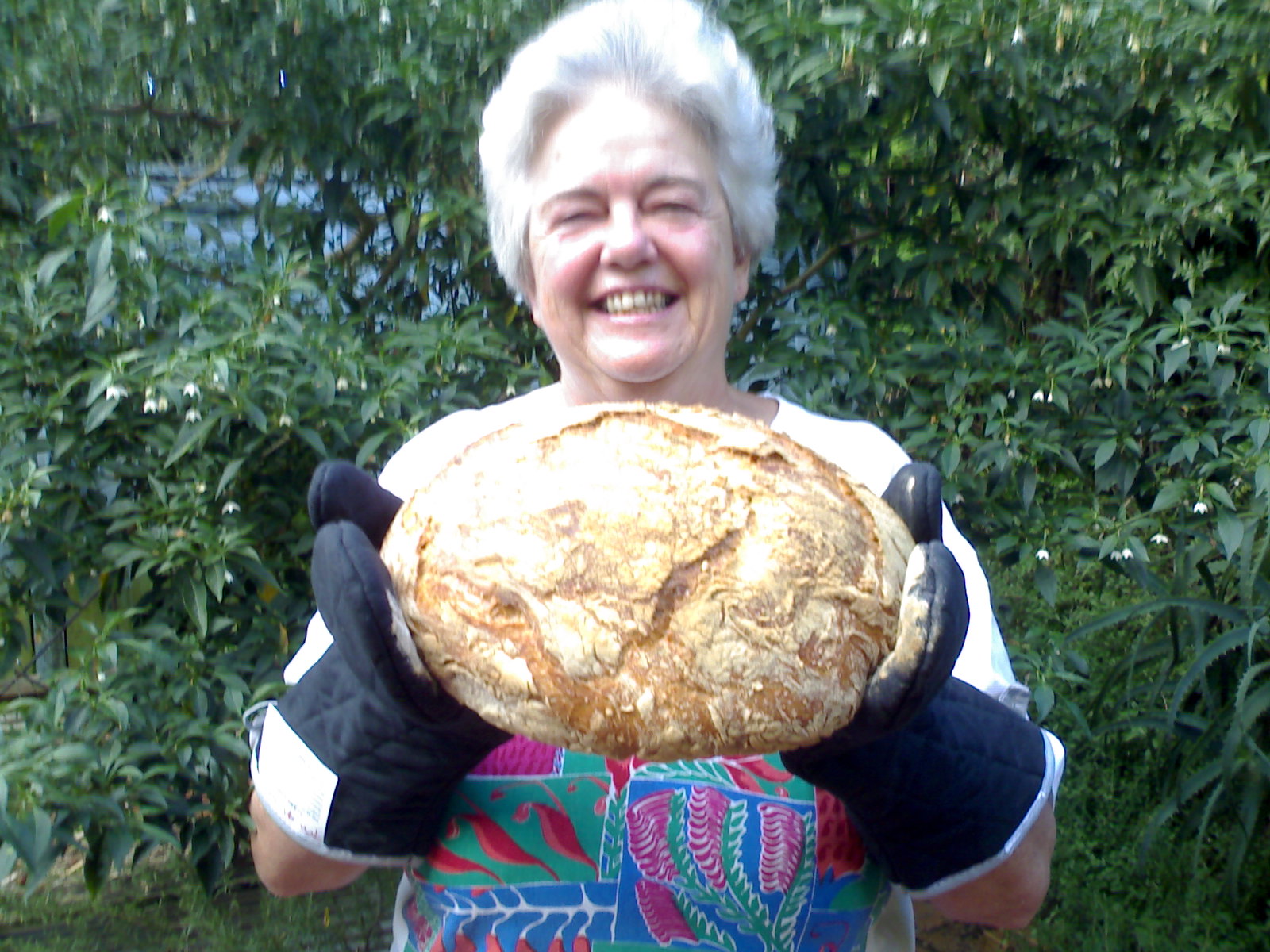
Susi Papi with a beautiful double size loaf of no knead bread - about 3 days supply for Sister T


THE BELLY HOUSE NO-KNEAD BREAD

Having found and tried and adapted this recipe, I now leave it to my partner who EVERY TIME turns out a better bread than I can.  I think the secret is being very absent minded and forgetting it at every step, especially while it is cooking.  It probably helps that we have a really good, solid cast iron pot that holds the heat, and a standard electric oven that can’t get too hot.  Also making it twice a week (because I cry when there is none left), means much practice and no need to worry about quantities any more.  But even the first time, when I miscounted the cups of water and ended up with a ridiculous liquid mess,  still cooked to a fine tasting (though flat and funny looking) crusty loaf.  Yes, crusty bread in Byron Bay is possible!

3 cups bread flour; more for work surface [1]
1/4 tsp instant yeast
1 1/4 tsp salt
cornmeal or wheat bran or more white flour

note : we now double the quantities because it keeps so well and I eat so much, to save work and electricity.  But try this size until you have mastered the only tricky bit, getting it into a heated pot without getting  burned.

In a large bowl, combine flour, yeast, and salt. Add 1 5/8 cups water, [=1 and 1/2 cups, then keep another spoonful or 2 ready, see if it needs the extra water to come together – usually yes]
And stir until just blended; dough will be shaggy and sticky. Cover bowl with a plate. Let dough rest at least 12 hours, but preferably up to
18 [even 24], at room temperature. When surface is dotted with bubbles, dough is ready.

Lightly flour work surface. Place dough on work surface and sprinkle with more flour. Fold the dough over on itself once or twice.  Cover with bowl and let rest about 15 minutes.

Sprinkle just enough flour over work surface and your fingers to keep dough from sticking; quickly and gently shape dough into a ball.

Generously flour the bowl with plain flour, cornmeal/polenta flour, or wheat bran; place dough seam side down in bowl and dust with more flour. Cover with a  towel and let rise  until it has more than doubled in size and does not readily spring back when poked with a finger, about 2 hours.   The original recipe calls for rising bread in between floured tea-towels, but we now have got tired of cleaning bread dough from tea towels and find this works just as well.

After about 1 1/2 hours, preheat oven to 220-230°C.  Place a large heavy covered pot, such as cast iron or Pyrex, in oven as it heats (for 20 to 30 minutes).  When dough has fully risen, carefully remove pot from oven.  Sprinkle some flour on the bottom of the pot.  Gently put dough into VERY HOT pot. Shake pot once or twice if dough looks unevenly distributed;  it will straighten out as it bakes. Cover, and bake 30 minutes. [40 in our oven]

Uncover, and continue baking until browned, about 30 minutes. [tap to see if it feels crusty and hollow] Cool on a wire rack. In our climate it’s better to get it very crusty at this stage, anything else will lose the crust in a few hours.  If baked long enough, this is the only bread we have found here that will stay crusty – and not mouldy (!) for days.

[1] We use bakers’ white flour  (5 kg bags) or organic white as the base usually, sometimes 1 cup of wholemeal/kamut/semolina etc

Depending on the oven and the pot used, you may not need to leave the oven on so long before baking – but at least 10 minutes after it reaches 220-230 is good.


this bread is so crusty it should have dreadlocks


Susi has promised more stories in the near future – it seems she was in London when it was called Swinging, too – if I can find a vague food link, we’ll be there.

Love and chocolate sandwiches,

Sister T


MUSIC

Herbie Hancock’s story of “the Watermelon Man” is on the album “Watermelon Man, the ultimate Hancock!”

Sapore di Sale by Gino Paoli, 1963

On the sunny side of the street by Kermit Ruffins, from Putamayo presents kermit Ruffins

Cantiam, facciamo brindisi (Let’s sing, let’s toast) from the opera L’elisir d’amore (the elixir of love), by Donizetti

Les Moissoneurs (the haymakers) by Couperin, performed by John Williams on guitar, from  “the baroque album”